Xu Xiaohong, Zheng Peng, Zhao Hongyan, Song Bailin, Wang Fuchun
Changchun University of Chinese Medicine, Changchun 130117, China.
Jilin Provincial Hospital of Traditional Chinese Medicine, Changchun University of Chinese Medicine, Changchun 130021, China.
Evid Based Complement Alternat Med. 2020 Aug 21;2020:7481813. doi: 10.1155/2020/7481813. eCollection 2020.
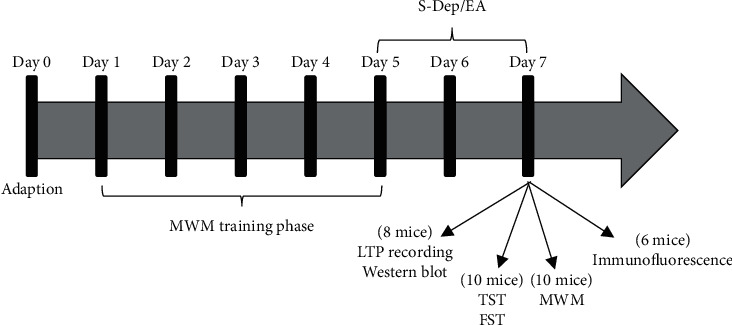
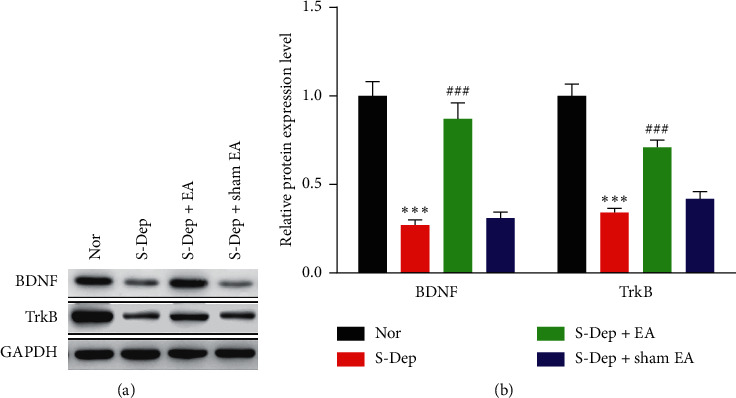
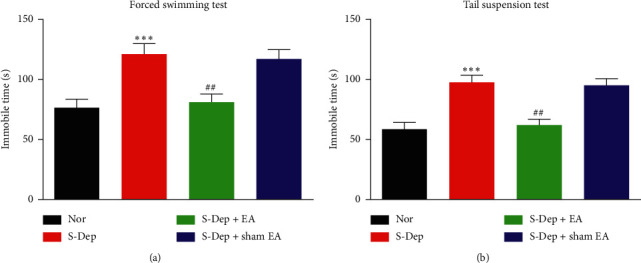
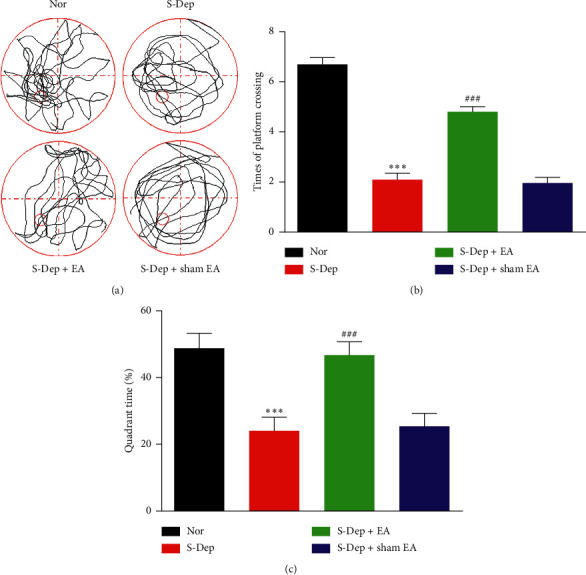
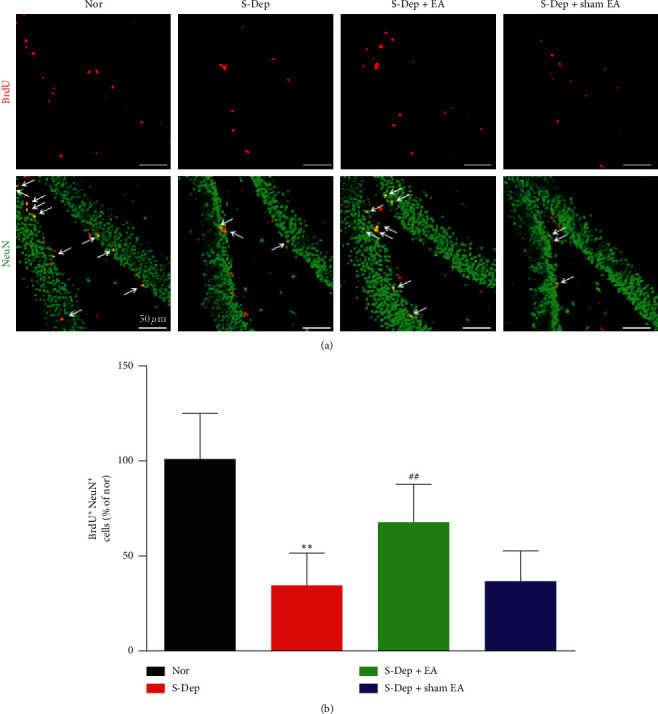
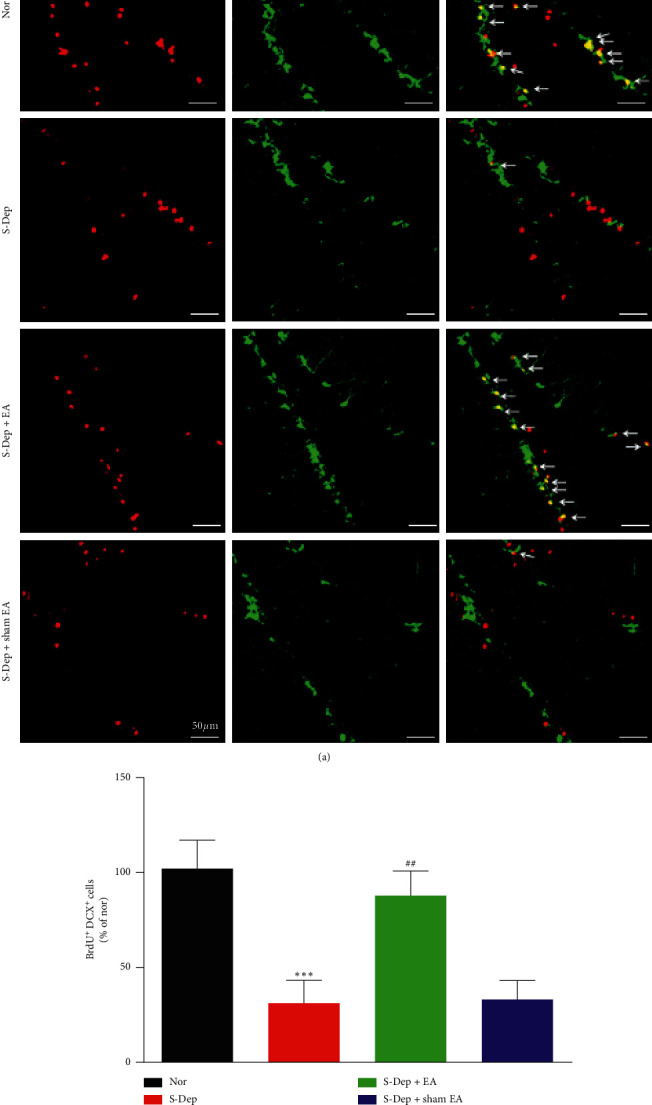
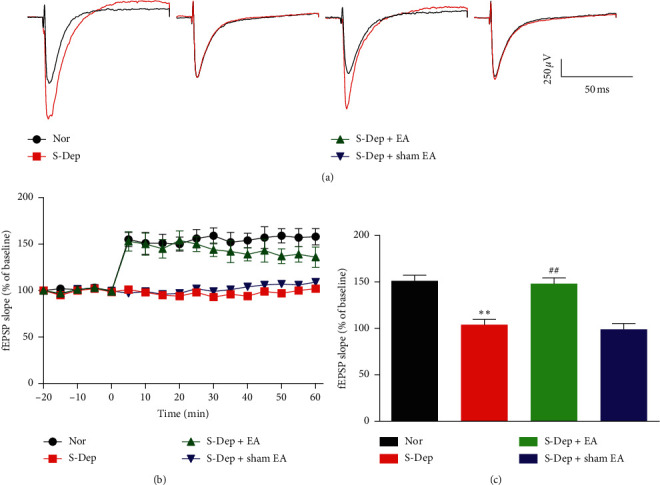
Accumulating evidence suggests that sleep deprivation (S-Dep) is a critical risk factor for depression. Electroacupuncture (EA) treatment has been reported to ameliorate posttraumatic stress disorder- (PSTD-) like behavior and enhance hippocampal neurogenesis. However, whether EA treatment has any beneficial effect on S-Dep-induced depression-like behavior is still unknown. In the present study, we focused on whether EA at Baihui (GV20) can ameliorate the deterioration effect of S-Dep in mice. Mice were randomly divided into normal, S-Dep, S-Dep + EA, and S-Dep + sham EA groups. Cognitive behavior test and in vitro assay were performed separately to avoid the influence of behavior test on synaptic transmission and protein expression. Depression-like behaviors were determined by forced swimming test (FST), tail suspension test (TST), and Morris water maze (MWM). Neurogenesis was identified by BrdU, DCX, and NeuN immunofluorescence staining. In vitro long-term potentiation was detected by high frequency stimulation (HFS) at Schaffer collateral-CA1 synapses in hippocampal slices. Brain-derived neurotropic factor (BDNF) and tropomyosin receptor kinase B (TrkB) protein expression level were assayed by western blot. Our results indicated that D-Sep mice demonstrated depression-like behaviors determined by prolonged immobility duration in FST and TST; D-Sep mice also manifested spatial memory retention deficit in MWM. Furthermore, EA treatment ameliorated D-Sep-induced depression-like behaviors and spatial memory retention deficit. Mechanically, EA treatment alleviated neuron progenitor cell proliferation and differentiation, ameliorated the field excitatory postsynaptic potentials (fEPSPs) slope impaired by S-Dep, and elevated BDNF/TrkB protein expression. Taken together, our data suggested that EA treatment has a protective effect on S-Dep-induced depression-like behavior and cognitive impairment, which may be through regulating BDNF/TrkB protein expression.
越来越多的证据表明,睡眠剥夺(S-Dep)是抑郁症的一个关键风险因素。据报道,电针(EA)治疗可改善创伤后应激障碍(PTSD)样行为,并增强海马神经发生。然而,EA治疗对S-Dep诱导的抑郁样行为是否有任何有益作用仍不清楚。在本研究中,我们关注百会穴(GV20)电针是否能改善S-Dep对小鼠的恶化作用。将小鼠随机分为正常组、S-Dep组、S-Dep + EA组和S-Dep + 假电针组。分别进行认知行为测试和体外试验,以避免行为测试对突触传递和蛋白质表达的影响。通过强迫游泳试验(FST)、悬尾试验(TST)和莫里斯水迷宫(MWM)来确定抑郁样行为。通过BrdU、DCX和NeuN免疫荧光染色来鉴定神经发生。通过海马脑片上的Schaffer侧支-CA1突触高频刺激(HFS)检测体外长时程增强。通过蛋白质印迹法检测脑源性神经营养因子(BDNF)和原肌球蛋白受体激酶B(TrkB)蛋白表达水平。我们的结果表明,S-Dep小鼠在FST和TST中表现出因不动时间延长而确定的抑郁样行为;S-Dep小鼠在MWM中也表现出空间记忆保持缺陷。此外,EA治疗改善了S-Dep诱导的抑郁样行为和空间记忆保持缺陷。从机制上讲,EA治疗减轻了神经元祖细胞的增殖和分化,改善了受S-Dep损害的场兴奋性突触后电位(fEPSPs)斜率,并提高了BDNF/TrkB蛋白表达。综上所述,我们的数据表明,EA治疗对S-Dep诱导的抑郁样行为和认知障碍具有保护作用,这可能是通过调节BDNF/TrkB蛋白表达来实现的。