Wang Ge, Li Wei
Tongji Hospital, Tongji Medical College, Huazhong University of Science and Technology, Wuhan, China.
Physician Assistant Studies, School of Health Professions, University of Alabama at Birmingham, Birmingham, AL, USA.
J Alzheimers Dis Rep. 2020 Jul 6;4(1):237-242. doi: 10.3233/ADR-200181.
Diabetes has been shown as a risk factor for cognitive impairments. However, it is still not clear about the time course of developing abnormal cognition in those with diabetes especially if the morbidity accelerates the cognitive deterioration process.
To study how diabetes is related to the abnormal cognition development.
A retrospective analysis was performed using data collected by the National Alzheimer's Coordinating Center. Incidence, prevalence, and age at onset (AAO) of either mild cognitive impairment (MCI) or dementia were compared between participants with and without diabetes.
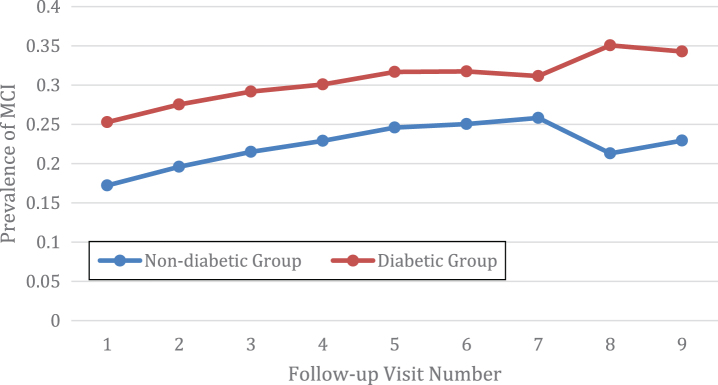
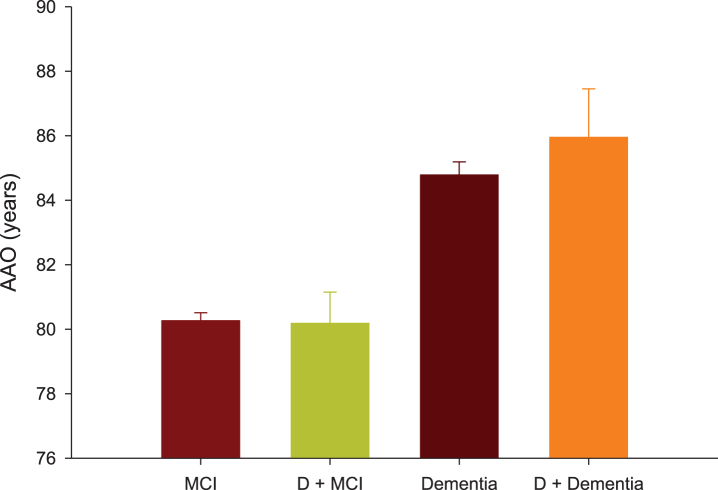
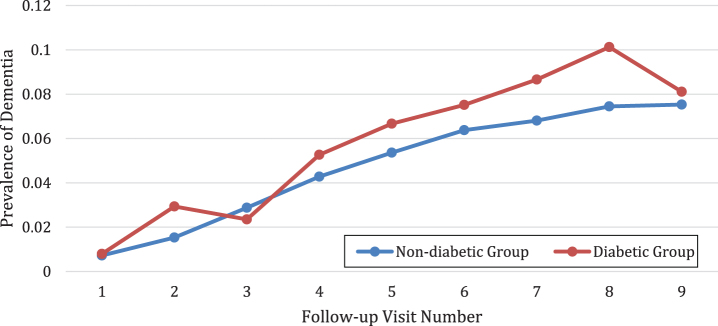
During a follow-up period of more than 10 years, the diabetic group had a higher incidence and prevalence of MCI or dementia than the non-diabetic group. However, the AAO of either MCI or dementia was independent of the diagnosis of diabetes.
Although diabetic patients have a higher incidence and prevalence of abnormal cognition than those without diabetes, diabetes does not accelerate the cognitive deterioration process.
糖尿病已被证明是认知障碍的一个风险因素。然而,糖尿病患者出现认知异常的时间进程仍不明确,尤其是其发病率是否会加速认知衰退过程。
研究糖尿病与认知异常发展之间的关系。
使用美国国家阿尔茨海默病协调中心收集的数据进行回顾性分析。比较有糖尿病和无糖尿病参与者的轻度认知障碍(MCI)或痴呆的发病率、患病率及发病年龄(AAO)。
在超过10年的随访期内,糖尿病组的MCI或痴呆发病率和患病率高于非糖尿病组。然而,MCI或痴呆的发病年龄与糖尿病诊断无关。
尽管糖尿病患者的认知异常发病率和患病率高于非糖尿病患者,但糖尿病并不会加速认知衰退过程。