Li Wei, Risacher Shannon L, McAllister Thomas W, Saykin Andrew J
School of Health and Rehabilitation Sciences, Indiana University Purdue University, 2039 N. Capitol Avenue, Indianapolis, IN, 46202, USA.
Department of Radiology and Imaging Sciences, Center for Neuroimaging, Indiana Alzheimer Disease Center, Indiana University School of Medicine, 355 W. 16th Street, Suite 4100, Indianapolis, IN, 46202, USA.
J Neurol. 2016 Jul;263(7):1280-5. doi: 10.1007/s00415-016-8093-4. Epub 2016 Mar 23.
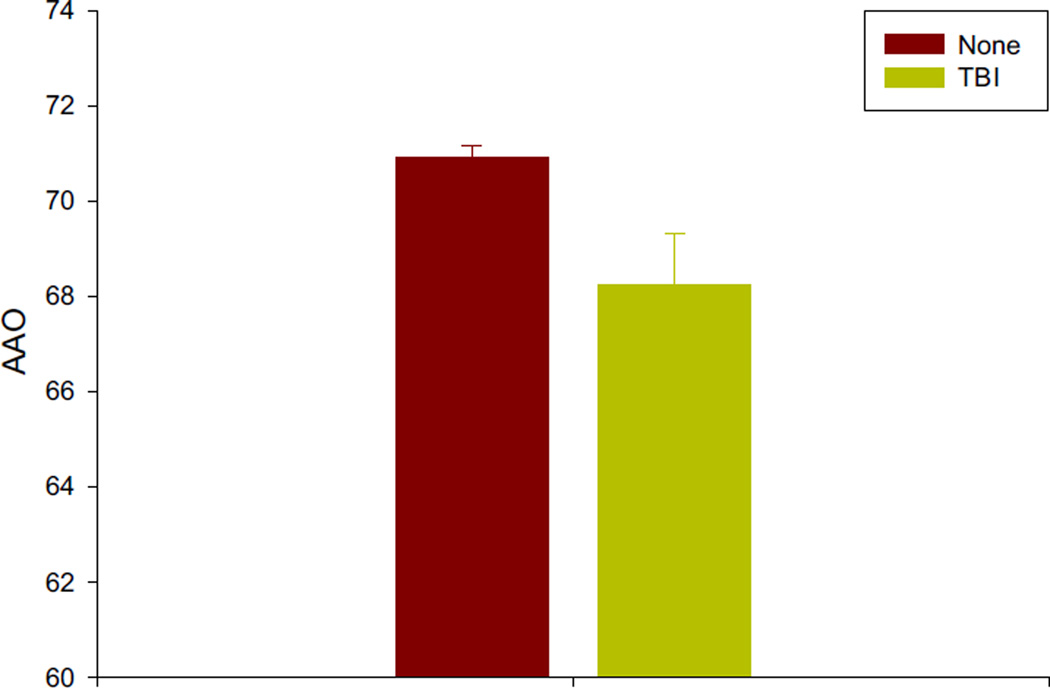
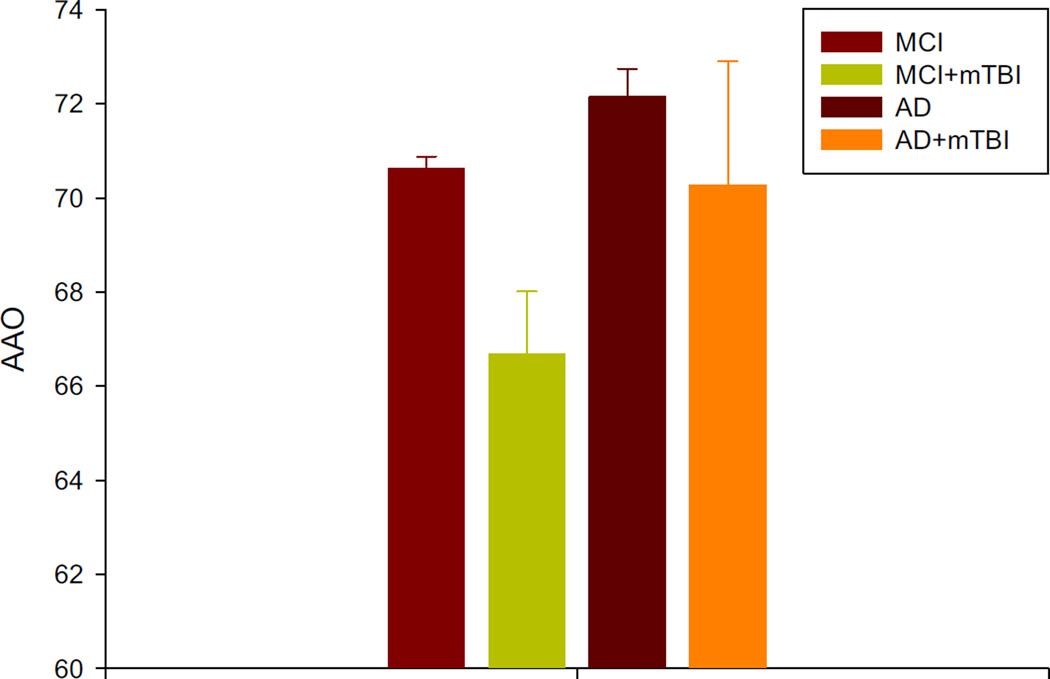
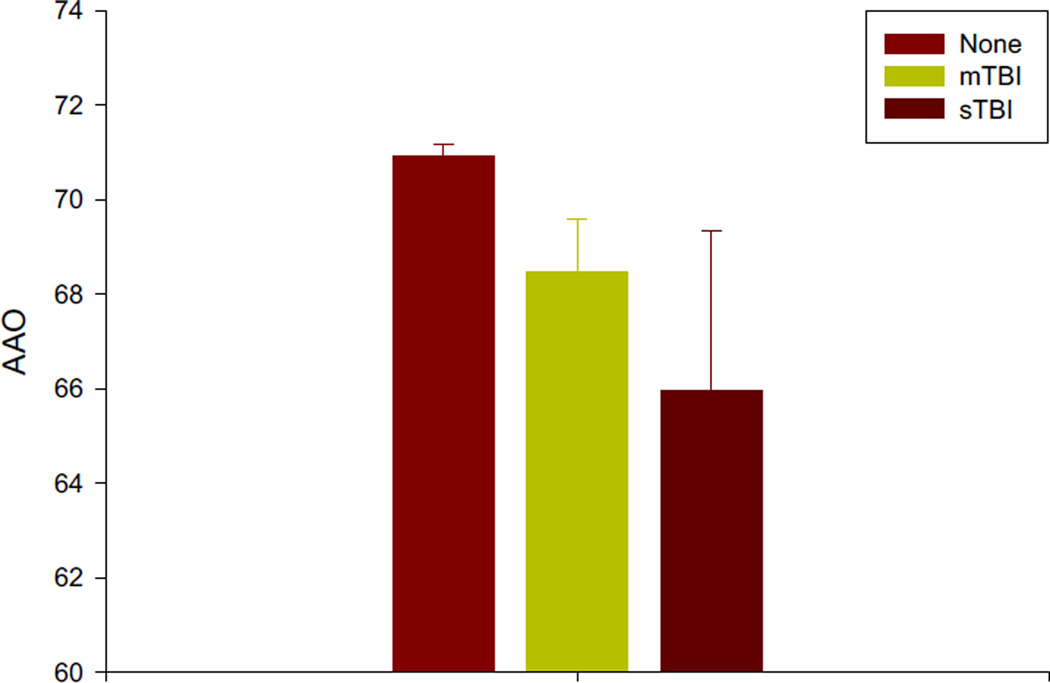
There is a deficiency of knowledge regarding how traumatic brain injury (TBI) is associated with age at onset (AAO) of cognitive impairment in older adults. Participants with a TBI history were identified from the Alzheimer's disease neuroimaging initiative (ADNI 1/GO/2) medical history database. Using an analysis of covariance (ANCOVA) model, the AAO was compared between those with and without TBI, and potential confounding factors were controlled. The AAO was also compared between those with mild TBI (mTBI) and moderate or severe TBI (sTBI). Lastly, the effects of mTBI were analyzed on the AAO of participants with clinical diagnoses of either mild cognitive impairment (MCI) or Alzheimer's disease (AD). The AAO for a TBI group was 68.2 ± 1.1 years [95 % confidence interval (CI) 66.2-70.3, n = 62], which was significantly earlier than the AAO for the non-TBI group of 70.9 ± 0.2 years (95 % CI 70.5-71.4, n = 1197) (p = 0.013). Participants with mTBI history showed an AAO of 68.5 ± 1.1 years (n = 56), which was significantly earlier than the AAO for the non-TBI group (p = 0.032). Participants with both MCI and mTBI showed an AAO of 66.5 ± 1.3 years (95 % CI 63.9-69.1, n = 45), compared to 70.6 ± 0.3 years for the non-TBI MCI group (95 % CI 70.1-71.1, n = 935) (p = 0.016). As a conclusion, a history of TBI may accelerate the AAO of cognitive impairment by two or more years. These results were consistent with reports of TBI as a significant risk factor for cognitive decline in older adults, and TBI is associated with an earlier AAO found in patients with MCI or AD.
关于创伤性脑损伤(TBI)如何与老年人认知障碍的发病年龄(AAO)相关联,目前存在知识不足的情况。有TBI病史的参与者是从阿尔茨海默病神经影像倡议(ADNI 1/GO/2)病史数据库中识别出来的。使用协方差分析(ANCOVA)模型,比较了有和没有TBI的参与者之间的AAO,并控制了潜在的混杂因素。还比较了轻度TBI(mTBI)和中度或重度TBI(sTBI)参与者之间的AAO。最后,分析了mTBI对临床诊断为轻度认知障碍(MCI)或阿尔茨海默病(AD)的参与者的AAO的影响。TBI组的AAO为68.2±1.1岁[95%置信区间(CI)66.2 - 70.3,n = 62],这明显早于非TBI组的AAO 70.9±0.2岁(95% CI 70.5 - 71.4,n =