
基于咪唑鎓的离子液体对新型环氧树脂固化动力学和物理化学性质的影响
Impact of Imidazolium-Based Ionic Liquids on the Curing Kinetics and Physicochemical Properties of Nascent Epoxy Resins.
作者信息
Dzienia Andrzej, Tarnacka Magdalena, Koperwas Kajetan, Maksym Paulina, Ziȩba Andrzej, Feder-Kubis Joanna, Kamiński Kamil, Paluch Marian
机构信息
Institute of Chemistry, University of Silesia, Szkolna 9, 40-006 Katowice, Poland.
Silesian Center of Education and Interdisciplinary Research, University of Silesia, 75 Pulku Piechoty 1A, 41-500 Chorzow, Poland.
出版信息
Macromolecules. 2020 Aug 11;53(15):6341-6352. doi: 10.1021/acs.macromol.0c00783. Epub 2020 Jul 20.
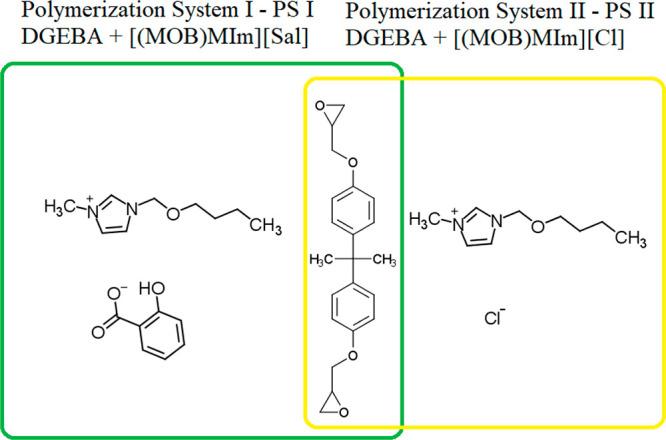
We investigated the influence of anion type (salicylate, [(MOB)MIm][Sal], vs chloride, [(MOB)MIm][Cl]) of imidazolium-based ionic liquid (IL) and its content on the curing kinetics of bisphenol A diglicydyl ether (DGEBA of molecular weight = 340 g/mol). Further physicochemical properties (i.e., glass transition temperature, , and conductivity, σ) of produced polymers were investigated. The polymerization of the studied systems was examined at various molar ratios (1:1, 10:1, and 20:1) at different reaction temperatures ( = 353-383 K) by using differential scanning calorimetry (DSC). Interestingly, both DGEBA/IL compositions studied herein revealed significantly different reaction kinetics and yielded materials of completely distinct physical properties. Surprisingly, in contrast to [(MOB)MIm][Cl], for the low concentration of [(MOB)MIm][Sal] in the reaction mixture, an additional step in the kinetic curves, likely due to the combined enhanced initiation activity of anion (salicylate)-cation (imidazolium-based), was noted. To thoroughly analyze the kinetics of all studied systems, including the two-step kinetics of DGEBA/[(MOB)MIm][Sal], we applied a new approach that relies on the combination of the two phenomenological Avrami equations. Analysis of the determined constant rates revealed that the reaction occurring in the presence of the salicylate anion is characterized by higher activation energy with respect to those with the chloride. Moreover, DGEBA/[(MOB)MIm][Sal] cured materials have higher in comparison to DGEBA polymerized with [(MOB)MIm][Cl] independent of the IL concentration. This fact might indicate that, most likely, the products of hardening are highly cross-linked (high ) or oligomeric linear polymers (low ) in the former and latter cases, respectively. Such a change in the chemical structure of the polymer is also reflected in the dc conductivity measured at the glass transition temperature, which is much higher for DGEBA cured with [(MOB)MIm][Cl]. Herein, we have clearly demonstrated that the type of anion has a crucial impact on the polymerization mechanism, kinetics, and properties of produced materials.
我们研究了咪唑基离子液体(IL)的阴离子类型(水杨酸根,[(MOB)MIm][Sal],与氯离子,[(MOB)MIm][Cl])及其含量对双酚A二缩水甘油醚(分子量 = 340 g/mol的DGEBA)固化动力学的影响。还研究了所得聚合物的其他物理化学性质(即玻璃化转变温度, ,和电导率,σ)。通过差示扫描量热法(DSC)在不同反应温度( = 353 - 383 K)下,对所研究体系在各种摩尔比(1:1、10:1和20:1)下的聚合反应进行了研究。有趣的是,本文研究的两种DGEBA/IL组合物均显示出明显不同的反应动力学,并产生了物理性质完全不同的材料。令人惊讶的是,与[(MOB)MIm][Cl]相反,对于反应混合物中低浓度的[(MOB)MIm][Sal],在动力学曲线上发现了一个额外的步骤,这可能是由于阴离子(水杨酸根) - 阳离子(咪唑基)组合增强的引发活性所致。为了全面分析所有研究体系的动力学,包括DGEBA/[(MOB)MIm][Sal]的两步动力学,我们应用了一种新方法,该方法依赖于两个唯象阿弗拉米方程的组合。对所确定的恒定速率的分析表明,与氯离子存在下发生的反应相比,在水杨酸根阴离子存在下发生的反应具有更高的活化能。此外,与用[(MOB)MIm][Cl]聚合的DGEBA相比,DGEBA/[(MOB)MIm][Sal]固化材料具有更高的 ,且与IL浓度无关。这一事实可能表明,在前一种和后一种情况下,硬化产物很可能分别是高度交联的(高 )或低聚物线性聚合物(低 )。聚合物化学结构的这种变化也反映在玻璃化转变温度下测得的直流电导率上,用[(MOB)MIm][Cl]固化的DGEBA的直流电导率要高得多。在此,我们清楚地证明了阴离子类型对聚合机理、动力学和所生产材料的性能具有至关重要的影响。



 Zotero 插件