Li Mengmeng, Shang Zhigang, Zhao Kun, Cheng Shuguan, Wan Hong
School of Electrical Engineering, Zhengzhou University, Zhengzhou 450001, China.
Henan Key Laboratory of Brain Science and Brain-Computer Interface Technology, Zhengzhou 450001, China.
Brain Sci. 2020 Sep 7;10(9):617. doi: 10.3390/brainsci10090617.
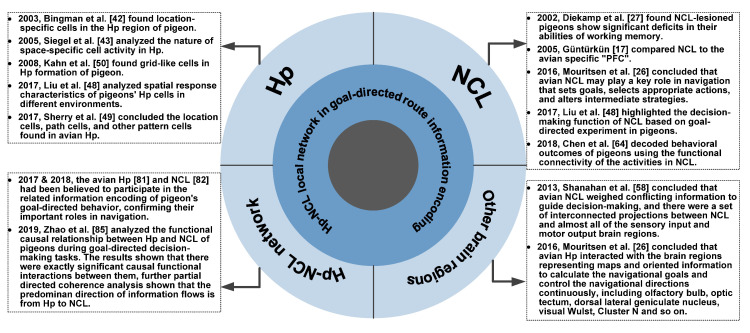
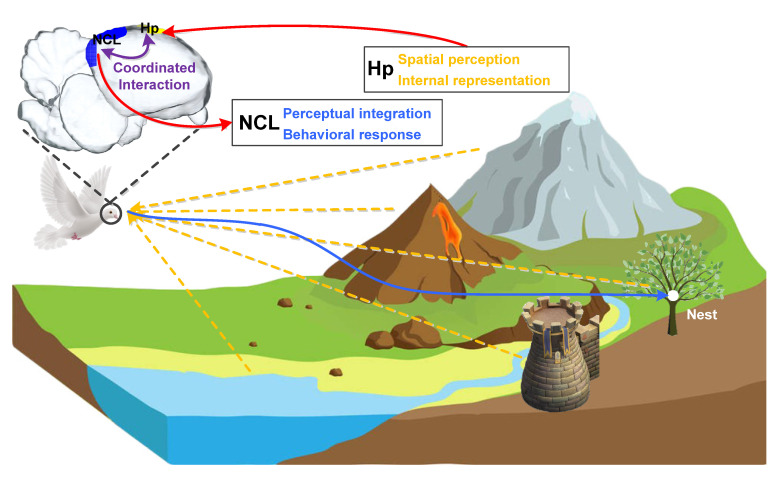
Goal-directed navigation is a crucial behavior for the survival of animals, especially for the birds having extraordinary spatial navigation ability. In the studies of the neural mechanism of the goal-directed behavior, especially involving the information encoding mechanism of the route, the hippocampus (Hp) and nidopallium caudalle (NCL) of the avian brain are the famous regions that play important roles. Therefore, they have been widely concerned and a series of studies surrounding them have increased our understandings of the navigation mechanism of birds in recent years. In this paper, we focus on the studies of the information encoding mechanism of the route in the avian goal-directed behavior. We first summarize and introduce the related studies on the role of the Hp and NCL for goal-directed behavior comprehensively. Furthermore, we review the related cooperative interaction studies about the Hp-NCL local network and other relevant brain regions supporting the goal-directed routing information encoding. Finally, we summarize the current situation and prospect the existing important questions in this field. We hope this paper can spark fresh thinking for the following research on routing information encoding mechanism of birds.
目标导向导航是动物生存的关键行为,对于具有非凡空间导航能力的鸟类而言尤为重要。在对目标导向行为神经机制的研究中,尤其是涉及路线信息编码机制的研究时,鸟类大脑中的海马体(Hp)和尾侧巢皮质(NCL)是发挥重要作用的著名区域。因此,它们受到了广泛关注,近年来围绕它们展开的一系列研究增进了我们对鸟类导航机制的理解。在本文中,我们聚焦于鸟类目标导向行为中路线信息编码机制的研究。我们首先全面总结并介绍关于Hp和NCL在目标导向行为中作用的相关研究。此外,我们回顾了关于Hp-NCL局部网络以及支持目标导向路线信息编码的其他相关脑区的相关协同相互作用研究。最后,我们总结当前状况并展望该领域现存的重要问题。我们希望本文能为后续鸟类路线信息编码机制的研究激发新的思路。