Centro de Biología Molecular Severo Ochoa, Consejo Superior de Investigaciones Científicas and Universidad Autónoma de Madrid (CSIC/UAM), 28049 Madrid, Spain.
Cells. 2020 Sep 7;9(9):2044. doi: 10.3390/cells9092044.
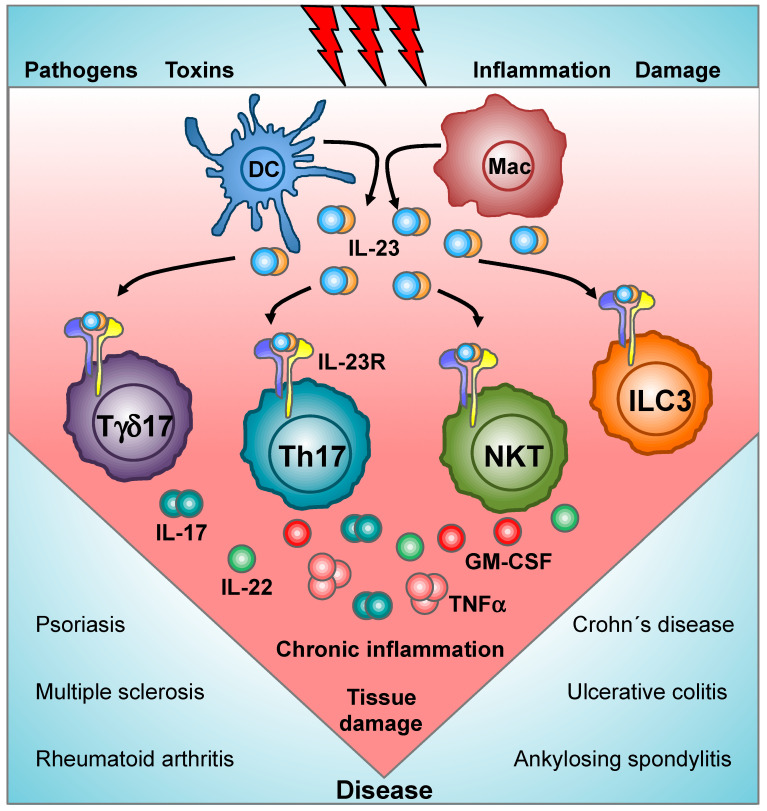
The interleukin 23 (IL-23) is a key pro-inflammatory cytokine in the development of chronic inflammatory diseases, such as psoriasis, inflammatory bowel diseases, multiple sclerosis, or rheumatoid arthritis. The pathological consequences of excessive IL-23 signaling have been linked to its ability to promote the production of inflammatory mediators, such as IL-17, IL-22, granulocyte-macrophage colony-stimulating (GM-CSF), or the tumor necrosis factor (TNFα) by target populations, mainly Th17 and IL-17-secreting TCRγδ cells (Tγδ17). Due to their pivotal role in inflammatory diseases, IL-23 and its downstream effector molecules have emerged as attractive therapeutic targets, leading to the development of neutralizing antibodies against IL-23 and IL-17 that have shown efficacy in different inflammatory diseases. Despite the success of monoclonal antibodies, there are patients that show no response or partial response to these treatments. Thus, effective therapies for inflammatory diseases may require the combination of multiple immune-modulatory drugs to prevent disease progression and to improve quality of life. Alternative strategies aimed at inhibiting intracellular signaling cascades using small molecule inhibitors or interfering peptides have not been fully exploited in the context of IL-23-mediated diseases. In this review, we discuss the current knowledge about proximal signaling events triggered by IL-23 upon binding to its membrane receptor to bring to the spotlight new opportunities for therapeutic intervention in IL-23-mediated pathologies.
白细胞介素 23 (IL-23) 是慢性炎症性疾病(如银屑病、炎症性肠病、多发性硬化症或类风湿关节炎)发展中的关键促炎细胞因子。过量的 IL-23 信号传递的病理后果与其促进炎症介质产生的能力有关,如白细胞介素 17 (IL-17)、白细胞介素 22 (IL-22)、粒细胞-巨噬细胞集落刺激因子 (GM-CSF) 或肿瘤坏死因子 (TNFα),这些炎症介质主要由 Th17 和分泌白细胞介素 17 的 TCRγδ 细胞(Tγδ17)产生。由于它们在炎症性疾病中的关键作用,IL-23 及其下游效应分子已成为有吸引力的治疗靶点,导致针对 IL-23 和 IL-17 的中和抗体的开发,这些抗体在不同的炎症性疾病中显示出疗效。尽管单克隆抗体取得了成功,但仍有一些患者对这些治疗方法没有反应或反应不完全。因此,为了预防疾病进展和提高生活质量,针对炎症性疾病的有效治疗可能需要联合使用多种免疫调节药物。使用小分子抑制剂或干扰肽抑制细胞内信号级联反应的替代策略在 IL-23 介导的疾病中尚未得到充分利用。在这篇综述中,我们讨论了关于 IL-23 与其膜受体结合后触发的近端信号事件的现有知识,以突出 IL-23 介导的病理过程中治疗干预的新机会。