Department of Midwifery, School of Nursing and Midwifery. Zanjan University of Medical Sciences, Zanjan, Iran.
Department of Clinical Psychology, Beheshti Hospital and Zanjan University of Medical Sciences, Zanjan, Iran.
BMC Pregnancy Childbirth. 2020 Sep 9;20(1):522. doi: 10.1186/s12884-020-03230-1.
Studies show that childbirth fear is a common problem among Iranian women. Therefore, most Iranian women prefer caesarean section for giving birth. This study investigated the effectiveness of a psychoeducational intervention by midwives (birth emotions - looking to improve expectant fear (BELIEF)) on decreasing childbirth fear and self-efficacy among first-time pregnant women who were afraid of giving birth.
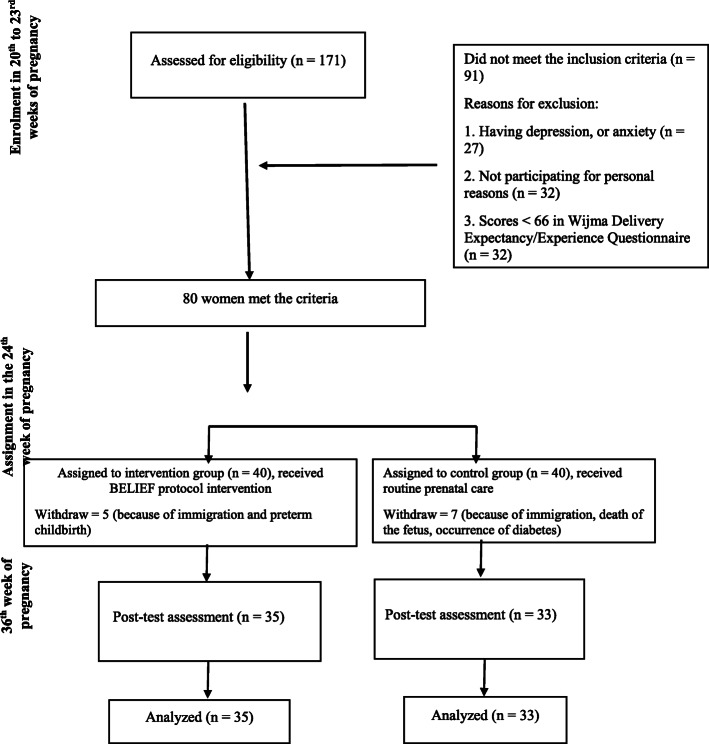
A number of 80 pregnant women participated in the study. They had received a score of ≥66 on the Wijma delivery expectancy/experience questionnaire. They were randomly assigned into two groups: intervention (n = 40) and control groups (n = 40). The intervention group received two face-to-face counseling sessions based on the BELEF protocol in the 24th and 34th weeks of pregnancy. Between these two sessions, it also received eight telephone-counseling sessions once a week. The control group only received the prenatal routine care. The outcome measures were childbirth fear, childbirth self-efficacy, and childbirth preference.
The intervention group showed significantly more reduction in childbirth fear and more increase in childbirth self-efficacy compared to the control group. In addition, more women in the intervention group reported that they preferred to give normal vaginal birth than women in the control group.
The BELIEF protocol could be an effective approach in reducing childbirth fear and increasing childbirth self-efficacy among first-time pregnant women who are afraid of giving birth.
IRCT20101219005417N3, Date of Registration: 19-12-2018.
研究表明,分娩恐惧是伊朗女性中常见的问题。因此,大多数伊朗女性更喜欢剖宫产分娩。本研究调查了助产士实施的心理教育干预(生育情绪-期待改善恐惧(BELIEF))对减轻害怕分娩的初产妇分娩恐惧和自我效能的效果。
共有 80 名孕妇参与了这项研究。她们在 Wijma 分娩期望/体验问卷上的得分≥66。她们被随机分为两组:干预组(n=40)和对照组(n=40)。干预组在妊娠第 24 周和第 34 周接受了两次基于 BELIEF 方案的面对面咨询。在这两次咨询之间,她们还接受了每周一次的八次电话咨询。对照组仅接受常规产前护理。结局指标为分娩恐惧、分娩自我效能和分娩偏好。
与对照组相比,干预组的分娩恐惧明显减轻,分娩自我效能明显提高。此外,与对照组相比,更多的干预组妇女表示她们更喜欢正常阴道分娩。
BELIEF 方案可能是减轻害怕分娩的初产妇分娩恐惧和提高分娩自我效能的有效方法。
IRCT20101219005417N3,注册日期:2018 年 12 月 19 日。