Leibniz Institute for Prevention Research and Epidemiology - BIPS, Achterstr. 30, 28359, Bremen, Germany.
Institute of Medical Biostatistics, Epidemiology and Informatics, University Medical Center of the Johannes Gutenberg University Mainz, Mainz, Germany.
Mol Med. 2020 Sep 9;26(1):85. doi: 10.1186/s10020-020-00203-0.
Exposure to ionizing radiation induces complex stress responses in cells, which can lead to adverse health effects such as cancer. Although a variety of studies investigated gene expression and affected pathways in human fibroblasts after exposure to ionizing radiation, the understanding of underlying mechanisms and biological effects is still incomplete due to different experimental settings and small sample sizes. Therefore, this study aims to identify the time point with the highest number of differentially expressed genes and corresponding pathways in primary human fibroblasts after irradiation at two preselected time points.
Fibroblasts from skin biopsies of 15 cell donors were exposed to a high (2Gy) and a low (0.05Gy) dose of X-rays. RNA was extracted and sequenced 2 h and 4 h after exposure. Differentially expressed genes with an adjusted p-value < 0.05 were flagged and used for pathway analyses including prediction of upstream and downstream effects. Principal component analyses were used to examine the effect of two different sequencing runs on quality metrics and variation in expression and alignment and for explorative analysis of the radiation dose and time point of analysis.
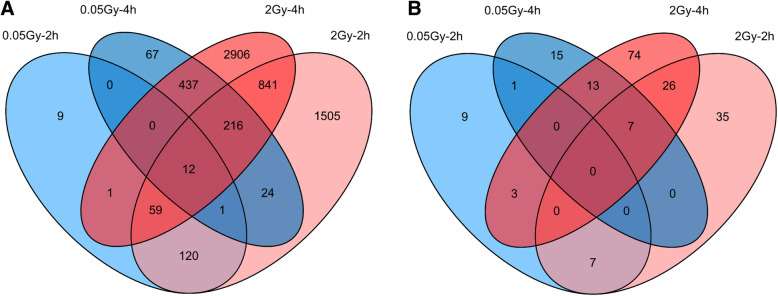
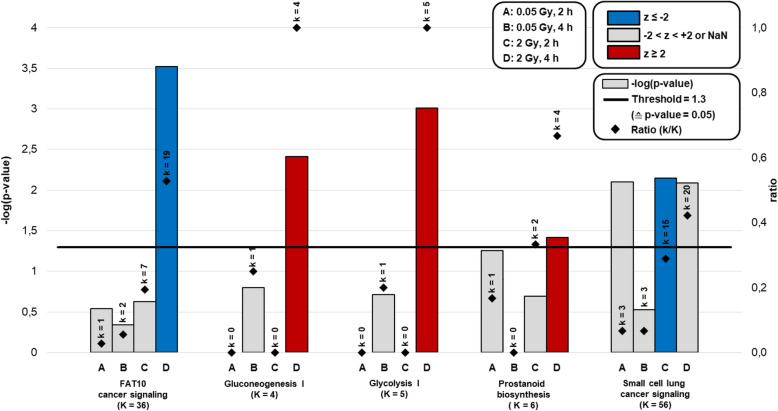
More genes were differentially expressed 4 h after exposure to low and high doses of radiation than after 2 h. In experiments with high dose irradiation and RNA sequencing after 4 h, inactivation of the FAT10 cancer signaling pathway and activation of gluconeogenesis I, glycolysis I, and prostanoid biosynthesis was observed taking p-value (< 0.05) and (in) activating z-score (≥2.00 or ≤ - 2.00) into account. Two hours after high dose irradiation, inactivation of small cell lung cancer signaling was observed. For low dose irradiation experiments, we did not detect any significant (p < 0.05 and z-score ≥ 2.00 or ≤ - 2.00) activated or inactivated pathways for both time points.
Compared to 2 h after irradiation, a higher number of differentially expressed genes were found 4 h after exposure to low and high dose ionizing radiation. Differences in gene expression were related to signal transduction pathways of the DNA damage response after 2 h and to metabolic pathways, that might implicate cellular senescence, after 4 h. The time point 4 h will be used to conduct further irradiation experiments in a larger sample.
电离辐射会引起细胞内的复杂应激反应,从而导致癌症等不良健康影响。尽管许多研究都调查了人类成纤维细胞暴露于电离辐射后基因表达和受影响的途径,但由于实验设置和样本量较小,对潜在机制和生物学效应的理解仍不完整。因此,本研究旨在确定在两个预先选定的时间点照射后,人原代成纤维细胞中差异表达基因数量最多和相应途径的时间点。
从 15 名细胞供体的皮肤活检中提取成纤维细胞,并用高(2Gy)和低(0.05Gy)剂量的 X 射线照射。暴露后 2 小时和 4 小时提取 RNA 并进行测序。用调整后的 p 值<0.05 标记差异表达基因,并用于通路分析,包括上游和下游效应的预测。主成分分析用于检查两个不同测序运行对质量指标、表达和比对的变异以及对辐射剂量和分析时间点的探索性分析的影响。
与 2 小时相比,低剂量和高剂量辐射暴露 4 小时后差异表达的基因更多。在高剂量照射实验和 4 小时后 RNA 测序中,观察到 FAT10 癌症信号通路失活和糖异生 I、糖酵解 I 和前列腺素生物合成激活,考虑到 p 值(<0.05)和(in)激活 z 分数(≥2.00 或≤-2.00)。在高剂量照射后 2 小时,观察到小细胞肺癌信号失活。对于低剂量照射实验,我们没有检测到两个时间点任何显著的(p<0.05 和 z 分数≥2.00 或≤-2.00)激活或失活途径。
与照射后 2 小时相比,低剂量和高剂量电离辐射暴露后 4 小时发现更多差异表达基因。基因表达的差异与 2 小时后 DNA 损伤反应的信号转导途径有关,与 4 小时后的代谢途径有关,这些途径可能暗示细胞衰老。将使用 4 小时作为时间点在更大的样本中进行进一步的照射实验。