Department of Orthopedics, The Affliated Hospital of Guizhou Medical University, Guiyang, 550004, Guizhou, China.
Guizhou Medical University, Guiyang, 550004, Guizhou, China.
J Orthop Surg Res. 2020 Sep 9;15(1):392. doi: 10.1186/s13018-020-01916-y.
To investigate the effects of low-concentration hydrogen peroxide pretreatment on the anti-oxidative stress of the bone marrow mesenchymal stem cells (BMSCs).
Rabbit BMSCs were isolated and cultured by density gradient centrifugation combined with the adherence method. Then, the third generation of well-grown BMSCs was continuously treated with 50-μM hydrogen peroxide (HO) for 8 h as the optimal pretreatment concentration and the BMSCs were continuously applied for 24 h with 500 μM HO, and the optimal damage concentration was determined as the oxidative stress cell model. The experiment was divided into three groups: control group, high-concentration HO injury group (500 μM), and low-concentration HO pretreatment group (50 μM + 500 μM). In each group, the DCFH-DA fluorescence probe was used to detect the reactive oxygen species (ROS). ELISA was used to detect the activity of superoxide dismutase (SOD) and catalase (CAT), and the TBA method was used to detect malondialdehyde (MDA). The mitochondrial membrane potential was detected by JC-1. The cell viability was detected by CCK-8 method, while flow cytometry and TUNEL/DAPI double staining were performed to detect cell apoptosis. Hence, the effect of HO pretreatment on the anti-oxidative stress of BMSCs was investigated. One-way analysis of variance was performed using SPSS 19.0 statistical software, and P < 0.05 was considered statistically significant.
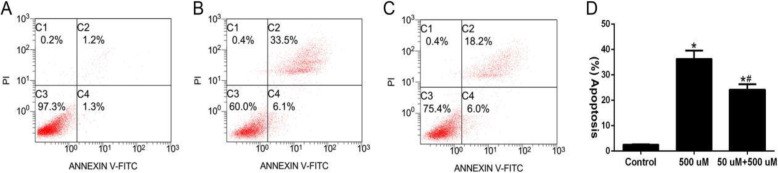
A large number of typical BMSCs were obtained by density gradient centrifugation and adherent culture. The oxidative stress cell model was successfully established by 500-μM HO. Compared with the high-concentration HO injury group, the low-concentration HO pretreatment reduced the production of ROS [(62.33 ± 5.05), P < 0.05], SOD and CAT activities significantly increased (P < 0.05), and MDA levels significantly decreased (P < 0.05). The mitochondrial membrane potential fluorescence changes, the ratio of red/green fluorescence intensity of the high-concentration HO injury group was less, and the ratio of the low-concentration HO pretreatment group was significantly higher than that. The ratio of red/green increased by about 1.8 times (P < 0.05). The cell viability and survival rate of BMSCs were significantly increased in low-concentration HO pretreatment group (P < 0.05), and the cell apoptosis rate was significantly decreased (P < 0.05).
Pretreatment with low-concentration HO can enhance the anti-oxidative stress ability and reduce their apoptosis of BMSCs under oxidative stress.
研究低浓度过氧化氢预处理对骨髓间充质干细胞(BMSCs)抗氧化应激的影响。
采用密度梯度离心结合贴壁法分离培养兔 BMSCs,将第三代生长良好的 BMSCs 连续用 50-μM 过氧化氢(HO)处理 8 h,作为最佳预处理浓度,然后用 500 μM HO 连续处理 24 h,确定最佳损伤浓度作为氧化应激细胞模型。实验分为三组:对照组、高浓度 HO 损伤组(500 μM)和低浓度 HO 预处理组(50 μM+500 μM)。在每组中,使用 DCFH-DA 荧光探针检测活性氧(ROS)。采用 ELISA 法检测超氧化物歧化酶(SOD)和过氧化氢酶(CAT)的活性,采用 TBA 法检测丙二醛(MDA)。采用 JC-1 检测线粒体膜电位。采用 CCK-8 法检测细胞活力,采用流式细胞术和 TUNEL/DAPI 双重染色法检测细胞凋亡。因此,研究了 HO 预处理对 BMSCs 抗氧化应激能力的影响。采用 SPSS 19.0 统计软件进行单因素方差分析,P<0.05 为差异有统计学意义。
通过密度梯度离心和贴壁培养获得了大量典型的 BMSCs。通过 500 μM HO 成功建立了氧化应激细胞模型。与高浓度 HO 损伤组相比,低浓度 HO 预处理组 ROS 的产生减少[(62.33±5.05),P<0.05],SOD 和 CAT 活性显著增加(P<0.05),MDA 水平显著降低(P<0.05)。线粒体膜电位荧光变化,高浓度 HO 损伤组的红/绿荧光强度比值较小,低浓度 HO 预处理组的比值明显升高,约增加 1.8 倍(P<0.05)。低浓度 HO 预处理组 BMSCs 的细胞活力和存活率明显增加(P<0.05),细胞凋亡率明显降低(P<0.05)。
低浓度 HO 预处理可增强 BMSCs 在氧化应激下的抗氧化应激能力,减少其凋亡。