Department of Ophthalmology, Hallym University Sacred Heart Hospital, Anyang, Korea.
Institute of New Frontier Research, Hallym University College of Medicine, Chuncheon, Korea.
Sci Rep. 2020 Sep 9;10(1):14803. doi: 10.1038/s41598-020-71927-6.
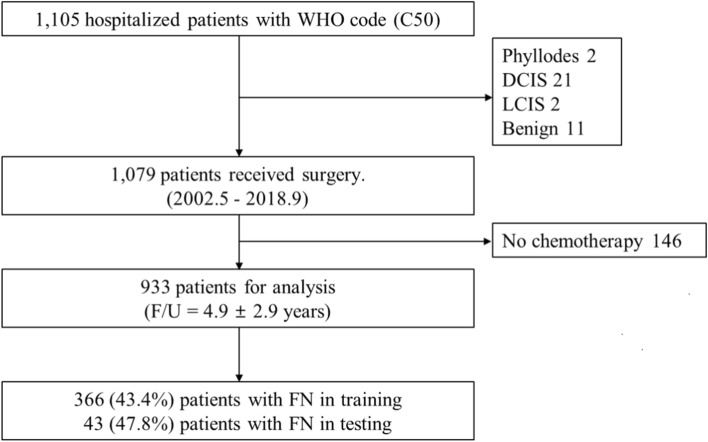
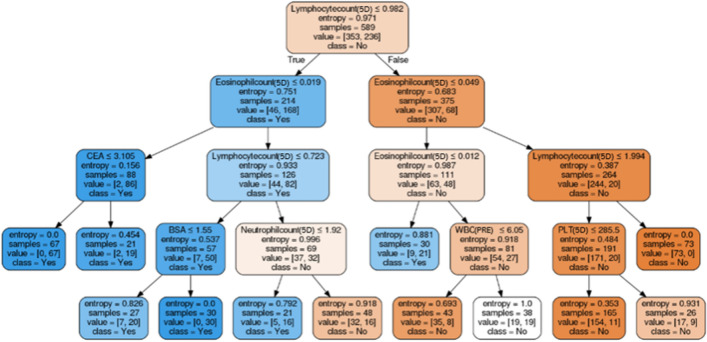
Febrile neutropenia (FN) is one of the most concerning complications of chemotherapy, and its prediction remains difficult. This study aimed to reveal the risk factors for and build the prediction models of FN using machine learning algorithms. Medical records of hospitalized patients who underwent chemotherapy after surgery for breast cancer between May 2002 and September 2018 were selectively reviewed for development of models. Demographic, clinical, pathological, and therapeutic data were analyzed to identify risk factors for FN. Using machine learning algorithms, prediction models were developed and evaluated for performance. Of 933 selected inpatients with a mean age of 51.8 ± 10.7 years, FN developed in 409 (43.8%) patients. There was a significant difference in FN incidence according to age, staging, taxane-based regimen, and blood count 5 days after chemotherapy. The area under the curve (AUC) built based on these findings was 0.870 on the basis of logistic regression. The AUC improved by machine learning was 0.908. Machine learning improves the prediction of FN in patients undergoing chemotherapy for breast cancer compared to the conventional statistical model. In these high-risk patients, primary prophylaxis with granulocyte colony-stimulating factor could be considered.
发热性中性粒细胞减少症(FN)是化疗最令人关注的并发症之一,其预测仍然困难。本研究旨在利用机器学习算法揭示 FN 的危险因素,并建立预测模型。选择性回顾了 2002 年 5 月至 2018 年 9 月间接受乳腺癌手术后化疗的住院患者的病历,以开发模型。分析了人口统计学、临床、病理和治疗数据,以确定 FN 的危险因素。使用机器学习算法开发并评估了预测模型的性能。在 933 名平均年龄为 51.8±10.7 岁的入选患者中,409 名(43.8%)患者发生 FN。FN 的发病率根据年龄、分期、紫杉烷类方案和化疗后 5 天的血细胞计数有显著差异。基于这些发现的逻辑回归构建的曲线下面积(AUC)为 0.870。机器学习的 AUC 提高到 0.908。与传统的统计模型相比,机器学习可提高接受乳腺癌化疗患者 FN 的预测能力。对于这些高危患者,可以考虑使用粒细胞集落刺激因子进行一级预防。