Long Ailin, Qing Ying, Gu Ting, Zhu Qing, Liu Yiping, Wang Yan, Yin Huadong, Shu Gang, Zhang Yu, Lai Shuang, Zhao Xiaoling
College of Animal Science & Technology, Sichuan Agricultural University, Wenjiang 611130, China.
College of Veterinary Medicine, Sichuan Agricultural University, Wenjiang 611130, China.
J Poult Sci. 2017 Jan 25;54(1):18-25. doi: 10.2141/jpsa.0160033.
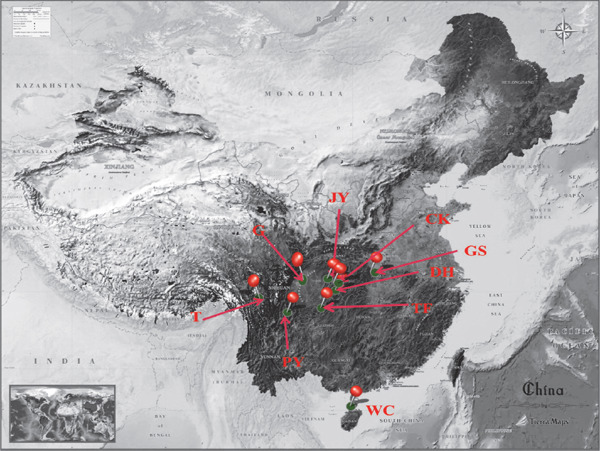
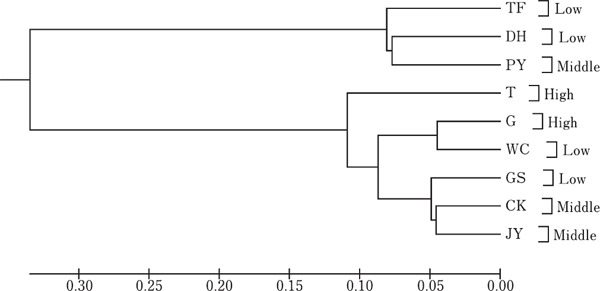
Genetic polymorphisms of 19 microsatellites were investigated in nine local chicken breeds collected from low, middle and high altitudes areas in China (total number was 256) and their population genetic diversity and population structure were analyzed. All breeds were assigned into three groups, including the high (Tibetan chicken (T) and Grey chicken (G), their altitudes were above 1000 m); middle (Chengkou mountainous chicken (CK), Jiuyuan chicken (JY) and Pengxian yellow chicken (PY), their altitudes were between 500 and 1000 m), and low groups (Da ninghe chicken (DH), Tassel first chicken (TF), Gushi chicken (GS) and Wenchang chicken (WC), their altitudes were below 500 m). We found 780 genotypes and 324 alleles via the 19 microsatellites primers, and the results showed that the mean number of alleles ( ) was 17.05; the average polymorphism information content () was 0.767; the mean expected heterozygosity () was 0.662; as for observed heterozygosity ( ), it was 0.647. The AMOVA results indicated the genetic variation mainly existed within individuals among populations (80%). There was no genetic variation among the three altitude groups (0%). The mean inbreeding coefficient among individuals within population ( ) was 0.031 and the mean gene flow ( ) was 1.790. The mean inbreeding coefficient among populations within a group ( ) was 0.157. All loci deviated Hardy-Weinberg equilibrium. The genetic distance ranged from 0.090 to 0.704. Generally, genetic variations were mainly made up of the variations among populations and within individuals. There were rich gene diversities in the populations for the detected loci. Meanwhile, frequent genes exchange existed among the populations. This can lead to extinction of the peripheral species, such as the Tibetan chicken breed.
对采自中国低、中、高海拔地区的9个地方鸡种(共256只)的19个微卫星的遗传多态性进行了研究,并分析了其群体遗传多样性和群体结构。所有品种分为三组,包括高海拔组(藏鸡(T)和乌鸡(G),海拔高于1000米);中海拔组(城口山地鸡(CK)、旧院鸡(JY)和彭县黄鸡(PY),海拔在500至1000米之间),以及低海拔组(大宁河鸡(DH)、丝羽乌骨鸡(TF)、固始鸡(GS)和文昌鸡(WC),海拔低于500米)。通过19个微卫星引物共发现780种基因型和324个等位基因,结果表明,等位基因平均数( )为17.05;平均多态信息含量( )为0.767;平均期望杂合度( )为0.662;观察杂合度( )为0.647。分子方差分析(AMOVA)结果表明,遗传变异主要存在于群体内个体间(80%)。三个海拔组间无遗传变异(0%)。群体内个体间平均近交系数( )为0.031,平均基因流( )为1.790。组内群体间平均近交系数( )为0.157。所有位点均偏离哈迪-温伯格平衡。遗传距离在0.090至0.704之间。总体而言,遗传变异主要由群体间和个体内变异组成。所检测位点的群体中存在丰富的基因多样性。同时,群体间存在频繁的基因交流。这可能导致边缘物种的灭绝,如藏鸡品种。