Brunet Eduard, Vela Emili, Melcarne Luigi, Clèries Montserrat, Pontes Caridad, Llovet Laura Patricia, García-Iglesias Pilar, Gallach Marta, Villòria Albert, Vergara Mercedes, Calvet Xavier
Servei Aparell Digestiu, Hospital Universitari Parc Taulí, 08208 Sabadell, Spain.
Departament de Medicina, Universitat Autònoma de Barcelona, 08193 Bellaterra, Spain.
J Clin Med. 2020 Sep 8;9(9):2896. doi: 10.3390/jcm9092896.
Data from clinical trials suggest that biological drugs may improve the outcomes in Crohn's disease (CD) by reducing the need for surgery or hospitalization. The aim of this study is to evaluate the time-trends of the use of biological drugs and other treatments for CD, and its relationship with outcomes in Catalonia.
All patients with CD included in the Catalan Health Surveillance System (containing data on a population of more than 7.5 million) from 2011 to 2017 were identified. The exposures to different treatments for inflammatory bowel disease were retrieved from electronic invoicing records.
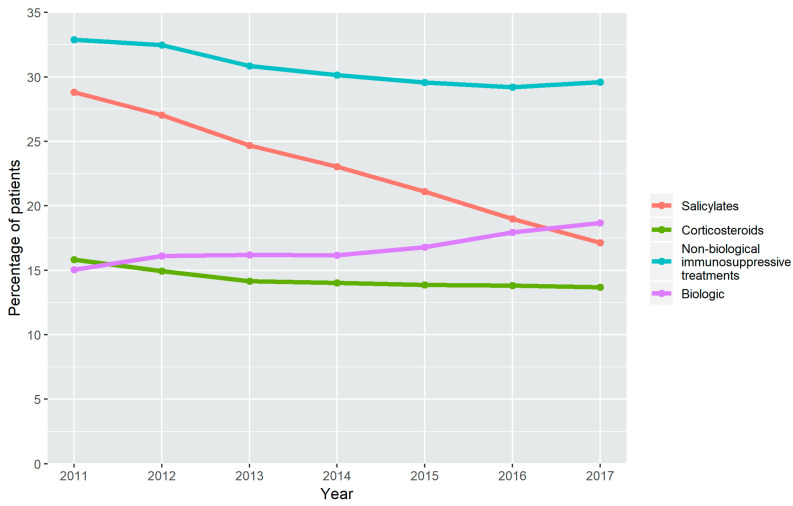
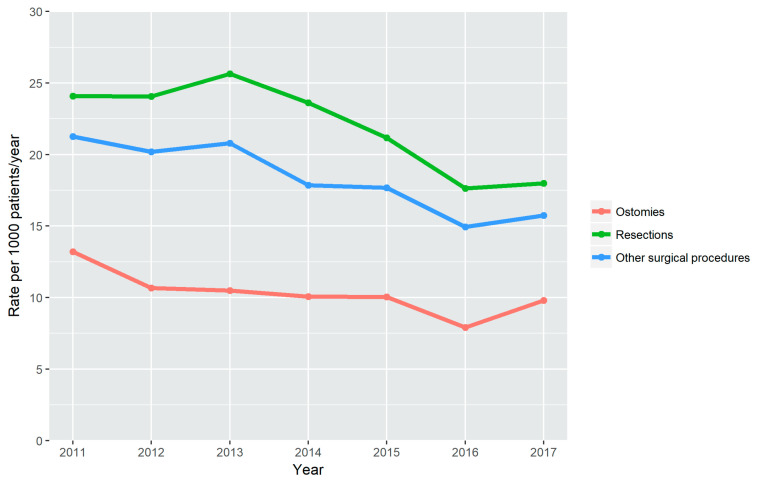
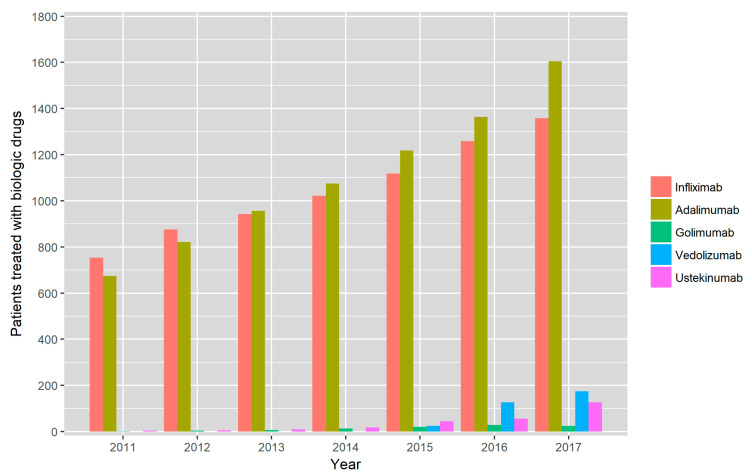
Between 2011 and 2017, the use of salicylates, corticosteroids and immunosuppressive treatment fell from 28.8% to 17.1%, 15.8% to 13.7%, and 32.9% to 29.6%, respectively ( < 0.001). Biological treatment use rose from 15.0% to 18.7% ( < 0.001). Ostomy rates per 1000 patients/year fell from 13.2 in 2011 to 9.8 in 2017 ( = 0.003), and surgical resection rates from 24.1 to 18.0 ( < 0.001). The rate of CD-related hospitalizations per 1000 patients/year also fell, from 92.7 to 72.2 ( < 0.001).
Biological drug use rose from 15.0% to 18.7% between 2011 and 2017. During this period, we observed an improvement in the outcomes of CD patients.
临床试验数据表明,生物药物可通过减少手术或住院需求来改善克罗恩病(CD)的治疗效果。本研究旨在评估加泰罗尼亚地区生物药物及其他CD治疗方法的使用时间趋势,及其与治疗效果的关系。
确定了2011年至2017年纳入加泰罗尼亚健康监测系统(包含超过750万人口的数据)的所有CD患者。从电子发票记录中获取炎症性肠病不同治疗方法的使用情况。
2011年至2017年期间,水杨酸盐、皮质类固醇和免疫抑制治疗的使用比例分别从28.8%降至17.1%、15.8%降至13.7%、32.9%降至29.6%(<0.001)。生物治疗的使用比例从15.0%升至18.7%(<0.001)。每1000例患者/年的造口率从2011年的13.2降至2017年的9.8(P = 0.003),手术切除率从24.1降至18.0(<0.001)。每1000例患者/年的CD相关住院率也有所下降,从92.7降至72.2(<0.001)。
2011年至2017年期间,生物药物的使用比例从15.0%升至18.7%。在此期间,我们观察到CD患者的治疗效果有所改善。