Brunet-Mas Eduard, Garcia-Sagué Belen, Vela Emli, Melcarne Luigi, Llovet Laura Patricia, Pontes Caridad, García-Iglesias Pilar, Puy Anna, Lario Sergio, Ramirez-Lazaro Maria Jose, Villoria Albert, Burisch Johan, Kaplan Gilaad G, Calvet Xavier
Servei d'Aparell Digestiu, Parc Taulí Hospital Universitari, Institut d'Investigació i Innovació Parc Taulí (I3PT-CERCA), Departament de Medicina, Universitat Autònoma de Barcelona, Sabadell, Spain.
CIBERehd, Instituto de Salud Carlos III, Madrid, Spain.
Therap Adv Gastroenterol. 2024 Feb 14;17:17562848231222344. doi: 10.1177/17562848231222344. eCollection 2024.
Inflammatory bowel disease (IBD) has a major economic impact on healthcare costs.
The aim of this study was to evaluate the current healthcare expenditure associated with IBD in a population-wide study in Catalonia.
Retrospective observational study.
All patients with IBD included in the Catalan Health Surveillance System (CHSS) were considered eligible. The CHSS compiles data on more than 7 million individuals in 2020 (34,823 with IBD). Data on the use of healthcare resources and its economic impact were extracted applying the International Classification of Diseases, 10th revision, Clinical Modification codes (ICD-10-CM codes). Health expenditure, comorbidities, and hospitalization were calculated according to the standard costs of each service provided by the Department of Health of the Catalan government. The data on the IBD population were compared with non-IBD population adjusted for age, sex, and income level. IBD costs were recorded separately for Crohn's disease (CD) and ulcerative colitis (UC).
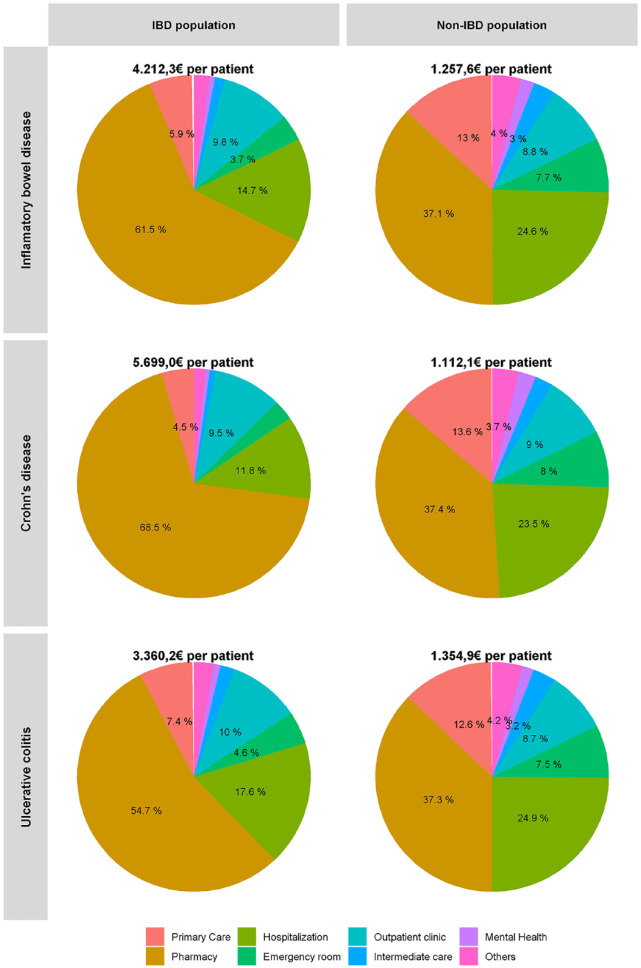
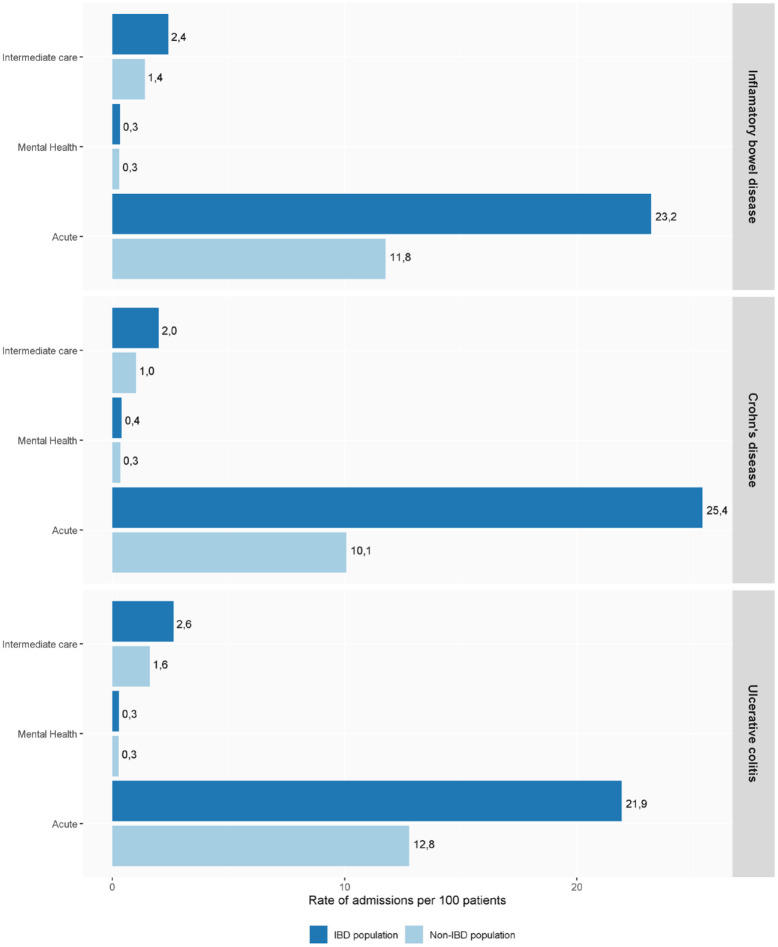
Prevalence of comorbidities was higher in patients with IBD than in those without. The risk of hospitalization was twice as high in the IBD population. The overall healthcare expenditure on IBD patients amounted to 164M€. The pharmacy cost represents the 60%. The average annual per capita expenditure on IBD patients was more than 3.4-fold higher (IBD 4200€, non-IBD 1200€). Average costs of UC were 3400€ and 5700€ for CD.
The risk of comorbidities was twice as high in patients with IBD and their use of healthcare resources was also higher than that of their non-IBD counterparts. Per capita healthcare expenditure was approximately 3.4 times higher in the population with IBD.
The study was not previously registered.
炎症性肠病(IBD)对医疗保健成本有重大经济影响。
本研究的目的是在加泰罗尼亚的一项全人群研究中评估与IBD相关的当前医疗保健支出。
回顾性观察研究。
加泰罗尼亚健康监测系统(CHSS)中纳入的所有IBD患者均被视为符合条件。CHSS汇编了2020年超过700万人的数据(34823例IBD患者)。使用国际疾病分类第10版临床修订版代码(ICD-10-CM代码)提取医疗保健资源使用及其经济影响的数据。根据加泰罗尼亚政府卫生部提供的每项服务的标准成本计算医疗支出、合并症和住院情况。将IBD人群的数据与根据年龄、性别和收入水平调整的非IBD人群进行比较。IBD成本分别记录为克罗恩病(CD)和溃疡性结肠炎(UC)。
IBD患者的合并症患病率高于非IBD患者。IBD人群的住院风险高出两倍。IBD患者的总体医疗保健支出达1.64亿欧元。药房成本占60%。IBD患者的人均年支出高出3.4倍多(IBD为4200欧元,非IBD为1200欧元)。UC的平均成本为3400欧元,CD为5700欧元。
IBD患者的合并症风险高出两倍,他们对医疗保健资源的使用也高于非IBD患者。IBD人群的人均医疗保健支出高出约3.4倍。
该研究之前未注册。