Murray Rachael L, Brain Kate, Britton John, Quinn-Scoggins Harriet D, Lewis Sarah, McCutchan Grace M, Quaife Samantha L, Wu Qi, Ashurst Alex, Baldwin David, Crosbie Philip A J, Neal Richard D, Parrott Steve, Rogerson Suzanne, Thorley Rebecca, Callister Matthew Ej
Division of Epidemiology & Public Health, Faculty of Medicine, University of Nottingham, Nottingham, United Kingdom
UK Centre for Tobacco and Alcohol Studies, University of Nottingham, Nottingham, United Kingdom.
BMJ Open. 2020 Sep 10;10(9):e037086. doi: 10.1136/bmjopen-2020-037086.
Integration of smoking cessation (SC) into lung cancer screening is essential to optimise clinical and cost effectiveness. The most effective way to use this 'teachable moment' is unclear. The Yorkshire Enhanced Stop Smoking study will measure the effectiveness of an SC service integrated within the Yorkshire Lung Screening Trial (YLST) and will test the efficacy of a personalised SC intervention, incorporating incidental findings detected on the low-dose CT scan performed as part of YLST.
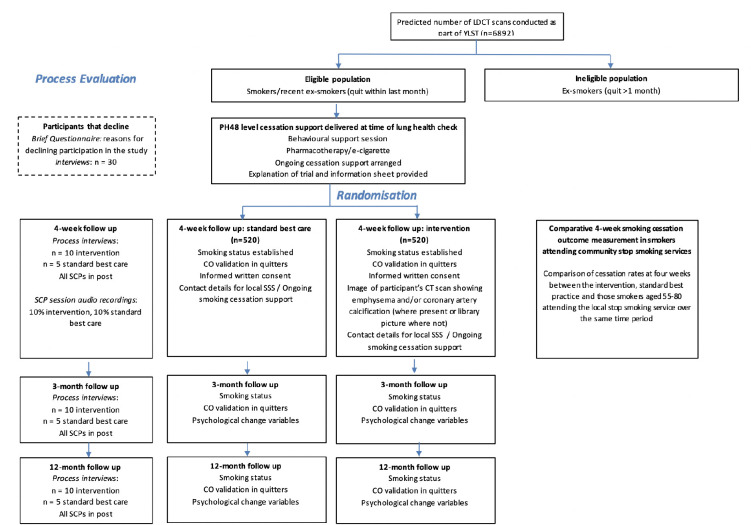
Unless explicitly declined, all smokers enrolled in YLST will see an SC practitioner at baseline and receive SC support over 4 weeks comprising behavioural support, pharmacotherapy and/or a commercially available e-cigarette. Eligible smokers will be randomised (1:1 in permuted blocks of random size up to size 6) to receive either an enhanced, personalised SC support package, including CT scan images, or continued standard best practice. Anticipated recruitment is 1040 smokers (January 2019-December 2020). The primary objective is to measure 7-day point prevalent carbon monoxide (CO) validated SC after 3 months. Secondary outcomes include CO validated cessation at 4 weeks and 12 months, self-reported continuous cessation at 4 weeks, 3 months and 12 months, attempts to quit smoking and changes in psychological variables, including perceived risk of lung cancer, motivation to quit smoking tobacco, confidence and efficacy beliefs (self and response) at all follow-up points. A process evaluation will explore under which circumstances and on which groups the intervention works best, test intervention fidelity and theory test the mechanisms of intervention impact.
This study has been approved by the East Midlands-Derby Research Ethics Committee (18/EM/0199) and the Health Research Authority/Health and Care Research Wales. Results will be disseminated through publication in peer-reviewed scientific journals, presentation at conferences and via the YLST website.
ISRCTN63825779, NCT03750110.
将戒烟纳入肺癌筛查对于优化临床效果和成本效益至关重要。利用这一“可教时刻”的最有效方法尚不清楚。约克郡强化戒烟研究将评估在约克郡肺癌筛查试验(YLST)中整合的戒烟服务的效果,并将测试个性化戒烟干预措施的疗效,该干预措施纳入了作为YLST一部分进行的低剂量CT扫描检测到的偶然发现。
除非明确拒绝,所有参加YLST的吸烟者在基线时将见到一名戒烟从业者,并在4周内接受戒烟支持,包括行为支持、药物治疗和/或一种市售电子烟。符合条件的吸烟者将被随机分组(按大小不超过6的随机排列块以1:1的比例),接受强化的个性化戒烟支持包,包括CT扫描图像,或继续接受标准最佳实践。预计招募1040名吸烟者(2019年1月至2020年12月)。主要目标是在3个月后测量7天时点流行的经一氧化碳(CO)验证的戒烟情况。次要结果包括4周和12个月时经CO验证的戒烟情况、4周、3个月和12个月时自我报告的持续戒烟情况、戒烟尝试以及心理变量的变化,包括肺癌感知风险、戒烟动机、信心和效能信念(自我和反应)在所有随访点的情况。一项过程评估将探讨干预措施在何种情况下对哪些群体效果最佳,测试干预措施的保真度,并从理论上检验干预影响的机制。
本研究已获得东米德兰兹-德比研究伦理委员会(18/EM/0199)以及健康研究局/威尔士健康与护理研究机构的批准。研究结果将通过在同行评审科学期刊上发表、在会议上展示以及通过YLST网站进行传播。
ISRCTN63825779,NCT03750110。