From the Department of Neurology (J.R.C., T.A.D., W.D.G., B.M.D., D.K., C.M.Y., J.-M.L.), The Knight Alzheimer's Disease Research Center, Hope Center for Neurological Disorders, Washington University School of Medicine, St. Louis, MO; Center for Neuromodulation in Depression and Stress, Department of Psychiatry (C.E.W., P.Y., Y.I.S.), and Departments of Psychiatry, Radiology, and Neurology (Y.I.S.), University of Pennsylvania, Philadelphia.
Neurology. 2020 Nov 10;95(19):e2666-e2674. doi: 10.1212/WNL.0000000000010733. Epub 2020 Sep 10.
Several neurotransmitter receptors activate signaling pathways that alter processing of the amyloid precursor protein (APP) into β-amyloid (Aβ). Serotonin signaling through a subset of serotonin receptors suppresses Aβ generation. We proposed that escitalopram, the most specific selective serotonin reuptake inhibitor (SSRI) that inhibits the serotonin transporter SERT, would suppress Aβ levels in mice.
We hypothesized that acute treatment with escitalopram would reduce Aβ generation, which would be reflected chronically with a significant reduction in Aβ plaque load.
We performed in vivo microdialysis and in vivo 2-photon imaging to assess changes in brain interstitial fluid (ISF) Aβ and Aβ plaque size over time, respectively, in the APP/presenilin 1 mouse model of Alzheimer disease treated with vehicle or escitalopram. We also chronically treated mice with escitalopram to determine the effect on plaques histologically.
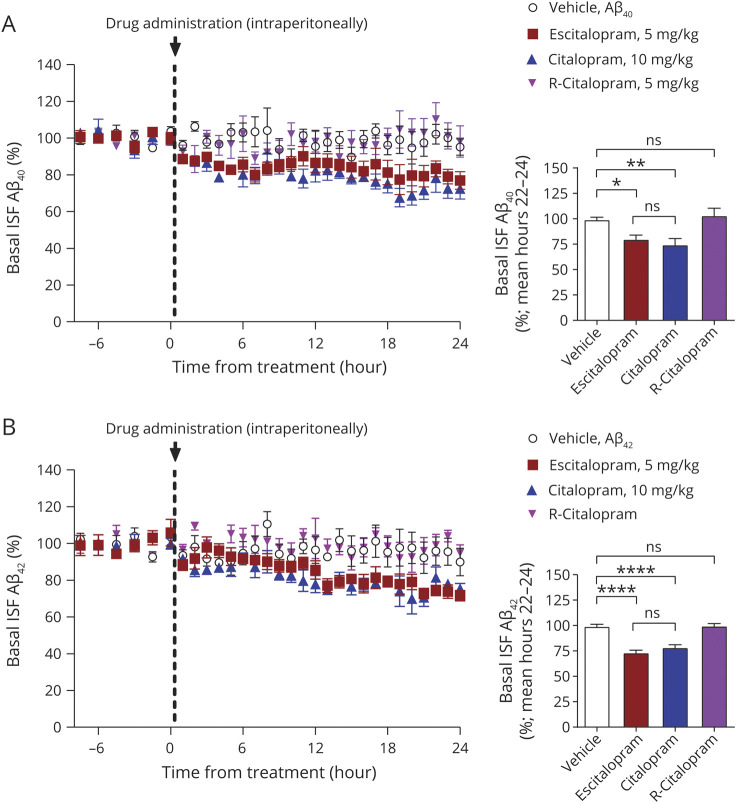
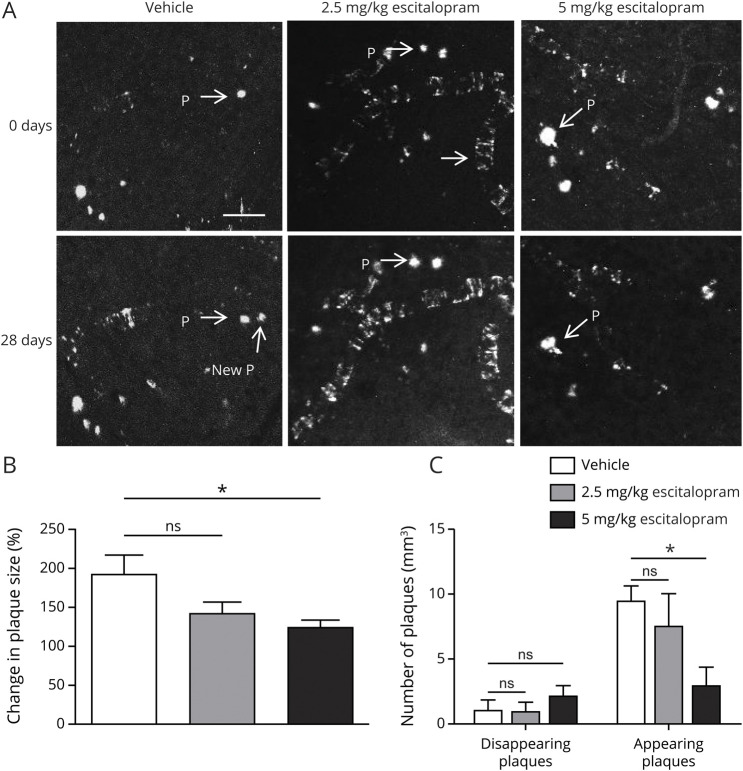
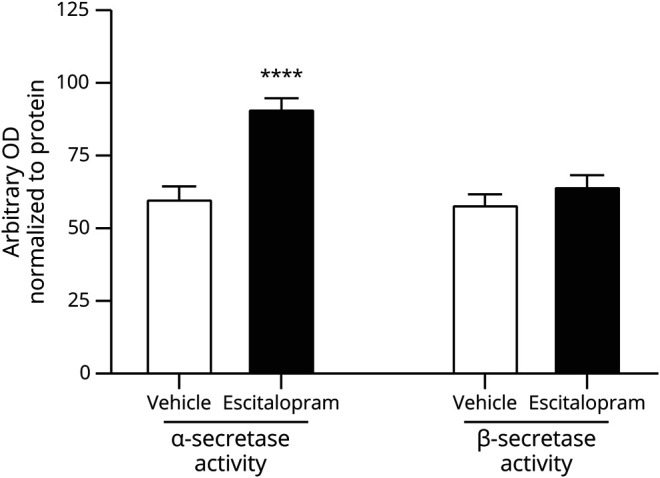
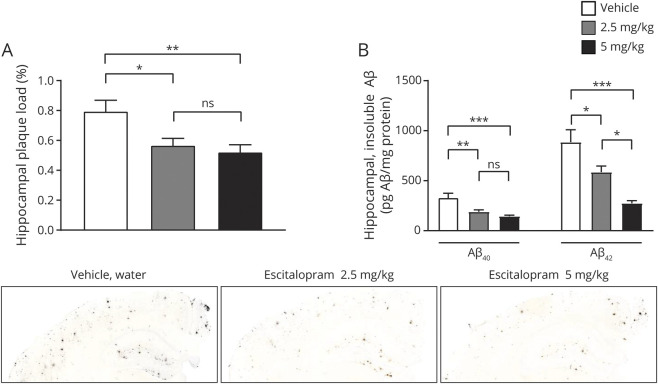
Escitalopram acutely reduced ISF Aβ by 25% by increasing α-secretase cleavage of APP. Chronic administration of escitalopram significantly reduced plaque load by 28% and 34% at 2.5 and 5 mg/d, respectively. Escitalopram at 5 mg/kg did not remove existing plaques, but completely arrested individual plaque growth over time.
Escitalopram significantly reduced Aβ in mice, similar to previous findings in humans treated with acute dosing of an SSRI.
几种神经递质受体激活信号通路,改变淀粉样前体蛋白(APP)转化为β-淀粉样蛋白(Aβ)的过程。通过一组特定的血清素受体传递的血清素信号抑制 Aβ的产生。我们提出,作为最特异的选择性血清素再摄取抑制剂(SSRI),抑制血清素转运体 SERT 的艾司西酞普兰,将会降低小鼠体内的 Aβ水平。
我们假设艾司西酞普兰的急性治疗会减少 Aβ的产生,这将在慢性期通过 Aβ斑块负荷的显著减少来反映。
我们通过体内微透析和体内双光子成像,分别评估了阿尔茨海默病 APP/presenilin1 小鼠模型中脑间质液(ISF)Aβ和 Aβ斑块大小随时间的变化,该模型接受了 vehicle 或艾司西酞普兰的治疗。我们还对慢性接受艾司西酞普兰治疗的小鼠进行了组织学研究,以确定其对斑块的影响。
艾司西酞普兰通过增加 APP 的α-分泌酶切割,急性降低了 25%的 ISF Aβ。慢性艾司西酞普兰治疗分别使斑块负荷降低了 28%和 34%,剂量为 2.5 和 5mg/d。5mg/kg 的艾司西酞普兰不会去除现有的斑块,但随着时间的推移,会完全阻止单个斑块的生长。
艾司西酞普兰显著降低了小鼠体内的 Aβ,与之前人类接受 SSRI 急性治疗的研究结果相似。