Department of Haematology, Oxford University Hospitals, Oxford, United Kingdom.
University of Oxford Medical School, Oxford, United Kingdom.
Blood Adv. 2020 Sep 22;4(18):4337-4346. doi: 10.1182/bloodadvances.2020002553.
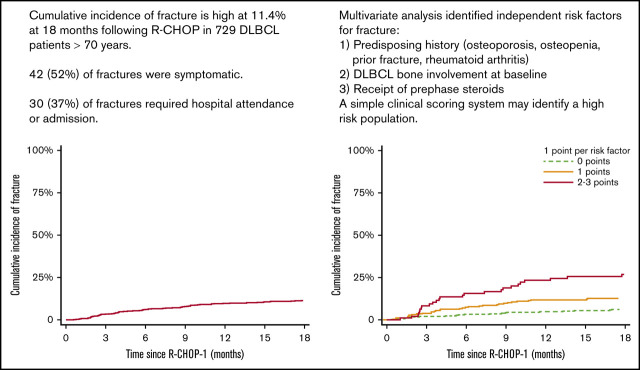
Diffuse large B-cell lymphoma (DLBCL) and osteoporotic fracture are both more common in older patients. Exposure to R-CHOP (rituximab, cyclophosphamide, doxorubicin, vincristine, and prednisolone) is likely to increase the risk of fracture, but evidence is lacking to define fracture incidence in this group. Data on consecutive patients with DLBCL aged ≥70 years treated with 1 to 8 cycles of full or attenuated R-CHOP were retrospectively collected across 10 UK centers (2009-2019). Patients were followed up from starting R-CHOP for a minimum of 6 months and censored at 18 months; at last follow-up if <18 months; or at progression or death. Of 877 patients identified, 148 were excluded: 121 had progression or died before 6 months; 23 had follow-up <6 months. Across 729 remaining patients, the median age was 77 years, and 68% had an Eastern Cooperative Oncology Group performance status of 0 to 1. Eighty-one fractures occurred within 18 months of follow-up; 42 were symptomatic, including 30 requiring hospital attendance or admission. The cumulative fracture incidence was 6.2% (95% confidence interval [CI], 4.7-8.2) at 6 months; 9.7% (95% CI, 7.8-12.1) at 12 months; and 11.4% (95% CI, 9.3-14.0) at 18 months. Multivariate analysis identified a predisposing history (osteoporosis, osteopenia, prior fracture, and rheumatoid arthritis [RhA]), DLBCL bone involvement at baseline, and receipt of prephase steroids as independent risk factors for fracture. There is a clinically relevant fracture risk and significant associated morbidity in older patients receiving R-CHOP. Careful attention to bone health is warranted in older patients receiving R-CHOP. Randomized studies are required to better define the most effective strategies to reduce fracture risk.
弥漫性大 B 细胞淋巴瘤 (DLBCL) 和骨质疏松性骨折在老年患者中更为常见。接受 R-CHOP(利妥昔单抗、环磷酰胺、多柔比星、长春新碱和泼尼松)治疗可能会增加骨折风险,但缺乏该人群骨折发生率的证据。在 10 个英国中心(2009-2019 年),回顾性收集了年龄≥70 岁、接受 1 至 8 个周期全剂量或减剂量 R-CHOP 治疗的连续 DLBCL 患者的数据。患者从开始 R-CHOP 治疗开始至少随访 6 个月,随访时间在 18 个月时截止;如果随访时间<18 个月,则在最后一次随访时截止;或在进展或死亡时截止。在确定的 877 例患者中,排除了 148 例:121 例在 6 个月前进展或死亡;23 例随访时间<6 个月。在剩余的 729 例患者中,中位年龄为 77 岁,68%的患者东部肿瘤协作组体能状态评分为 0-1。在随访的 18 个月内发生了 81 例骨折;42 例有症状,其中 30 例需要就诊或住院治疗。6 个月时累积骨折发生率为 6.2%(95%置信区间,4.7-8.2);12 个月时为 9.7%(95%置信区间,7.8-12.1);18 个月时为 11.4%(95%置信区间,9.3-14.0)。多变量分析确定了易患病史(骨质疏松症、骨量减少、既往骨折和类风湿关节炎[RhA])、基线时 DLBCL 骨骼受累以及接受预治疗类固醇为骨折的独立危险因素。在接受 R-CHOP 治疗的老年患者中,存在明显的临床相关骨折风险和较高的相关发病率。在接受 R-CHOP 治疗的老年患者中,应谨慎关注骨骼健康。需要进行随机研究以更好地确定降低骨折风险的最有效策略。