Department of Internal Medicine, Kudanzaka Hospital, Company Overview of Federation of National Public Service Personnel Mutual Aid Associations, Chiyoda-ku, Tokyo, Japan.
Department of Preventive Medicine and Public Health, School of Medicine, Keio University, Shinjuku-ku, Tokyo, Japan.
PLoS One. 2020 Sep 11;15(9):e0238723. doi: 10.1371/journal.pone.0238723. eCollection 2020.
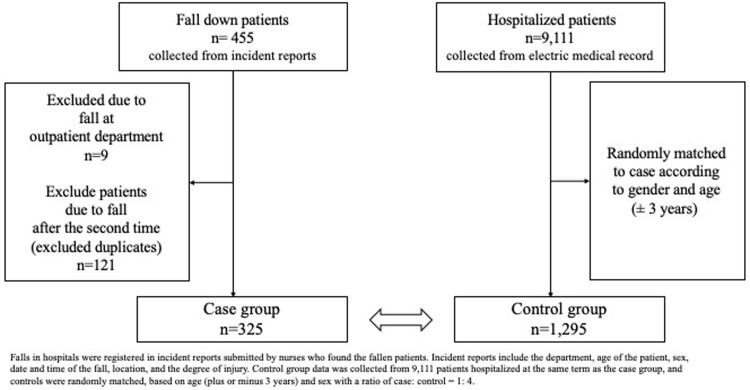
The aim of this study was to examine the risk of falls associated with the use of non-gamma amino butyric acid (GABA) sleep medications, suvorexant and ramelteon. This case-control and case-crossover study was performed at the Kudanzaka Hospital, Chiyoda Ward, Tokyo. A total of 325 patients who had falls and 1295 controls matched by sex and age were included. The inclusion criteria for the case group were hospitalized patients who had their first fall and that for the control were patients who were hospitalized and did not have a fall, between January 2016 and November 2018. The internal sleep medications administered were classified as suvorexant, ramelteon, non-benzodiazepines, benzodiazepines, or kampo. In the case-control study, age, sex, clinical department, the fall down risk score, and hospitalized duration were adjusted in the logistic regression model. In the case-control study, multivariable logistic regression showed that the use of suvorexant (odds ratio [OR]: 2.61, 95% confidence interval [CI]: 1.29-5.28), nonbenzodiazepines (OR: 2.49, 95% CI: 1.73-3.59), and benzodiazepines (OR: 1.65, 95% CI: 1.16-2.34) was significantly associated with an increased OR of falls. However, the use of ramelteon (OR: 1.40, 95% CI: 0.60-3.16) and kampo (OR: 1.55, 95% CI: 0.75-3.19) was not significantly associated with an increased OR of falls. In the case-crossover study, the use of suvorexant (OR: 1.78, 95% CI: 1.05-3.00) and nonbenzodiazepines (OR: 1.63, 95% CI: 1.17-2.27) was significantly associated with an increased OR of falls. Similar patterns were observed in several sensitivity analyses. It was suggested that suvorexant increases the OR of falls. This result is robust in various analyses. This study showed that the risk of falls also exists for non-GABA sleep medication, suvorexant, and thus it is necessary to carefully prescribe hypnotic drugs under appropriate assessment.
本研究旨在探讨非γ-氨基丁酸(GABA)类助眠药物苏沃雷生和雷美尔酮与跌倒风险的关系。该病例对照和病例交叉研究在东京都千代田区九段南的九段坂医院进行。共纳入 2016 年 1 月至 2018 年 11 月期间首次跌倒的 325 例患者(病例组)和按性别和年龄匹配的 1295 例对照。病例组纳入标准为住院患者首次跌倒,对照组为住院且未跌倒的患者。纳入的内部助眠药物分为苏沃雷生、雷美尔酮、非苯二氮䓬类、苯二氮䓬类和汉方药。在病例对照研究中,采用 logistic 回归模型调整年龄、性别、临床科室、跌倒风险评分和住院时间。在病例对照研究中,多变量 logistic 回归显示,使用苏沃雷生(比值比 [OR]:2.61,95%置信区间 [CI]:1.29-5.28)、非苯二氮䓬类(OR:2.49,95%CI:1.73-3.59)和苯二氮䓬类(OR:1.65,95%CI:1.16-2.34)与跌倒的 OR 增加显著相关。然而,雷美尔酮(OR:1.40,95%CI:0.60-3.16)和汉方药(OR:1.55,95%CI:0.75-3.19)的使用与跌倒的 OR 增加无显著相关性。在病例交叉研究中,使用苏沃雷生(OR:1.78,95%CI:1.05-3.00)和非苯二氮䓬类(OR:1.63,95%CI:1.17-2.27)与跌倒的 OR 增加显著相关。在几次敏感性分析中也观察到类似的模式。结果提示苏沃雷生增加了跌倒的 OR。该结果在各种分析中均稳健。本研究表明,非 GABA 类助眠药物苏沃雷生也存在跌倒风险,因此需要在适当评估的基础上谨慎开具催眠药物。