Ahn Jungryul, Phan Huu Lam, Cha Seongkwang, Koo Kyo-In, Yoo Yongseok, Goo Yong Sook
Department of Physiology, Chungbuk National University School of Medicine, Cheongju 28644, Korea.
Department of Biomedical Engineering, University of Ulsan, Ulsan 44610, Korea.
Exp Neurobiol. 2020 Aug 31;29(4):285-299. doi: 10.5607/en20025.
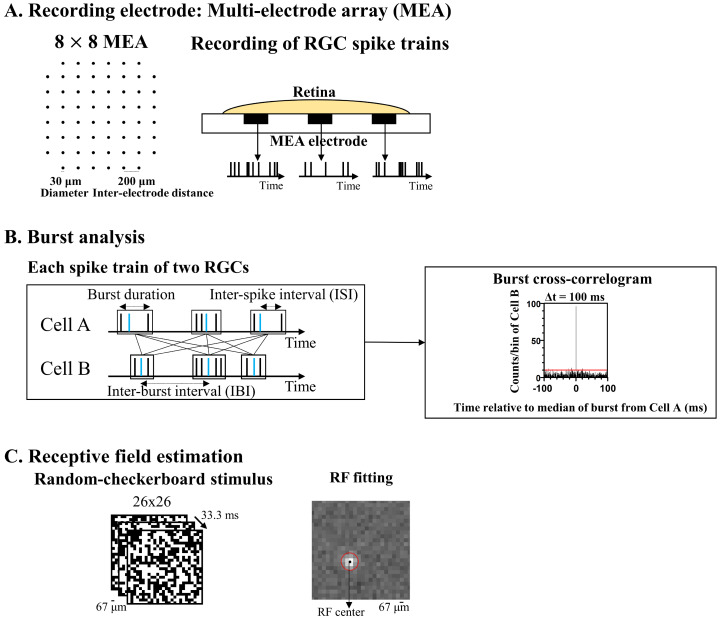
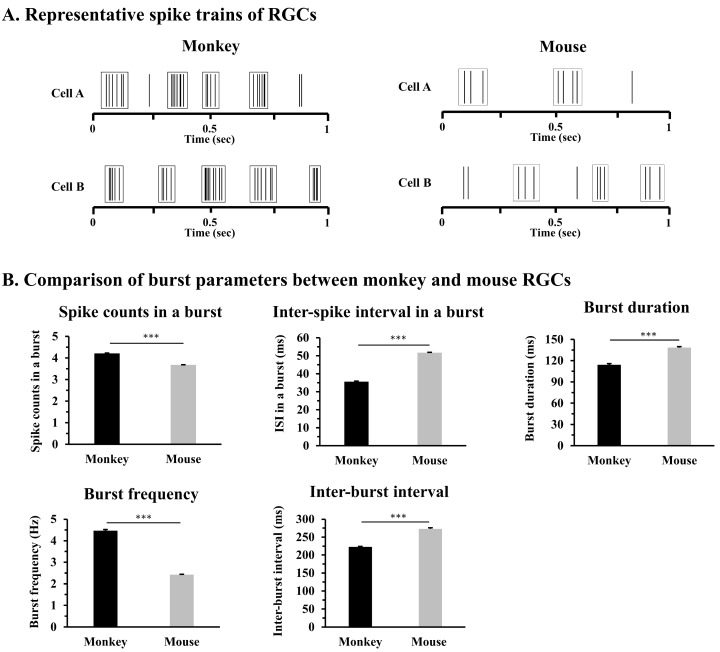
Neurons communicate with other neurons in response to environmental changes. Their goal is to transmit information to their targets reliably. A burst, which consists of multiple spikes within a short time interval, plays an essential role in enhancing the reliability of information transmission through synapses. In the visual system, retinal ganglion cells (RGCs), the output neurons of the retina, show bursting activity and transmit retinal information to the lateral geniculate neuron of the thalamus. In this study, to extend our interest to the population level, the burstings of multiple RGCs were simultaneously recorded using a multi-channel recording system. As the first step in network analysis, we focused on investigating the pairwise burst correlation between two RGCs. Furthermore, to assess if the population bursting is preserved across species, we compared the synchronized bursting of RGCs between marmoset monkey (callithrix jacchus), one species of the new world monkeys and mouse (C57BL/6J strain). First, monkey RGCs showed a larger number of spikes within a burst, while the inter-spike interval, burst duration, and inter-burst interval were smaller compared with mouse RGCs. Monkey RGCs showed a strong burst synchronization between RGCs, whereas mouse RGCs showed no correlated burst firing. Monkey RGC pairs showed significantly higher burst synchrony and mutual information than mouse RGC pairs did. Comprehensively, through this study, we emphasize that two species have a different bursting activity of RGCs and different burst synchronization suggesting two species have distinctive retinal processing.
神经元会根据环境变化与其他神经元进行通信。它们的目标是将信息可靠地传输到其靶标。一个爆发,即在短时间间隔内由多个尖峰组成,在提高通过突触的信息传输可靠性方面起着至关重要的作用。在视觉系统中,视网膜神经节细胞(RGCs)是视网膜的输出神经元,表现出爆发活动并将视网膜信息传输到丘脑的外侧膝状神经元。在本研究中,为了将我们的兴趣扩展到群体水平,使用多通道记录系统同时记录多个RGCs的爆发。作为网络分析的第一步,我们专注于研究两个RGCs之间的成对爆发相关性。此外,为了评估群体爆发是否在不同物种中得以保留,我们比较了新世界猴之一的狨猴(绢毛猴)和小鼠(C57BL/6J品系)的RGCs的同步爆发。首先,与小鼠RGCs相比,猴RGCs在一次爆发中显示出更多的尖峰,而峰间间隔、爆发持续时间和爆发间隔则更小。猴RGCs在RGCs之间表现出强烈的爆发同步性,而小鼠RGCs则没有相关的爆发放电。猴RGC对显示出比小鼠RGC对显著更高的爆发同步性和互信息。综合来看,通过这项研究,我们强调两个物种的RGCs具有不同的爆发活动和不同的爆发同步性,这表明两个物种具有独特的视网膜处理方式。