Department of Translational Medical Sciences, Pediatric Section, Federico II University of Naples, Naples, Italy.
Front Immunol. 2020 Aug 14;11:1837. doi: 10.3389/fimmu.2020.01837. eCollection 2020.
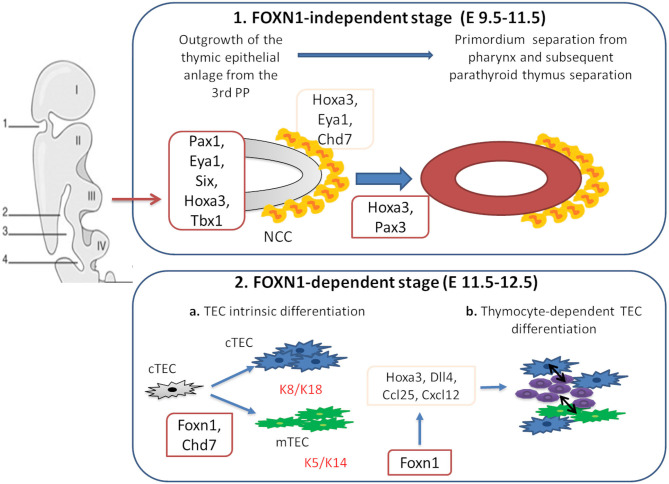
Combined Immunodeficiencies (CID) are rare congenital disorders characterized by defective T-cell development that may be associated with B- and NK-cell deficiency. They are usually due to alterations in genes expressed in hematopoietic precursors but in few cases, they are caused by impaired thymic development. Athymia was classically associated with DiGeorge Syndrome due to gene haploinsufficiency. Other genes, implicated in thymic organogenesis include , associated with Nude SCID syndrome, , associated with Otofaciocervical Syndrome type 2, and , one of the genes implicated in CHARGE syndrome. More recently, chromosome 2p11.2 microdeletion, causing haploinsufficiency, has been identified in 5 families with impaired thymus development. In this review, we will summarize the main genetic, clinical, and immunological features related to the abovementioned gene mutations. We will also focus on different therapeutic approaches to treat SCID in these patients.
联合免疫缺陷病(CID)是一种罕见的先天性疾病,其特征是 T 细胞发育缺陷,可能伴有 B 细胞和 NK 细胞缺陷。它们通常是由于造血前体细胞中表达的基因突变引起的,但在少数情况下,它们是由胸腺发育受损引起的。无胸腺通常与由于 基因单倍体不足引起的 DiGeorge 综合征相关。其他参与胸腺器官发生的基因包括 ,与 Nude SCID 综合征相关; ,与 Otofaciocervical 综合征 2 型相关; ,是 CHARGE 综合征相关基因之一。最近,在 5 个存在胸腺发育障碍的家族中发现了染色体 2p11.2 微缺失,导致 基因单倍体不足。在这篇综述中,我们将总结与上述基因突变相关的主要遗传、临床和免疫学特征。我们还将重点介绍治疗这些患者的 SCID 的不同治疗方法。