Torres Neusa F, Solomon Vernon P, Middleton Lyn E
Higher Institute for Health Sciences (ISCISA). Maputo (Mozambique).
MSc (Clin Psychol). Discipline of Pharmaceutical Sciences School of Health Sciences, University of KwaZulu Natal. Durban (South Africa).
Pharm Pract (Granada). 2020 Jul-Sep;18(3):1965. doi: 10.18549/PharmPract.2020.3.1965. Epub 2020 Aug 18.
Antibiotics are the most frequently used medicines worldwide with most of the countries defining these as prescription-only medicines. Though, dispensing non-prescribed antibiotics represent one of the chief causal factors to the irrational use of antibiotics that paves the way to the development of antimicrobial resistance.
We aimed at describing the practices and the enablers for non-prescribed antibiotic dispensing in Maputo city, Mozambique.
A qualitative study was conducted, between October 2018 and March 2019, in nine private pharmacies randomly selected across Maputo city. Eighteen pharmacists were contacted and seventeen enrolled through snowball sampling. In-depth interviews were conducted, audiotaped, and transcribed verbatim. Transcripts were coded and analysed though thematic analysis with guidelines from Braun and Clark. The Consolidated Criteria for Reporting Qualitative Studies (COREQ) checklist by (Tong, 2007) was performed.
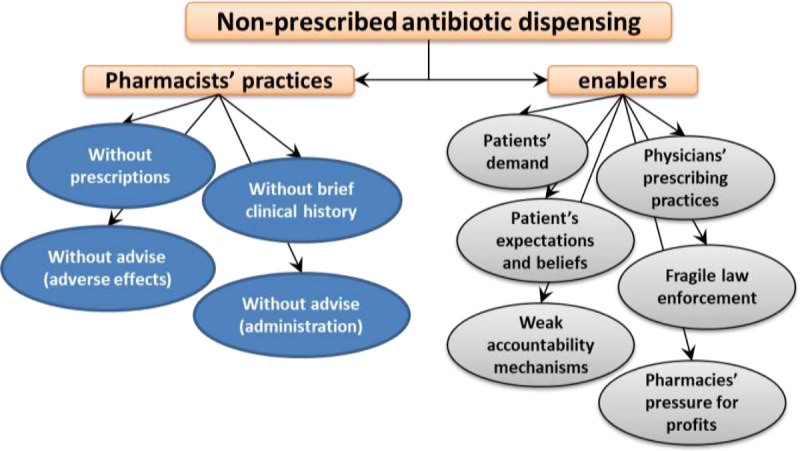
Out of seventeen, fifteen pharmacists admitted non-prescribed dispensing of antibiotics. Common antibiotic dispensing practices included; dispensing without prescription, without asking for a brief clinical history of patients, without clear explanation of the appropriate way of administering, without advising on the side effects. Reasons for non-prescribed antibiotic dispensing are linked to patients' behaviour of demanding for non-prescribed antibiotics, to the patients expectations and beliefs on the healing power of antibiotics, to the physicians' prescribing practices. Other reasons included the pressure for profits from the pharmacy owners, the fragile law enforcement, and absence of accountability mechanisms.
The practices of non-prescribed antibiotic dispensing characterize the 'daily life' of the pharmacists. On the one hand, the patient's demand for antibiotics without valid prescriptions, and pharmacist's wish to assist based on their role in the pharmacy, the pressure for profits and on the understanding of the larger forces driving the practices of self-medication with antibiotics - rock. On the other hand, pharmacists are aware of the legal status of antibiotics and the public health consequences of their inappropriate dispensing practices and their professional and ethical responsibility for upholding the law - hard place. Highlighting the role of pharmacists and their skills as health promotion professionals is needed to optimizing antibiotic dispensing and better conservancy in Mozambique.
抗生素是全球使用最频繁的药物,大多数国家将其定义为仅凭处方使用的药物。然而,配给非处方抗生素是抗生素不合理使用的主要原因之一,这为抗菌药物耐药性的发展铺平了道路。
我们旨在描述莫桑比克马普托市非处方抗生素配给的做法和促成因素。
2018年10月至2019年3月期间,在马普托市随机选择的9家私人药店进行了一项定性研究。联系了18名药剂师,通过滚雪球抽样法招募了17名。进行了深入访谈,录音并逐字转录。根据布劳恩和克拉克的指导方针,通过主题分析对转录本进行编码和分析。采用了汤(2007年)的定性研究报告综合标准(COREQ)清单。
在17名药剂师中,有15名承认非处方配给抗生素。常见的抗生素配给做法包括:无处方配给、不询问患者简要临床病史、未清楚解释正确的给药方式、未告知副作用。非处方抗生素配给的原因与患者要求非处方抗生素的行为、患者对抗生素治疗效果的期望和信念、医生的处方习惯有关。其他原因包括药店老板的盈利压力、执法不力以及缺乏问责机制。
非处方抗生素配给做法是药剂师“日常生活”的特征。一方面,患者无有效处方要求使用抗生素,药剂师基于其在药店中的角色希望提供帮助、盈利压力以及对推动抗生素自我药疗做法的更大力量的理解——形成了困境。另一方面,药剂师意识到抗生素的法律地位以及其不当配给做法对公共卫生的影响,以及他们维护法律的专业和道德责任——处于艰难境地。需要突出药剂师的作用及其作为健康促进专业人员的技能,以优化莫桑比克的抗生素配给并更好地进行管理。