Wang Miao, Liu Jing, Bellows Brandon K, Qi Yue, Sun Jiayi, Liu Jun, Moran Andrew E, Zhao Dong
Department of Epidemiology, Beijing Anzhen Hospital, Capital Medical University, Beijing Institute of Heart, Lung and Blood Vessel Diseases, Beijing, CN.
The Key Laboratory of Remodeling-Related Cardiovascular Diseases, Ministry of Education, Beijing, CN.
Glob Heart. 2020 Jun 25;15(1):43. doi: 10.5334/gh.830.
Statin medications reduce the risk of atherosclerotic cardiovascular disease (ASCVD). China's new central government medicine procurement policy lowered statin prices by five-fold or more, which may impact the cost-effectiveness of statin therapy.
To explore the impact of China's 2019 centralized medicine procurement policy on the cost-effectiveness of statins treatment for primary ASCVD prevention.
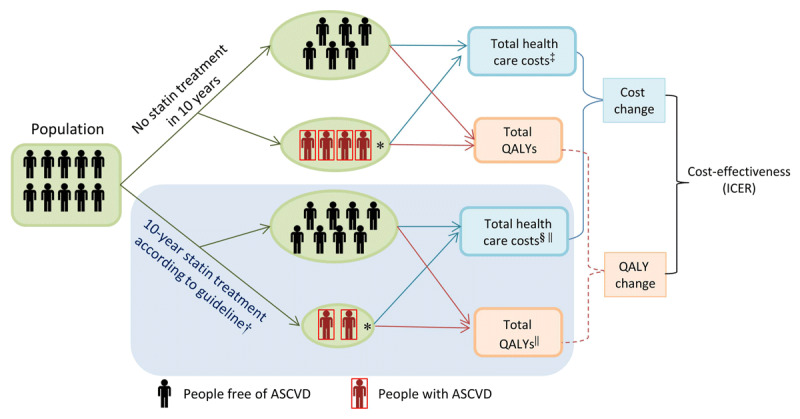
A microsimulation decision tree analytic model was built using individual participant data from ASCVD-free adults aged 35-64 years (n = 21,265) in the China Multi-provincial Cohort Study. ASCVD incidence, costs (2019 Int$), and quality-adjusted life years (QALYs) over a 10-year period from health-care sector and societal perspectives were estimated. Effect and cost-effectiveness of low-dose statins (equivalent potency regimens of simvastatin 20 mg/day, atorvastatin 10 mg/day, or rosuvastatin 5 mg/day) and moderate-dose (double low dose) statins therapy were simulated. The incremental cost-effectiveness ratio (ICER) of statin treatment was compared with no treatment by category of 10-year ASCVD risk. New lower prices of statins were from the centralized procurement policy bid-winning announcement file. One-way and probabilistic sensitivity analyses quantified model uncertainty.
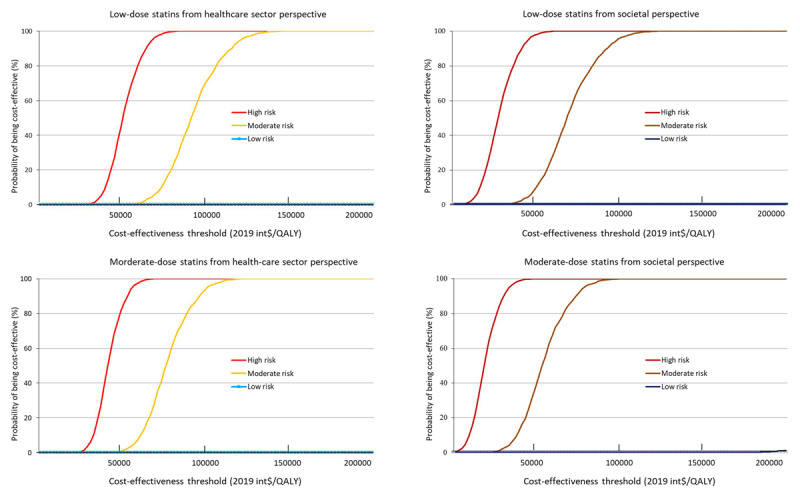
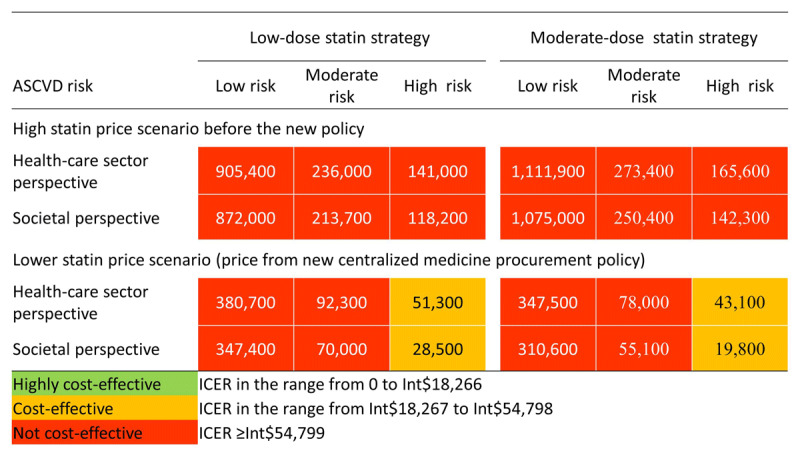
Low-dose statins interventions reduced 10-year ASCVD incidence by 4.1%, 9.7%, and 15.5% among people with low, moderate, and high risk comparing to no treatment. Lowering statin prices to the 2019 central government procurement policy level could lower the ICER of low-dose statins treatment for high-risk people from Int$ 141,000 to Int$ 51,300 per QALY gained from health-care sector perspective. Moderate-dose statin treatment lowered the ICER compared with the low-dose statins treatment in each ASCVD risk category (Int$ 43,100 vs. Int$ 51,300 per QALY gained from the health-care sector perspective for high risk people). Cost-effectiveness improved progressively with increased baseline ASCVD risk.
Implementing low central government prices will substantially improve the cost-effectiveness of statins for primary ASCVD prevention in 35-64-year-old Chinese adults.
他汀类药物可降低动脉粥样硬化性心血管疾病(ASCVD)的风险。中国新的中央政府药品采购政策使他汀类药物价格降低了五倍或更多,这可能会影响他汀类药物治疗的成本效益。
探讨中国2019年集中药品采购政策对他汀类药物治疗原发性ASCVD预防成本效益的影响。
使用中国多省队列研究中35-64岁无ASCVD成年人(n = 21,265)的个体参与者数据建立微观模拟决策树分析模型。从医疗保健部门和社会角度估计了10年内的ASCVD发病率、成本(2019国际美元)和质量调整生命年(QALY)。模拟了低剂量他汀类药物(辛伐他汀20毫克/天、阿托伐他汀10毫克/天或瑞舒伐他汀5毫克/天的等效效价方案)和中等剂量(低剂量加倍)他汀类药物治疗的效果和成本效益。根据10年ASCVD风险类别,将他汀类药物治疗的增量成本效益比(ICER)与未治疗进行比较。他汀类药物的新低价来自集中采购政策中标公告文件。单向和概率敏感性分析量化了模型的不确定性。
与未治疗相比,低剂量他汀类药物干预使低、中、高风险人群的10年ASCVD发病率分别降低了4.1%、9.7%和15.5%。将他汀类药物价格降至2019年中央政府采购政策水平,可使医疗保健部门视角下高危人群低剂量他汀类药物治疗的ICER从每获得一个QALY 141,000国际美元降至51,300国际美元。在每个ASCVD风险类别中,中等剂量他汀类药物治疗的ICER低于低剂量他汀类药物治疗(从医疗保健部门视角看,高危人群每获得一个QALY分别为43,100国际美元和51,300国际美元)。随着基线ASCVD风险增加,成本效益逐渐提高。
实施中央政府的低价政策将大幅提高他汀类药物对35-64岁中国成年人原发性ASCVD预防的成本效益。