Ma Li, Yang Ruixue, Gu Jingxiang, Jiang Hao, Li Hongwei
Department of Pathology.
Department of Pathology, Bengbu Medical University.
Medicine (Baltimore). 2020 Sep 11;99(37):e22173. doi: 10.1097/MD.0000000000022173.
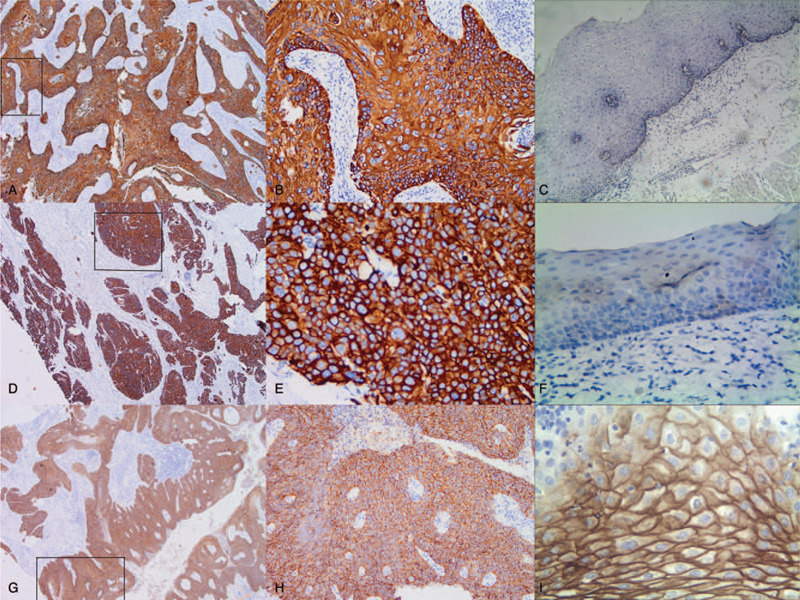
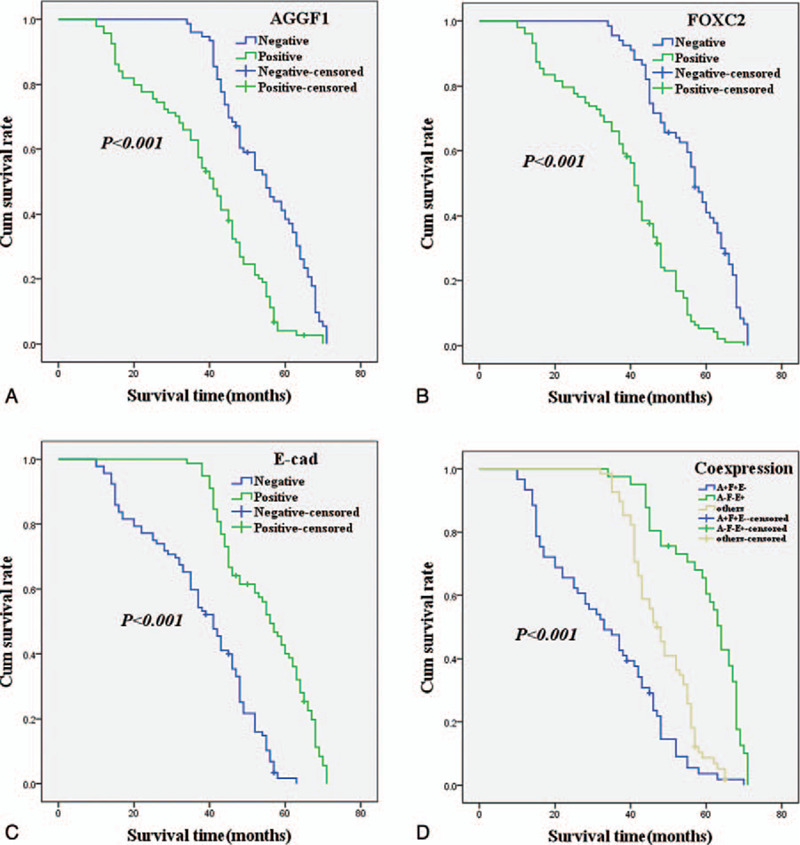
Angiogenic factor with G-patch and FHA domain 1 (AGGF1) is a newly initiator of angiogenesis. Forkhead box C2 (FOXC2) that is a member of the winged spiral transcription factor family plays an important role in epithelial-mesenchymal transition (EMT). Epithelial-cadherin (E-cad) that is an adhesion molecule is also involved in EMT. The purpose of this study is to investigate the expression of AGGF1, FOXC2, and E-cad in esophageal squamous cell carcinoma (ESCC) and their clinical significance.Immunohistochemistry was performed to investigate the expression of AGGF1, FOXC2, and E-cad in 170 ESCC specimens and corresponding normal esophageal mucosa tissues. Follow-up data was also collected.The positive rates of AGGF1 and FOXC2 expression were significantly higher in ESCC group when compared with the control group; the positive rate of E-cad expression was significantly lower in ESCC group when compared with the control group. Positive rates of AGGF1, FOXC2, and E-cad expression were significantly associated with grades of differentiation, tumor grades, lymph node metastasis stages, as well as tumor-node-metastasis stages. Kaplan-Meier analysis demonstrated that positive expression of AGGF1 or FOXC2 for ESCC patients had significantly unfavorably overall survival time when compared with patients with negative expression of AGGF1 or FOXC2; and positive expression of E-cad for ESCC patients had significantly longer overall survival time when compared with patients with negative expression of E-cad. Multivariate analysis indicated that AGGF1, FOXC2, and E-cad expression and tumor-node-metastasis stages were postoperative independent prognostic factors for ESCC patients.AGGF1, FOXC2, and E-cad may be considered promising biomarkers of ESCC patients' prognosis.
含G-结构域和FHA结构域的血管生成因子1(AGGF1)是一种新的血管生成启动因子。叉头框C2(FOXC2)是翼状螺旋转录因子家族的成员,在上皮-间质转化(EMT)中起重要作用。上皮钙黏蛋白(E-cad)作为一种黏附分子也参与EMT。本研究旨在探讨AGGF1、FOXC2和E-cad在食管鳞状细胞癌(ESCC)中的表达及其临床意义。
采用免疫组织化学法检测170例ESCC标本及相应正常食管黏膜组织中AGGF1、FOXC2和E-cad的表达情况,并收集随访数据。
与对照组相比,ESCC组中AGGF1和FOXC2的阳性表达率显著更高;与对照组相比,ESCC组中E-cad的阳性表达率显著更低。AGGF1、FOXC2和E-cad的阳性表达率与分化程度、肿瘤分级、淋巴结转移分期以及肿瘤-淋巴结-转移分期显著相关。Kaplan-Meier分析表明,与AGGF1或FOXC2阴性表达的患者相比,ESCC患者中AGGF1或FOXC2阳性表达的总生存时间显著更差;与E-cad阴性表达的患者相比,ESCC患者中E-cad阳性表达的总生存时间显著更长。多因素分析表明,AGGF1、FOXC2和E-cad的表达以及肿瘤-淋巴结-转移分期是ESCC患者术后独立的预后因素。
AGGF1、FOXC2和E-cad可被视为ESCC患者预后有前景的生物标志物。