
紊乱的对接复合物是酵母 Abp1p SH3 结构域结合途径的核心。
A disordered encounter complex is central to the yeast Abp1p SH3 domain binding pathway.
机构信息
Department of Chemistry, Skidmore College, Saratoga Springs, New York, United States.
School of Life Sciences, University of Liverpool, Liverpool, United Kingdom.
出版信息
PLoS Comput Biol. 2020 Sep 14;16(9):e1007815. doi: 10.1371/journal.pcbi.1007815. eCollection 2020 Sep.
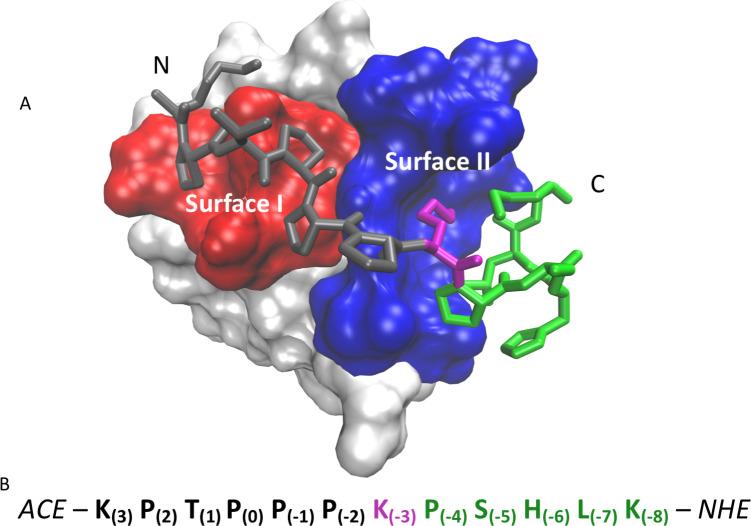
Protein-protein interactions are involved in a wide range of cellular processes. These interactions often involve intrinsically disordered proteins (IDPs) and protein binding domains. However, the details of IDP binding pathways are hard to characterize using experimental approaches, which can rarely capture intermediate states present at low populations. SH3 domains are common protein interaction domains that typically bind proline-rich disordered segments and are involved in cell signaling, regulation, and assembly. We hypothesized, given the flexibility of SH3 binding peptides, that their binding pathways include multiple steps important for function. Molecular dynamics simulations were used to characterize the steps of binding between the yeast Abp1p SH3 domain (AbpSH3) and a proline-rich IDP, ArkA. Before binding, the N-terminal segment 1 of ArkA is pre-structured and adopts a polyproline II helix, while segment 2 of ArkA (C-terminal) adopts a 310 helix, but is far less structured than segment 1. As segment 2 interacts with AbpSH3, it becomes more structured, but retains flexibility even in the fully engaged state. Binding simulations reveal that ArkA enters a flexible encounter complex before forming the fully engaged bound complex. In the encounter complex, transient nonspecific hydrophobic and long-range electrostatic contacts form between ArkA and the binding surface of SH3. The encounter complex ensemble includes conformations with segment 1 in both the forward and reverse orientation, suggesting that segment 2 may play a role in stabilizing the correct binding orientation. While the encounter complex forms quickly, the slow step of binding is the transition from the disordered encounter ensemble to the fully engaged state. In this transition, ArkA makes specific contacts with AbpSH3 and buries more hydrophobic surface. Simulating the binding between ApbSH3 and ArkA provides insight into the role of encounter complex intermediates and nonnative hydrophobic interactions for other SH3 domains and IDPs in general.
蛋白质-蛋白质相互作用涉及广泛的细胞过程。这些相互作用通常涉及固有无序蛋白质(IDP)和蛋白质结合域。然而,使用实验方法很难描述 IDP 结合途径的细节,因为这些方法很少能够捕获低丰度存在的中间状态。SH3 结构域是常见的蛋白质相互作用结构域,通常与富含脯氨酸的无序片段结合,并参与细胞信号转导、调节和组装。鉴于 SH3 结合肽的灵活性,我们假设其结合途径包括多个对功能重要的步骤。使用分子动力学模拟来描述酵母 Abp1p SH3 结构域(AbpSH3)与富含脯氨酸的 IDP ArkA 之间的结合步骤。在结合之前,ArkA 的 N 端片段 1 预先形成并采用聚脯氨酸 II 螺旋,而 ArkA 的 C 端片段 2(C 端)采用 310 螺旋,但比片段 1 结构化程度低。当片段 2 与 AbpSH3 相互作用时,它变得更加结构化,但即使在完全结合状态下也保持灵活性。结合模拟表明,ArkA 在形成完全结合的结合复合物之前进入了一个灵活的遇合复合物。在遇合复合物中,ArkA 与 SH3 结合表面之间形成短暂的非特异性疏水性和远程静电接触。遇合复合物集合包括片段 1 正向和反向取向的构象,表明片段 2 可能在稳定正确的结合取向中起作用。虽然遇合复合物形成很快,但结合的缓慢步骤是从无序的遇合集合到完全结合状态的转变。在这个转变中,ArkA 与 AbpSH3 形成特异性接触并埋藏更多的疏水面。模拟 ApbSH3 和 ArkA 之间的结合提供了对其他 SH3 结构域和 IDP 一般的遇合复合物中间体和非天然疏水性相互作用的作用的深入了解。



 Zotero 插件