Department of Orthopedic Trauma, Peking University Fourth School of Clinical Medicine, Beijing Jishuitan Hospital, Beijing, 100035, China.
Department of General Surgery, Peking University Fourth School of Clinical Medicine, Beijing Jishuitan Hospital, Beijing, 100035, China.
BMC Endocr Disord. 2020 Sep 14;20(1):141. doi: 10.1186/s12902-020-00622-4.
Studies have shown that the response of bone mineral density (BMD) to parathyroidectomy for symptomatic primary hyperparathyroidism (PHPT) is heterogeneous and difficult to predict. However, the independent factors affecting BMD in PHPT patients after parathyroidectomy remains limited and inconclusive. This study aimed to explore the independent factors affecting BMD changes in symptomatic PHPT patients after parathyroidectomy.
This study retrospectively analyzed 105 patients with symptomatic PHPT treated at Beijing Jishuitan Hospital between January 2010 and December 2015. The primary outcome was a > 10% increase in BMD at 3 years after parathyroidectomy compared with the preoperative value, whereas the secondary outcomes were BMD changes at various measurement sites.
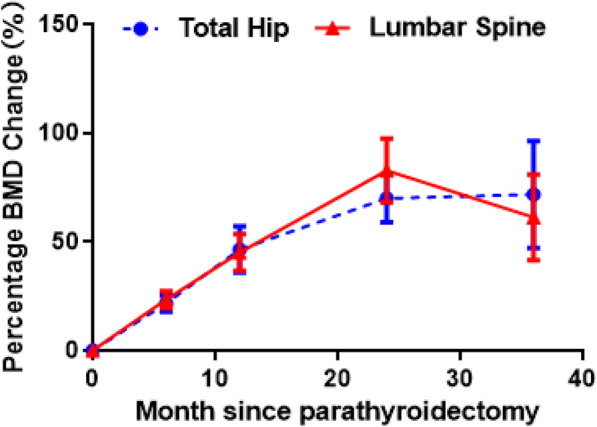
A total of 105 patients with a mean age of 46.37 years were included in this study. Univariate logistic regression analysis indicated that hypertension (odds ratio [OR[: 0.032; 95% confidence interval [CI]: 0.001-0.475; P = 0.012), and parathyroid hormone level (OR: 1.006; 95% CI: 1.004-1.009; P = 0.044) were associated with the > 10% BMD increase. However, these results were not significant after adjustments for potential confounders. Moreover, the BMD values at the lumbar spine, femoral neck, femoral trochanter, Ward's triangle, and whole body after parathyroidectomy were significantly greater than those before the operation (P < 0.05).
This study suggests that patient characteristics were not associated with the > 10% BMD increase. However, the BMD values of the femur and lumbar spine were significantly increased in symptomatic PHPT patients after parathyroidectomy.
研究表明,甲状旁腺切除术治疗有症状的原发性甲状旁腺功能亢进症(PHPT)后骨密度(BMD)的反应具有异质性,难以预测。然而,甲状旁腺切除术后影响 PHPT 患者 BMD 的独立因素仍然有限且尚无定论。本研究旨在探讨甲状旁腺切除术后有症状的 PHPT 患者 BMD 变化的独立影响因素。
本研究回顾性分析了 2010 年 1 月至 2015 年 12 月在北京积水潭医院接受治疗的 105 例有症状的 PHPT 患者。主要结局是与术前相比,甲状旁腺切除术后 3 年内 BMD 增加超过 10%;次要结局是各个测量部位的 BMD 变化。
本研究共纳入 105 例平均年龄为 46.37 岁的患者。单因素逻辑回归分析表明,高血压(比值比[OR]:0.032;95%置信区间[CI]:0.001-0.475;P=0.012)和甲状旁腺激素水平(OR:1.006;95% CI:1.004-1.009;P=0.044)与>BMD 增加 10%有关。然而,在调整了潜在混杂因素后,这些结果并不显著。此外,甲状旁腺切除术后腰椎、股骨颈、股骨粗隆、Ward 三角和全身的 BMD 值均明显高于术前(P<0.05)。
本研究表明,患者特征与>BMD 增加 10%无关。然而,甲状旁腺切除术后有症状的 PHPT 患者的股骨和腰椎 BMD 值显著增加。