Department of Medicine, Vanderbilt University Medical Center, Nashville, TN, United States of America.
Boston University School of Public Health, Boston, MA, United States of America.
PLoS One. 2020 Sep 15;15(9):e0237439. doi: 10.1371/journal.pone.0237439. eCollection 2020.
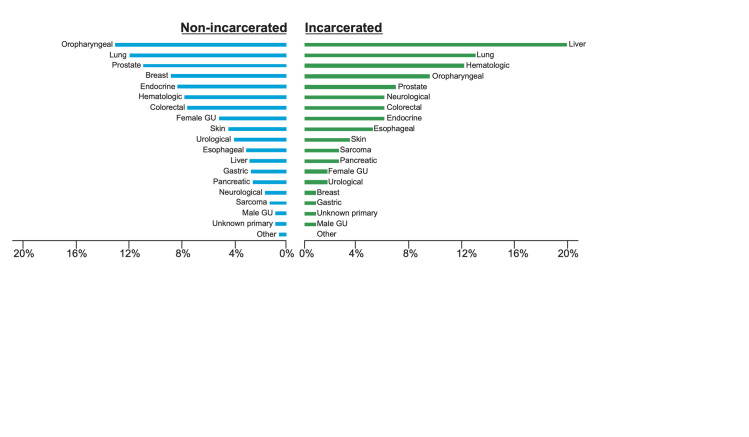
Patients who are incarcerated are a vulnerable patient population and may suffer from less access to routine cancer screenings compared to their non-incarcerated counterparts. Therefore, a thorough evaluation of potential differences in cancer diagnosis staging is needed. We sought to examine whether there are differences in cancer stage at initial diagnosis between non-incarcerated and incarcerated patients by pursuing a retrospective chart review from 2010-2017 for all patients who were newly diagnosed with cancer at an urban safety net hospital. Incarceration status was determined by insurance status. Our primary outcome was incarceration status at time of initial cancer diagnosis. Overall, patients who were incarcerated presented at a later cancer stage for all cancer types compared to the non-incarcerated (+.14 T stage, p = .033; +.23 N stage, p < .001). Incarcerated patients were diagnosed at later stages for colorectal (+0.93 T stage, p < .001; +.48 N stage, p < .001), oropharyngeal (+0.37 N stage, p = .003), lung (+0.60 N stage, p = .018), skin (+0.59 N stage, p = 0.014), and screenable cancers (colorectal, prostate, lung) as a whole (+0.23 T stage, p = 0.002; +0.17 N stage, p = 0.008). Incarcerated patients may benefit from more structured screening protocols in order to improve the stage at presentation for certain malignancies.
被监禁的患者是一个脆弱的患者群体,与未被监禁的患者相比,他们可能较少获得常规癌症筛查。因此,需要对癌症诊断分期的潜在差异进行全面评估。我们试图通过对 2010 年至 2017 年间在城市安全网医院新诊断患有癌症的所有患者进行回顾性图表审查,来研究非监禁和监禁患者在初始诊断时癌症分期是否存在差异。监禁状态由保险状况决定。我们的主要结局是在初始癌症诊断时的监禁状态。总的来说,与非监禁患者相比,所有癌症类型的监禁患者在癌症分期上都更晚(T 分期+.14,p =.033;N 分期+.23,p <.001)。监禁患者的结直肠癌(T 分期 0.93,p <.001;N 分期 0.48,p <.001)、口咽癌(N 分期 0.37,p =.003)、肺癌(N 分期 0.60,p =.018)、皮肤癌(N 分期 0.59,p = 0.014)和可筛查癌症(结直肠癌、前列腺癌、肺癌)的诊断分期都更晚。总的来说,T 分期+0.23,p = 0.002;N 分期+0.17,p = 0.008)。监禁患者可能受益于更结构化的筛查方案,以提高某些恶性肿瘤的就诊分期。