Simons Janice Leahgrace, McKenzie Jessica S, Wright Nicole C, Sheikh Shainela A, Subramaniam Akila, Tita Alan T N, Dionne-Odom Jodie
From the Department of Epidemiology, School of Public Health.
Department of Obstetrics and Gynecology, Division of Maternal-Fetal Medicine, Center for Women's Reproductive Health.
Sex Transm Dis. 2021 Jan;48(1):37-41. doi: 10.1097/OLQ.0000000000001261.
There is a paucity of population-based data on chlamydia in pregnancy despite rising rates in US women. Our objectives were to assess chlamydia prevalence by age group and to identify factors associated with infection in pregnant women to inform screening guidelines.
This cross-sectional study included pregnant women tested for chlamydia who delivered at the University of Alabama at Birmingham between November 1, 2012, and December 31, 2017. The primary outcome was chlamydia prevalence, defined as a positive urogenital chlamydia nucleic acid amplification test result documented in the electronic medical record. Multivariable logistic regression was used to identify factors associated with infection.
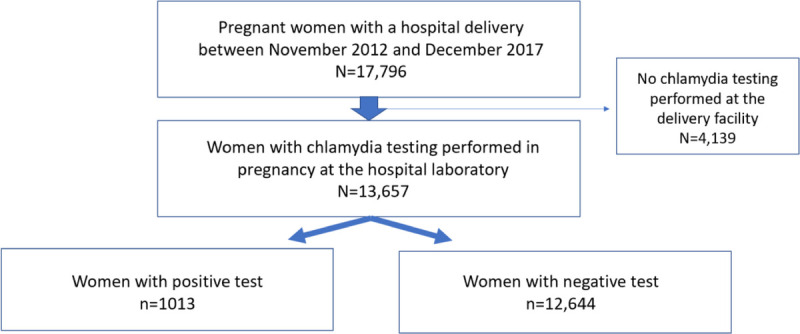
Among 17,796 women who delivered during the study period, 13,657 (77%) had chlamydia testing performed at the University of Alabama at Birmingham. Chlamydia prevalence (95% confidence interval) was 7.4% (7.0%-7.9%). Age-stratified prevalence rates were 14.6%, 4.3%, and 1.7% for women younger than 25 years, 25 to 29 years, and 30 years or older, respectively. Chlamydia in pregnancy remained strongly associated with age (adjusted odds ratio [95% confidence interval], 7.2 [5.6-9.2] for age <25 years, and 2.3 [1.7-3.0] for ages 25-29 years, when compared with >30 years) after adjustment for race, urban residence, and insurance status.
Among pregnant women living in the southeastern United States, chlamydia was detected in 1 of 14 women who were tested. Chlamydia positivity was highest among women younger than 30 years. Study findings support broad screening for chlamydia in pregnancy.
尽管美国女性衣原体感染率不断上升,但基于人群的孕期衣原体感染数据却很匮乏。我们的目标是按年龄组评估衣原体感染率,并确定与孕妇感染相关的因素,以为筛查指南提供依据。
这项横断面研究纳入了2012年11月1日至2017年12月31日期间在阿拉巴马大学伯明翰分校分娩且接受过衣原体检测的孕妇。主要结局为衣原体感染率,定义为电子病历中记录的泌尿生殖系统衣原体核酸扩增检测结果呈阳性。采用多变量逻辑回归分析确定与感染相关的因素。
在研究期间分娩的17796名女性中,有13657名(77%)在阿拉巴马大学伯明翰分校接受了衣原体检测。衣原体感染率(95%置信区间)为7.4%(7.0%-7.9%)。年龄分层的感染率分别为:25岁以下女性为14.6%,25至29岁女性为4.3%,30岁及以上女性为1.7%。在对种族、城市居住情况和保险状况进行调整后,孕期衣原体感染仍与年龄密切相关(调整后的优势比[95%置信区间],年龄<25岁为7.2[5.6-9.2],25-29岁为2.3[1.7-3.0],与>30岁相比)。
在美国东南部的孕妇中,接受检测的女性每14人中就有1人检测出衣原体感染。衣原体阳性率在30岁以下女性中最高。研究结果支持对孕期女性进行广泛的衣原体筛查。