Fostea Raluca Maria, Fontana Elisa, Torga Gonzalo, Arkenau Hendrik-Tobias
Drug Development Unit, Sarah Cannon Research Institute UK, 93 Harley Street, Marylebone, London W1G 6AD, UK.
Cancer Institute, University College London, 72 Huntley Street, Bloomsbury, London WC1E 6DD, UK.
Cancers (Basel). 2020 Sep 11;12(9):2599. doi: 10.3390/cancers12092599.
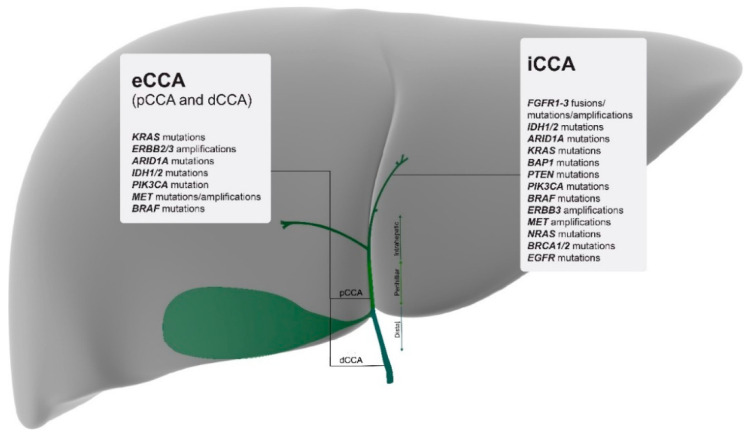
Cholangiocarcinomas (CCAs) comprise of a heterogeneous group of cancers arising in the biliary tract (intrahepatic or iCCA, perihilar or pCCA and distal or dCCA; the latter are known under the collective term of eCCA), each subtype having its own particularities in carcinogenesis, management and prognosis. The increasing incidence in recent decades, limited treatment options and high mortality rates, even in the early stages, have led to an imperious need for more in-depth understanding and development of tailored treatments for this type of aggressive tumour. The wide use of molecular profiling has increased the understanding of biology and identified key molecular drivers, for example, mutations or fusions for iCCA, or mutations in eCCA. Most recently, the FDA approved pemigatinib, an inhibitor and ivosidenib, an inhibitor, but even though progress has been made to better understand the mechanisms of tumorigenesis, genetic make-up, and tumour resistance to standard chemotherapy and targeted therapies, cholangiocarcinomas still represent an important challenge in the daily clinical practice of oncology. The purpose of this review is to highlight the recent progress in the systemic treatment of advanced/metastatic CCAs with a focus on targeted drugs and their biomarkers currently evaluated in early-phase clinical trials.
胆管癌(CCAs)是一组起源于胆道的异质性癌症(肝内胆管癌或iCCA、肝门周围胆管癌或pCCA以及远端胆管癌或dCCA;后者统称为肝外胆管癌[eCCA]),每种亚型在致癌作用、治疗和预后方面都有其自身特点。近几十年来发病率不断上升,治疗选择有限,即使在早期阶段死亡率也很高,这迫切需要更深入地了解并开发针对这类侵袭性肿瘤的个性化治疗方法。分子谱分析的广泛应用增进了对生物学的理解,并确定了关键分子驱动因素,例如,iCCA中的突变或融合,或eCCA中的突变。最近,美国食品药品监督管理局(FDA)批准了培米替尼(一种[具体药物类型1]抑制剂)和艾伏尼布(一种[具体药物类型2]抑制剂),但尽管在更好地理解肿瘤发生机制、基因组成以及肿瘤对标准化疗和靶向治疗的耐药性方面已经取得了进展,但胆管癌在肿瘤学日常临床实践中仍然是一项重大挑战。本综述的目的是强调晚期/转移性CCAs全身治疗的最新进展,重点关注目前在早期临床试验中评估的靶向药物及其生物标志物。