School of Biological Sciences, Victoria University of Wellington, Wellington, New Zealand
Michael Smith Laboratories, University of British Columbia, Vancouver, Canada.
mBio. 2020 Sep 15;11(5):e02068-20. doi: 10.1128/mBio.02068-20.
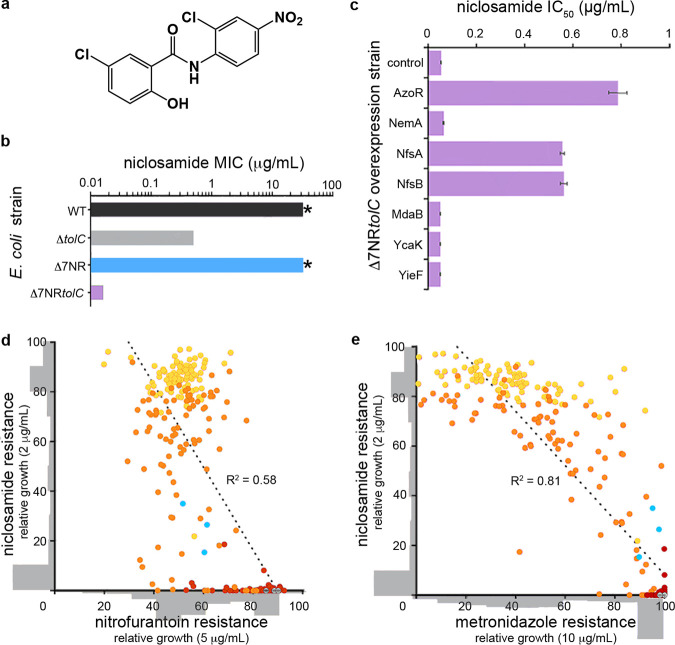
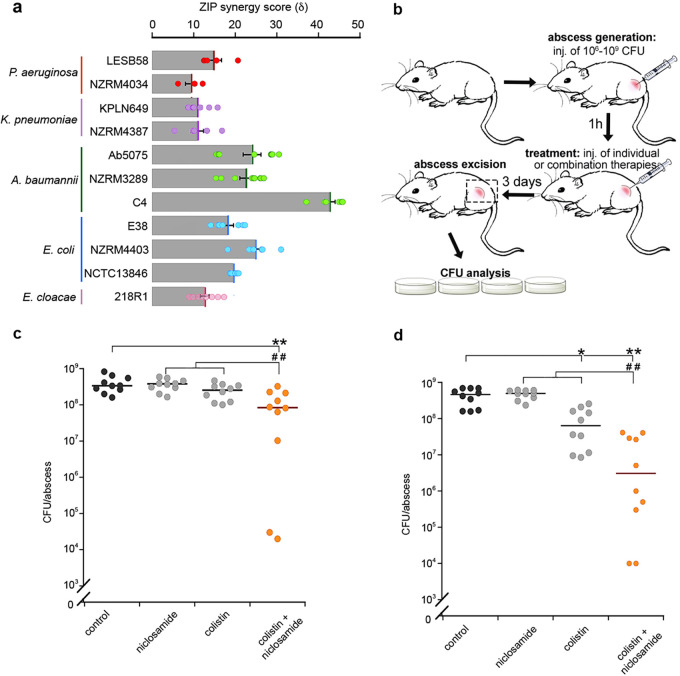
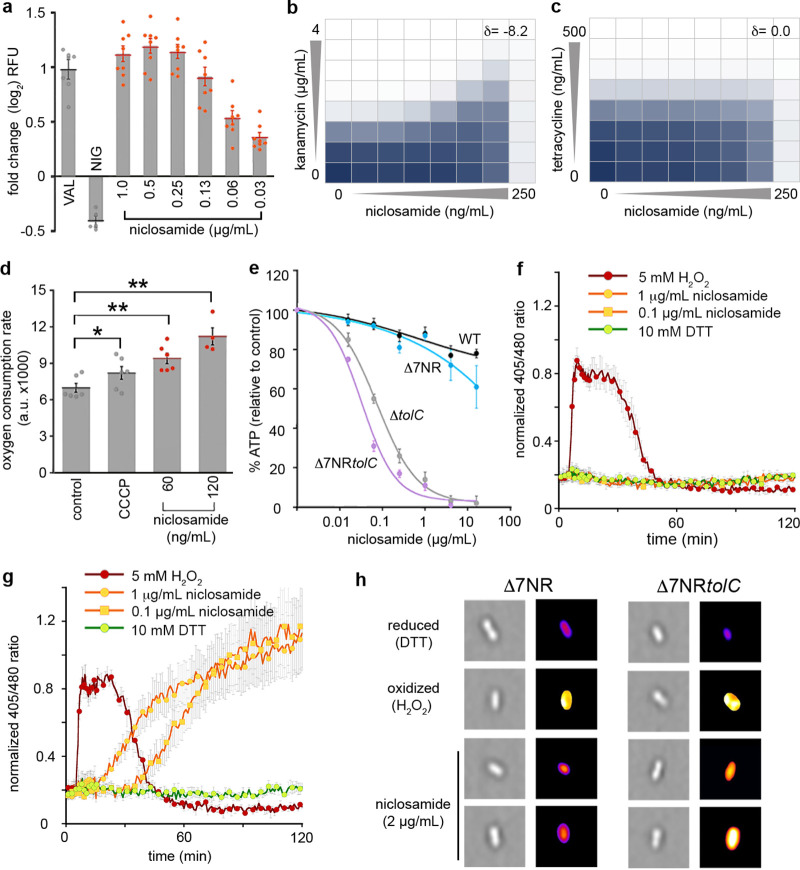
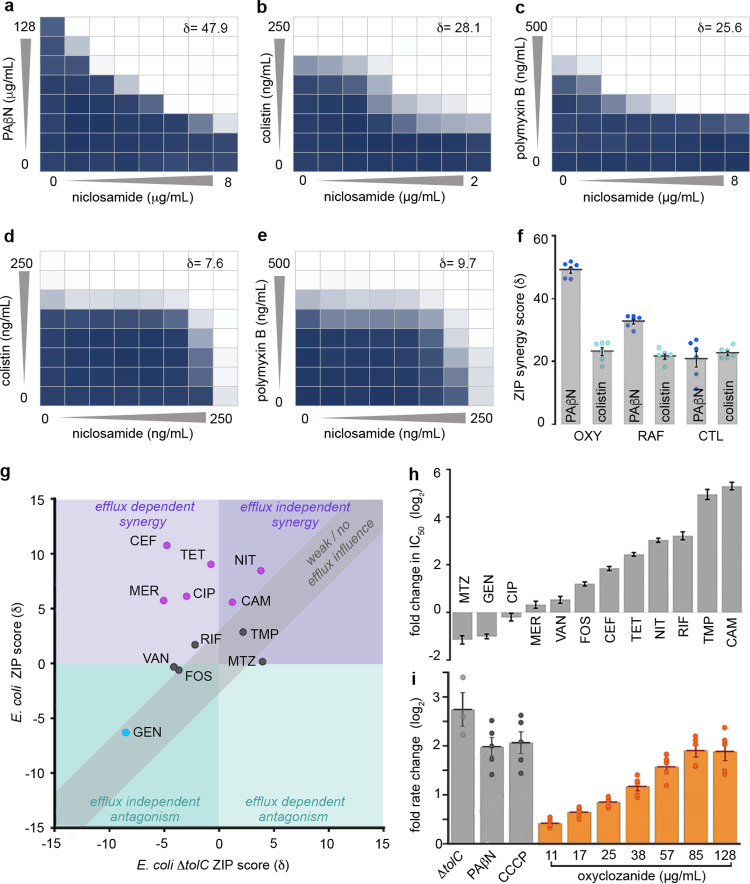
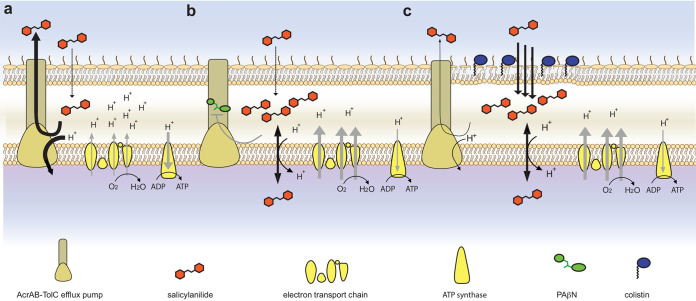
One avenue to combat multidrug-resistant Gram-negative bacteria is the coadministration of multiple drugs (combination therapy), which can be particularly promising if drugs synergize. The identification of synergistic drug combinations, however, is challenging. Detailed understanding of antibiotic mechanisms can address this issue by facilitating the rational design of improved combination therapies. Here, using diverse biochemical and genetic assays, we examine the molecular mechanisms of niclosamide, a clinically approved salicylanilide compound, and demonstrate its potential for Gram-negative combination therapies. We discovered that Gram-negative bacteria possess two innate resistance mechanisms that reduce their niclosamide susceptibility: a primary mechanism mediated by multidrug efflux pumps and a secondary mechanism of nitroreduction. When efflux was compromised, niclosamide became a potent antibiotic, dissipating the proton motive force (PMF), increasing oxidative stress, and reducing ATP production to cause cell death. These insights guided the identification of diverse compounds that synergized with salicylanilides when coadministered (efflux inhibitors, membrane permeabilizers, and antibiotics that are expelled by PMF-dependent efflux), thus suggesting that salicylanilide compounds may have broad utility in combination therapies. We validate these findings using a murine abscess model, where we show that niclosamide synergizes with the membrane permeabilizing antibiotic colistin against high-density infections of multidrug-resistant Gram-negative clinical isolates. We further demonstrate that enhanced nitroreductase activity is a potential route to adaptive niclosamide resistance but show that this causes collateral susceptibility to clinical nitro-prodrug antibiotics. Thus, we highlight how mechanistic understanding of mode of action, innate/adaptive resistance, and synergy can rationally guide the discovery, development, and stewardship of novel combination therapies. There is a critical need for more-effective treatments to combat multidrug-resistant Gram-negative infections. Combination therapies are a promising strategy, especially when these enable existing clinical drugs to be repurposed as antibiotics. We examined the mechanisms of action and basis of innate Gram-negative resistance for the anthelmintic drug niclosamide and subsequently exploited this information to demonstrate that niclosamide and analogs kill Gram-negative bacteria when combined with antibiotics that inhibit drug efflux or permeabilize membranes. We confirm the synergistic potential of niclosamide against a diverse range of recalcitrant Gram-negative clinical isolates and in a mouse abscess model. We also demonstrate that nitroreductases can confer resistance to niclosamide but show that evolution of these enzymes for enhanced niclosamide resistance confers a collateral sensitivity to other clinical antibiotics. Our results highlight how detailed mechanistic understanding can accelerate the evaluation and implementation of new combination therapies.
一种对抗多重耐药革兰氏阴性菌的方法是联合使用多种药物(联合治疗),如果药物具有协同作用,这可能特别有希望。然而,具有协同作用的药物组合的鉴定具有挑战性。对抗生素机制的详细了解可以通过促进改进的联合治疗的合理设计来解决这个问题。在这里,我们使用多种生化和遗传测定法,研究了临床批准的水杨酰苯胺化合物尼氯柳胺的分子机制,并证明了其在革兰氏阴性联合治疗中的潜力。我们发现革兰氏阴性菌具有两种降低其尼氯柳胺敏感性的固有耐药机制:一种由多药外排泵介导的主要机制和一种硝基还原的次要机制。当外排被破坏时,尼氯柳胺成为一种有效的抗生素,耗散质子动力势(PMF),增加氧化应激,并减少 ATP 产生导致细胞死亡。这些见解指导了不同化合物的鉴定,这些化合物与水杨酰苯胺类药物联合使用时具有协同作用(外排抑制剂、膜通透剂和由 PMF 依赖性外排排出的抗生素),因此表明水杨酰苯胺类化合物可能在联合治疗中有广泛的应用。我们使用鼠脓肿模型验证了这些发现,结果表明尼氯柳胺与膜通透抗生素黏菌素协同作用,可对抗高密感染的多重耐药革兰氏阴性临床分离株。我们进一步表明,增强的硝基还原酶活性是一种潜在的尼氯柳胺适应性耐药途径,但表明这会导致对临床硝基前药抗生素的交叉敏感性。因此,我们强调了对抗生素作用机制、固有/适应性耐药和协同作用的机制理解如何合理指导新的联合治疗的发现、开发和管理。迫切需要更有效的治疗方法来对抗多重耐药革兰氏阴性感染。联合治疗是一种很有前途的策略,特别是当这些治疗方法能够重新利用现有的临床药物作为抗生素时。我们研究了驱虫药尼氯柳胺的作用机制和革兰氏阴性固有耐药的基础,随后利用这些信息证明,当与抑制药物外排或渗透膜的抗生素联合使用时,尼氯柳胺及其类似物可杀死革兰氏阴性细菌。我们确认了尼氯柳胺在对抗多种耐药性革兰氏阴性临床分离株和鼠脓肿模型中的协同潜力。我们还表明,硝基还原酶可以赋予尼氯柳胺耐药性,但表明为增强尼氯柳胺耐药性而进化的这些酶会导致对其他临床抗生素的交叉敏感性。我们的研究结果强调了详细的机制理解如何加速新联合治疗的评估和实施。