Paris Sciences and Letters (PSL) University, Paris, France.
INSERM U932 Research Unit, Immunity and Cancer, Paris, France.
Oncoimmunology. 2020 May 13;9(1):1754094. doi: 10.1080/2162402X.2020.1754094.
Around 25% of oral cavity squamous cell carcinoma (OCSCC) are not controlled by the standard of care, but there is currently no validated biomarker to identify those patients. Our objective was to determine a robust biomarker for severe OCSCC, using a biology-driven strategy.
Tumor and juxtatumor secretome were analyzed in a prospective discovery cohort of 37 OCSCC treated by primary surgery. Independent biomarker validation was performed by RTqPCR in a retrospective cohort of 145 patients with similar clinical features. An 18-gene signature (18 G) predictive of the response to PD-1 blockade was evaluated in the same cohort.
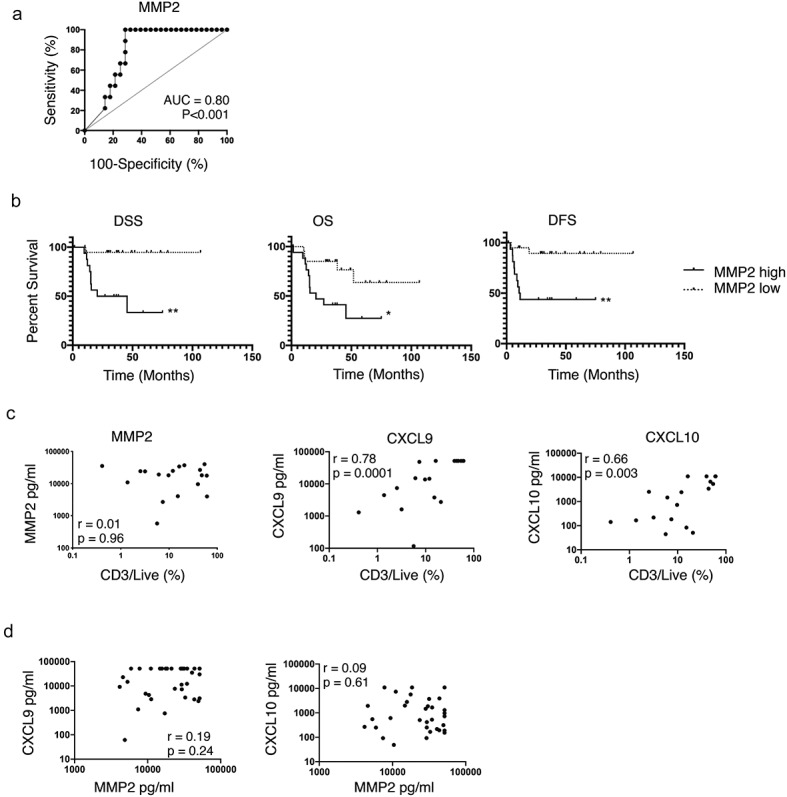
Among 29 deregulated molecules identified in a secretome analysis, including chemokines, cytokines, growth factors, and molecules related to tumor growth and tissue remodeling, only soluble MMP2 was a prognostic biomarker. In our validation cohort, high levels of and , and low levels of and mRNA were associated with poor prognosis in univariate analysis (Kaplan-Meier). ( = .001) and extra-nodal extension (ENE) ( = .006) were independent biomarkers of disease-specific survival (DSS) in multivariate analysis and defined prognostic groups with 5-year DSS ranging from 36% (highENE+) to 88% (lowENE-). The expression of 18 G was similar in the different prognostic groups, suggesting comparable responsiveness to anti-PD-1.
High levels of MMP2 were an independent and validated prognostic biomarker, surpassing other molecules of a large panel of the tumor and immune-related processes, which may be used to select poor prognosis patients for intensified neoadjuvant or adjuvant regimens.
约 25%的口腔鳞状细胞癌(OCSCC)无法通过标准治疗控制,但目前尚无经过验证的生物标志物来识别这些患者。我们的目标是使用生物学驱动的策略确定严重 OCSCC 的稳健生物标志物。
对 37 例接受原发手术治疗的 OCSCC 患者的肿瘤和肿瘤旁分泌组进行了前瞻性发现队列分析。在具有相似临床特征的 145 例患者的回顾性队列中,通过 RTqPCR 进行了独立的生物标志物验证。还评估了同一队列中预测 PD-1 阻断反应的 18 基因标志物(18G)。
在分泌组分析中鉴定的 29 个失调分子中,包括趋化因子、细胞因子、生长因子以及与肿瘤生长和组织重塑相关的分子,只有可溶性 MMP2 是一个预后生物标志物。在我们的验证队列中,高水平的和,以及低水平的和 mRNA 在单因素分析中与预后不良相关(Kaplan-Meier)。在多因素分析中,和额外的淋巴结受累(ENE)是疾病特异性生存(DSS)的独立生物标志物,并且定义了预后组,5 年 DSS 从 36%(高 ENE+)到 88%(低 ENE-)不等。在不同的预后组中,18G 的表达相似,表明对抗 PD-1 的反应相当。
高水平的 MMP2 是一个独立且经过验证的预后生物标志物,超过了肿瘤和免疫相关过程的大型面板中的其他分子,可用于选择预后不良的患者进行强化新辅助或辅助治疗方案。