József Kristóf, Schlégl Ádám Tibor, Burkus Máté, Márkus István, O'Sullivan Ian, Than Péter, Csapó Miklós Tunyogi
University of Pécs Medical School, Pécs, Hungary.
Global Spine J. 2022 Mar;12(2):244-248. doi: 10.1177/2192568220948830. Epub 2020 Sep 16.
Retrospective cross-sectional study.
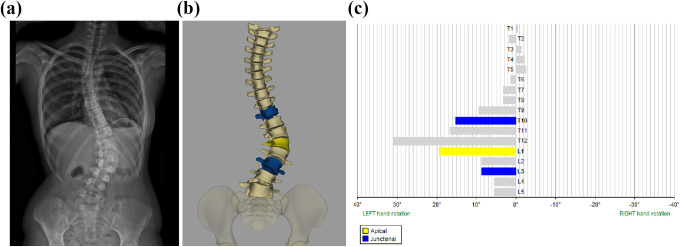
It is generally believed that the apical vertebra has the largest axial rotation in adolescent idiopathic scoliosis. We investigated the relationship between apical axial vertebral rotation (apicalAVR) and maximal axial vertebral rotation (maxAVR) in both major and minor curves using biplanar stereo-imaging.
EOS 2D/3D biplanar radiograph images were collected from 332 patients with adolescent idiopathic scoliosis (Cobb angle range 10°-122°, mean age 14.7 years). Based on the X-ray images, with the help of 3D full spine reconstructions Cobb angle, curvature level, apicalAVR and maxAVR were determined. These parameters were also determined for minor curves in Lenke 2, 3, 4, 6 type patients. Maximal thoracic rotation and maximal thoracolumbar/lumbar rotation were calculated. Statistical analysis was performed with descriptive statistics, Shapiro-Wilk test, and Wilcoxon signed-rank test.
The apical vertebrae were the most rotated vertebra in only 40.4% of the major curves, and 31.7% in minor curves. MaxAVR significantly exceeded apicalAVR values in the major curves ( < .001) as well as in minor curves ( < .001). The 2 parameters differed significantly in each severity group and Lenke type.
The apical vertebrae were not the most rotated vertebra in more than half of cases investigated indicating that apicalAVR and maxAVR should be considered as 2 distinct parameters, of which maxAVR fully describes the axial dimension of scoliosis. Furthermore, the substitution of maxAVR for the apicalAVR should be especially avoided in double and triple curves, as the apical vertebra was even less commonly the most rotated in minor curves.
回顾性横断面研究。
人们普遍认为,在青少年特发性脊柱侧弯中,顶椎的轴向旋转最大。我们使用双平面立体成像技术研究了主弯和次弯中顶椎轴向旋转(apicalAVR)与最大轴向旋转(maxAVR)之间的关系。
收集了332例青少年特发性脊柱侧弯患者(Cobb角范围为10° - 122°,平均年龄14.7岁)的EOS 2D/3D双平面X线片图像。基于X线图像,借助三维全脊柱重建确定Cobb角、弯曲水平、apicalAVR和maxAVR。还对Lenke 2、3、4、6型患者的次弯进行了这些参数的测定。计算最大胸椎旋转和最大胸腰段/腰椎旋转。采用描述性统计、Shapiro-Wilk检验和Wilcoxon符号秩检验进行统计分析。
在主弯中,顶椎仅在40.4%的病例中是旋转最多的椎体,在次弯中这一比例为31.7%。在主弯( <.001)和次弯( <.001)中,maxAVR均显著超过apicalAVR值。这两个参数在每个严重程度组和Lenke类型中均有显著差异。
在超过一半的研究病例中,顶椎并非旋转最多的椎体,这表明apicalAVR和maxAVR应被视为两个不同的参数,其中maxAVR能完全描述脊柱侧弯的轴向维度。此外,在双弯和三弯中应特别避免用maxAVR替代apicalAVR,因为在次弯中顶椎更不常见为旋转最多的椎体。