Department of Oral Biology, Medical University of Vienna, Vienna, Austria.
Division of Oral Surgery and Orthodontics, Department of Dental Medicine and Oral Health, Medical University of Graz, Graz, Austria.
J Periodontal Res. 2021 Jan;56(1):101-107. doi: 10.1111/jre.12798. Epub 2020 Sep 16.
The aim of the study was to determine whether the inhibition of apoptosis via pan-caspase inhibitors can attenuate the changes in the alveolar ridge upon tooth extraction.
Cells undergoing apoptosis might play a central role in the onset of alveolar bone resorption and the ensuing bone atrophy following tooth extraction. Caspases are proteases that regulate apoptotic cell death. It is, therefore, reasonable to hypothesize that blocking apoptosis with pan-caspase inhibitors attenuates the changes in the alveolar ridge following tooth extraction.
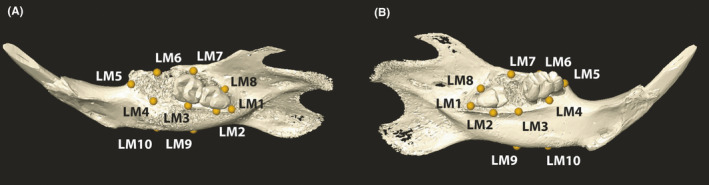
In 16 inbred rats, the mandibular first (M1) and second (M2) molars of one side were extracted. Following random allocation, the rats received either a cell-permeable pan-caspase inhibitor or diluent. After a healing period of 10 days, changes in shape and height of the alveolar ridge were examined using geometric morphometrics and linear measurements based on micro-computed tomography.
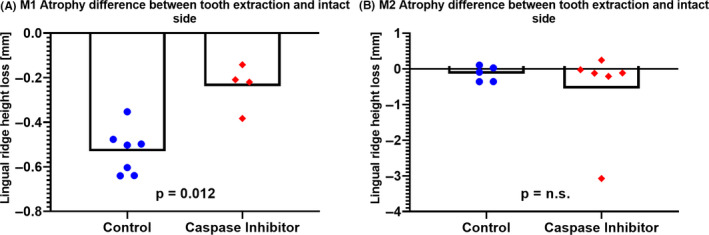
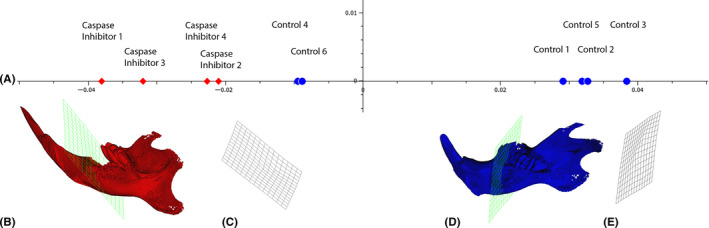
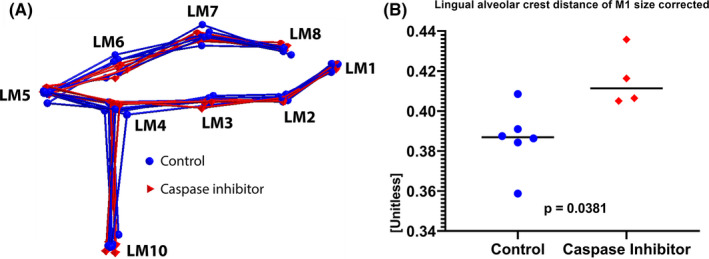
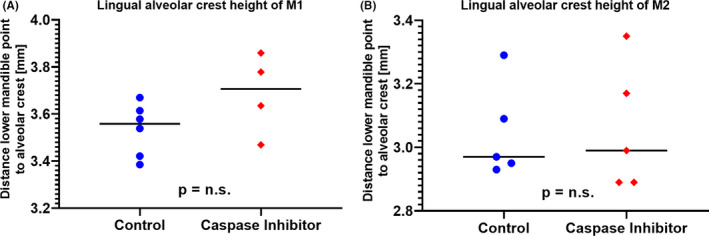
Geometric morphometric analysis revealed that the pan-caspase inhibitor prevented major shape changes of the alveolar ridge following M1 tooth extraction (P < .05). Furthermore, linear measurements confirmed that the pan-caspase inhibitor significantly prevented the atrophy of the alveolar ridge height following M1 tooth extraction compared to the diluent controls (-0.53 mm vs -0.24 mm; P = .012). M2 tooth extraction caused no shape changes of the alveolar ridge, and thus, the pan-caspase inhibitor group did not differ from the control group (-0.14 mm vs -0.05 mm; P = .931).
These findings suggest that the inhibition of apoptosis may attenuate shape changes of the alveolar ridge following M1 tooth extraction in rodents.
本研究旨在探讨通过泛半胱天冬酶抑制剂抑制细胞凋亡是否能减轻拔牙后牙槽嵴的变化。
凋亡细胞可能在牙槽骨吸收的发生和拔牙后随之发生的骨萎缩中起核心作用。半胱天冬酶是调节细胞凋亡的蛋白酶。因此,合理的假设是用泛半胱天冬酶抑制剂阻断细胞凋亡可以减轻拔牙后牙槽嵴的变化。
在 16 只近交系大鼠中,一侧下颌第一(M1)和第二(M2)磨牙被拔除。随机分配后,大鼠接受细胞渗透性泛半胱天冬酶抑制剂或稀释剂。在 10 天的愈合期后,使用几何形态测量和基于微计算机断层扫描的线性测量来检查牙槽嵴的形状和高度变化。
几何形态测量分析显示,泛半胱天冬酶抑制剂可防止 M1 牙拔除后牙槽嵴的主要形状变化(P<.05)。此外,线性测量证实,与稀释剂对照组相比,泛半胱天冬酶抑制剂显著防止了 M1 牙拔除后牙槽嵴高度的萎缩(-0.53mm 与-0.24mm;P=.012)。M2 牙拔除未引起牙槽嵴的形状变化,因此,抑制剂组与对照组之间没有差异(-0.14mm 与-0.05mm;P=.931)。
这些发现表明,抑制细胞凋亡可能减轻啮齿动物 M1 牙拔除后牙槽嵴的形状变化。