Institut für Mikrobiologie, Universität Stuttgart, Allmandring 31, 70569, Stuttgart, Germany.
Biochem Labor für chemische Analytik GmbH, Daimlerstr. 5B, 76185, Karlsruhe, Germany.
Biotechnol Lett. 2021 Jan;43(1):287-296. doi: 10.1007/s10529-020-02998-8. Epub 2020 Sep 16.
Chiral 2-hydroxycarboxylic acids and 2-hydroxycarboxamides are valuable synthons for the chemical industry.
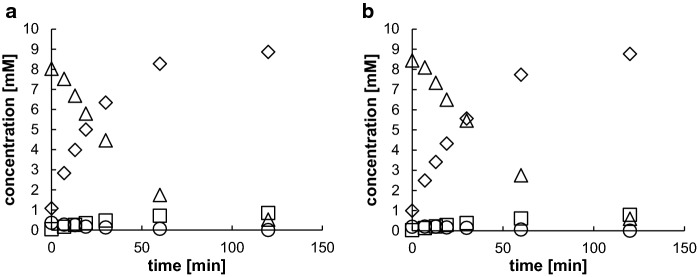
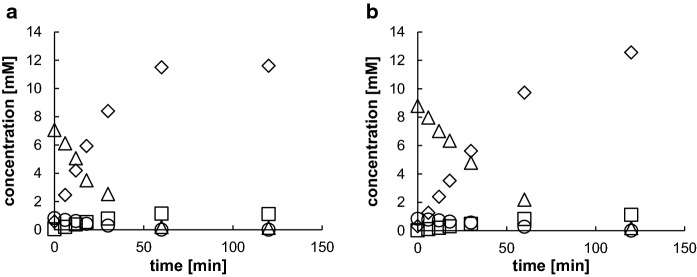
The biocatalytic syntheses of (R)-mandelic acid and (R)-mandelic acid amide by recombinant Escherichia coli clones were studied. Strains were constructed which simultaneously expressed a (R)-specific oxynitrilase (hydroxynitrile lyase) from the plant Arabidopsis thaliana together with the arylacetonitrilase from the bacterium Pseudomonas fluorescens EBC191. In addition, recombinant strains were constructed which expressed a previously described acid tolerant variant of the oxynitrilase and an amide forming variant of the nitrilase. The whole cell catalysts which simultaneously expressed the (R)-specific oxynitrilase and the wild-type nitrilase transformed in slightly acidic buffer systems benzaldehyde plus cyanide preferentially to (R)-mandelic acid with ee-values > 95%. The combination of the (R)-specific oxynitrilase with the amide forming nitrilase variant gave whole cell catalysts which converted at pH-values ≤ pH 5 benzaldehyde plus cyanide with a high degree of enantioselectivity (ee > 90%) to (R)-mandelic acid amide. The acid and the amide forming catalysts also converted chlorinated benzaldehydes with cyanide to chlorinated mandelic acid or chlorinated mandelic acid amides.
Efficient systems for the biocatalytic production of (R)-2-hydroxycarboxylic acids and (R)-2-hydroxycarboxamides were generated.
手性 2-羟基羧酸和 2-羟基羧酰胺是化学工业中非常有价值的合成子。
研究了重组大肠杆菌克隆物生物催化合成(R)-扁桃酸和(R)-扁桃酸酰胺。构建了同时表达来自拟南芥植物的(R)特异性羟腈酶(羟腈裂解酶)和荧光假单胞菌 EBC191 中的芳基乙腈酶的菌株。此外,还构建了表达先前描述的耐酸羟腈酶变体和腈酶形成酰胺变体的重组菌株。同时表达(R)特异性羟腈酶和野生型腈酶的全细胞催化剂在略微酸性的缓冲体系中优先将苯甲醛加氰化物转化为(R)-扁桃酸,ee 值>95%。将(R)特异性羟腈酶与形成酰胺的腈酶变体组合,可使全细胞催化剂在 pH 值≤pH 5 的条件下,将苯甲醛加氰化物以高对映选择性(ee>90%)转化为(R)-扁桃酸酰胺。酸和形成酰胺的催化剂也可将氯代苯甲醛与氰化物转化为氯代扁桃酸或氯代扁桃酸酰胺。
生成了用于生物催化生产(R)-2-羟基羧酸和(R)-2-羟基羧酰胺的有效体系。