ACIB GmbH, Austrian Centre of Industrial Biotechnology, c/o TU Graz, Petersgasse 14/4, 8010 Graz, Austria.
ACIB GmbH, Austrian Centre of Industrial Biotechnology, c/o TU Graz, Petersgasse 14/4, 8010 Graz, Austria ; Institute of Molecular Biotechnology, TU Graz, Petersgasse 14/5, 8010 Graz, Austria.
Comput Struct Biotechnol J. 2014 Jul 8;10(16):58-62. doi: 10.1016/j.csbj.2014.07.002. eCollection 2014 Jun.
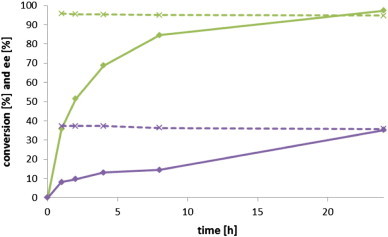
Hydroxynitrile lyases (HNLs) are powerful carbon-carbon bond forming enzymes. The reverse of their natural reaction - the stereoselective addition of hydrogen cyanide (HCN) to carbonyls - yields chiral cyanohydrins, versatile building blocks for the pharmaceutical and chemical industry. Recently, bacterial HNLs have been discovered, which represent a completely new type: HNLs with a cupin fold. Due to various benefits of cupins (e.g. high yield recombinant expression in Escherichia coli), the class of cupin HNLs provides a new source for interesting, powerful hydroxynitrile lyases in the ongoing search for HNLs with improved activity, enantioselectivity, stability and substrate scope. In this study, database mining revealed a novel cupin HNL from Acidobacterium capsulatum ATCC 51196 (AcHNL), which was able to catalyse the (R)-selective synthesis of mandelonitrile with significantly better conversion (97%) and enantioselectivity (96.7%) than other cupin HNLs.
羟腈裂解酶(HNLs)是一种强大的碳-碳键形成酶。它们的自然反应的逆反应——氰化氢(HCN)对羰基的立体选择性加成——生成手性氰醇,这是制药和化学工业中用途广泛的构建块。最近,人们发现了细菌 HNLs,它们代表了一种全新的类型:具有杯状折叠的 HNLs。由于杯蛋白的各种优点(例如在大肠杆菌中高效表达重组),杯蛋白 HNL 类为正在寻找具有更高活性、对映选择性、稳定性和底物范围的 HNL 的研究提供了一个新的来源。在这项研究中,通过数据库挖掘发现了一种来自 Acidobacterium capsulatum ATCC 51196(AcHNL)的新型杯状 HNL,它能够以比其他杯状 HNL 更高的转化率(97%)和对映选择性(96.7%)催化(R)-选择性合成扁桃腈。