Menzies Institute for Medical Research, College of Health and Medicine, University of Tasmania, Hobart, TAS 7000, Australia.
The Roslin Institute and Royal School of Veterinary Studies, University of Edinburgh, Easter Bush Campus, Midlothian EH25 9RG, UK.
Sci Adv. 2020 Jul 1;6(27). doi: 10.1126/sciadv.aba5031. Print 2020 Jul.
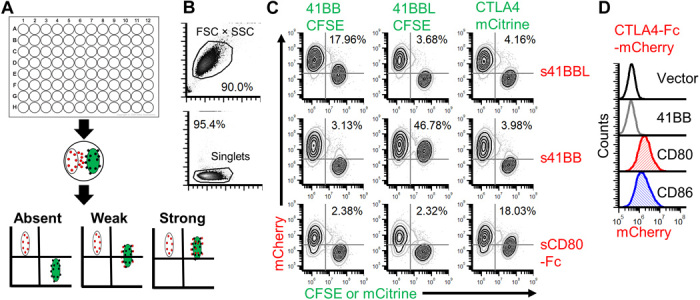
Around 40% of humans and Tasmanian devils () develop cancer in their lifetime, compared to less than 10% for most species. In addition, devils are affected by two of the three known transmissible cancers in mammals. Immune checkpoint immunotherapy has transformed human medicine, but a lack of species-specific reagents has limited checkpoint immunology in most species. We developed a cut-and-paste reagent development system and used the fluorescent fusion protein system to show that immune checkpoint interactions are conserved across 160,000,000 years of evolution, CD200 is highly expressed on transmissible tumor cells, and coexpression of CD200R1 can block CD200 surface expression. The system's versatility across species was demonstrated by fusing a fluorescent reporter to a camelid-derived nanobody that binds human programmed death ligand 1. The evolutionarily conserved pathways suggest that naturally occurring cancers in devils and other species can be used to advance our understanding of cancer and immunological tolerance.
大约 40%的人类和袋獾一生中会患上癌症,相比之下,大多数物种的这一比例不到 10%。此外,袋獾还患有三种已知可在哺乳动物间传播的癌症中的两种。免疫检查点免疫疗法改变了人类医学,但由于缺乏物种特异性试剂,大多数物种的检查点免疫学都受到限制。我们开发了一种剪切粘贴试剂开发系统,并使用荧光融合蛋白系统表明,免疫检查点相互作用在 1600 万年前的进化过程中是保守的,CD200 在可传播的肿瘤细胞上高度表达,并且共表达 CD200R1 可以阻断 CD200 表面表达。该系统在物种间的多功能性通过将荧光报告基因与结合人程序性死亡配体 1 的骆驼科纳米抗体融合来证明。进化上保守的途径表明,袋獾和其他物种中自然发生的癌症可以用于增进我们对癌症和免疫耐受的理解。