Department of Ecology, College of Urban and Environmental Sciences, and Key Laboratory for Earth Surface Processes of the Ministry of Education, Peking University, No.5 Yiheyuan Road Haidian District, Beijing, 100871, China.
Key Laboratory of Vegetation Restoration and Management of Degraded Ecosystems, Chinese Academy of Sciences, 723 Xingke Road, Guangzhou, 510650, China.
BMC Plant Biol. 2020 Sep 16;20(1):430. doi: 10.1186/s12870-020-02646-3.
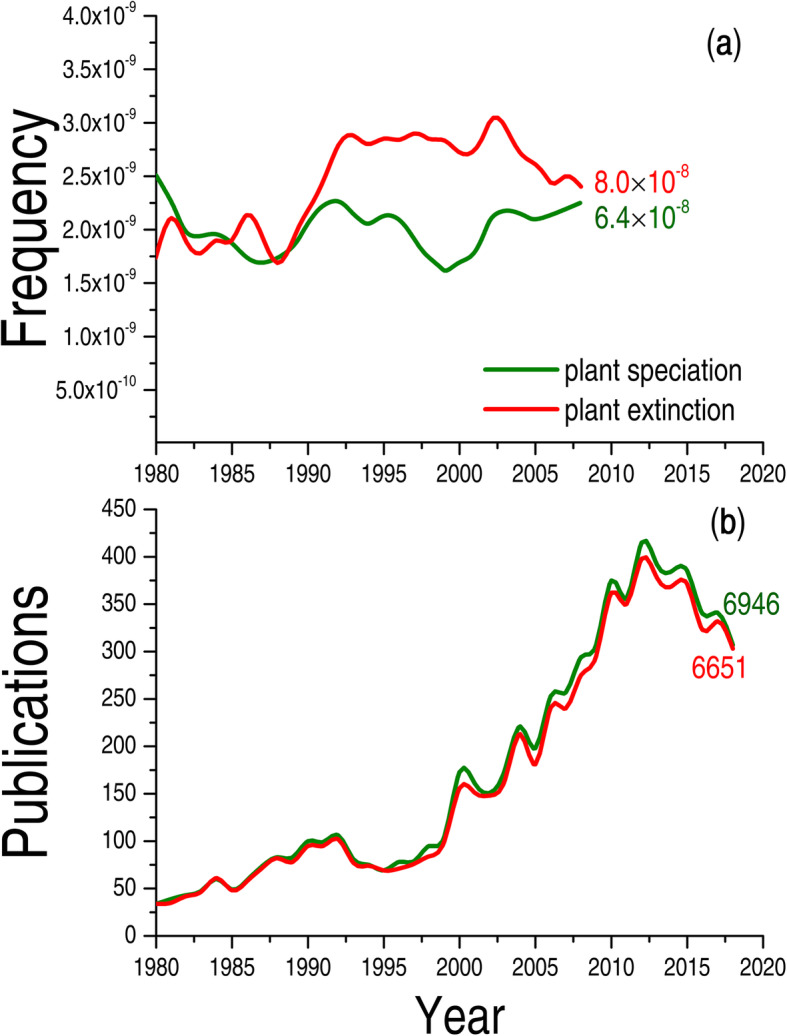
In the past several millenniums, we have domesticated several crop species that are crucial for human civilization, which is a symbol of significant human influence on plant evolution. A pressing question to address is if plant diversity will increase or decrease in this warming world since contradictory pieces of evidence exit of accelerating plant speciation and plant extinction in the Anthropocene.
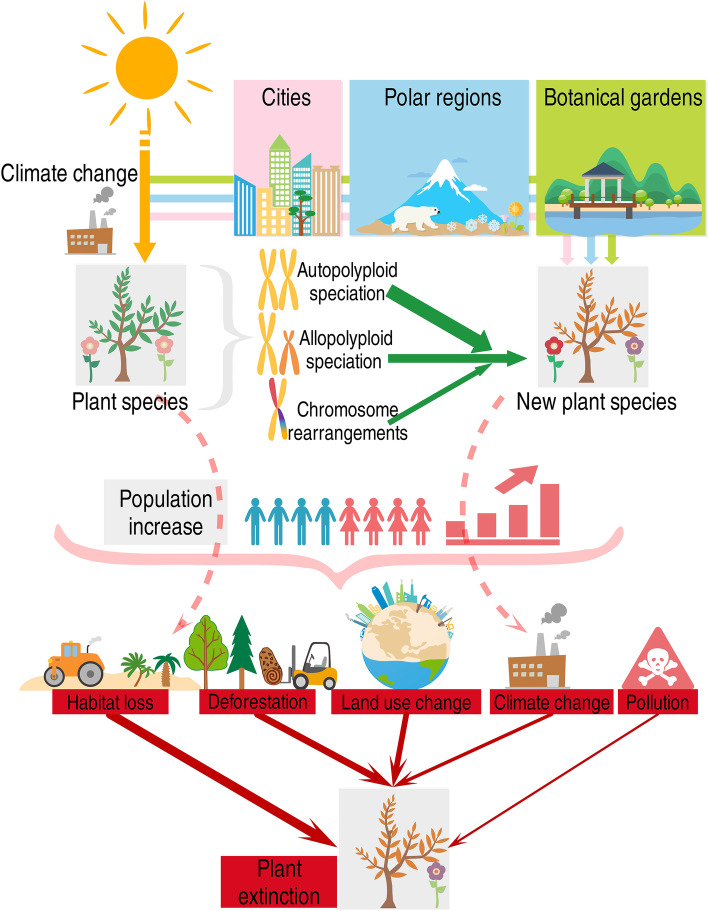
Comparison may be made of the Anthropocene with the past geological times characterised by a warming climate, e.g., the Palaeocene-Eocene Thermal Maximum (PETM) 55.8 million years ago (Mya)-a period of "crocodiles in the Arctic", during which plants saw accelerated speciation through autopolyploid speciation. Three accelerators of plant speciation were reasonably identified in the Anthropocene, including cities, polar regions and botanical gardens where new plant species might be accelerating formed through autopolyploid speciation and hybridization.
However, this kind of positive effect of climate warming on new plant species formation would be thoroughly offset by direct and indirect intensive human exploitation and human disturbances that cause habitat loss, deforestation, land use change, climate change, and pollution, thus leading to higher extinction risk than speciation in the Anthropocene. At last, four research directions are proposed to deepen our understanding of how plant traits affect speciation and extinction, why we need to make good use of polar regions to study the mechanisms of dispersion and invasion, how to maximize the conservation of plant genetics, species, and diverse landscapes and ecosystems and a holistic perspective on plant speciation and extinction is needed to integrate spatiotemporally.
在过去的几千年里,我们驯化了几种对人类文明至关重要的作物,这是人类对植物进化产生重大影响的标志。一个紧迫的问题是,在这个变暖的世界中,植物多样性是会增加还是减少,因为在人类世中既有加速植物物种形成和植物灭绝的矛盾证据。
可以将人类世与过去的地质时期进行比较,这些时期的特点是气候变暖,例如 5580 万年前的古新世-始新世极热事件(PETM)——一个“北极鳄鱼”的时期,在此期间,植物通过同源多倍体物种形成加速了物种形成。在人类世中,合理地确定了三个加速植物物种形成的因素,包括城市、极地地区和植物园,在这些地方,新的植物物种可能通过同源多倍体物种形成和杂交加速形成。
然而,气候变暖对新植物物种形成的这种积极影响将被直接和间接的人类密集开发和人类干扰所彻底抵消,这些干扰会导致栖息地丧失、森林砍伐、土地利用变化、气候变化和污染,从而导致更高的灭绝风险,超过人类世的物种形成。最后,提出了四个研究方向,以加深我们对植物特征如何影响物种形成和灭绝的理解,为什么我们需要利用极地地区来研究分散和入侵的机制,如何最大限度地保护植物的遗传多样性、物种和多样化的景观和生态系统,以及需要对植物物种形成和灭绝进行整体的时空综合视角。