Division of Cancer Epidemiology and Genetics, National Cancer Institute, National Institutes of Health, Department Health and Human Services, Bethesda, MD, USA.
Center for Health Promotion Disease Prevention, University of North Carolina at Chapel Hill, Chapel Hill, NC, USA.
BMC Med. 2020 Sep 17;18(1):248. doi: 10.1186/s12916-020-01716-5.
Due to the high prevalence of obesity and the difficulty in maintaining weight loss, repeated bouts of weight loss are a common occurrence. However, there are inconsistencies in epidemiological studies regarding repetitive weight fluctuations being associated with increased risk of mortality. Therefore, the purpose of this prospective cohort analysis was to determine the long-term association of the frequency of weight loss attempts on mortality.
This prospective cohort study used data collected from adult AARP members living in 6 states (California, Florida, Louisiana, New Jersey, North Carolina, or Pennsylvania) or 2 metropolitan areas (Atlanta, Georgia, or Detroit, Michigan) and participating in the National Institutes of Health-AARP Diet and Health Study between 2004 and 2006. Self-reported data were analyzed for 161,738 middle-aged adults. During an average 7 years of follow-up, 21,194 deaths were recorded. Hazard ratios of all-cause, cardiovascular, and cancer mortality were estimated adjusting for demographic, lifestyle, and behavioral risk factors.
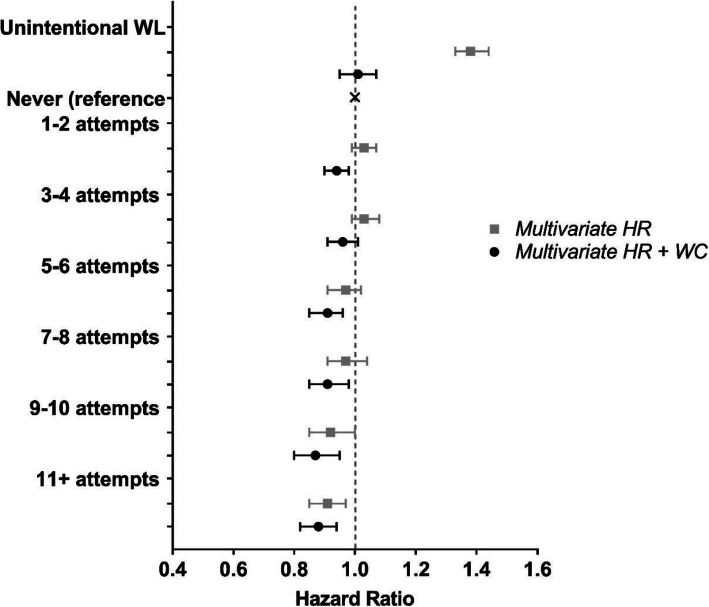
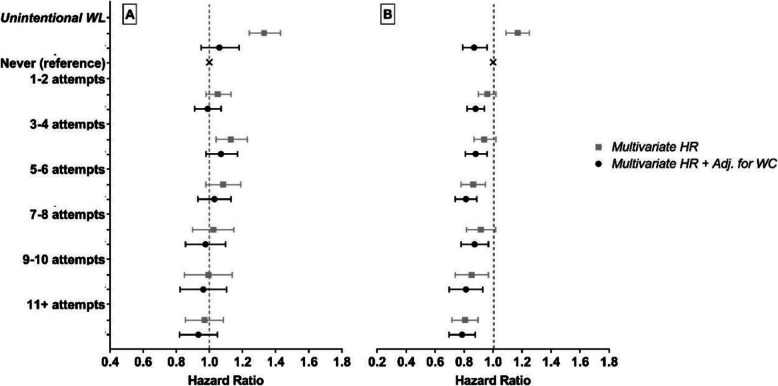
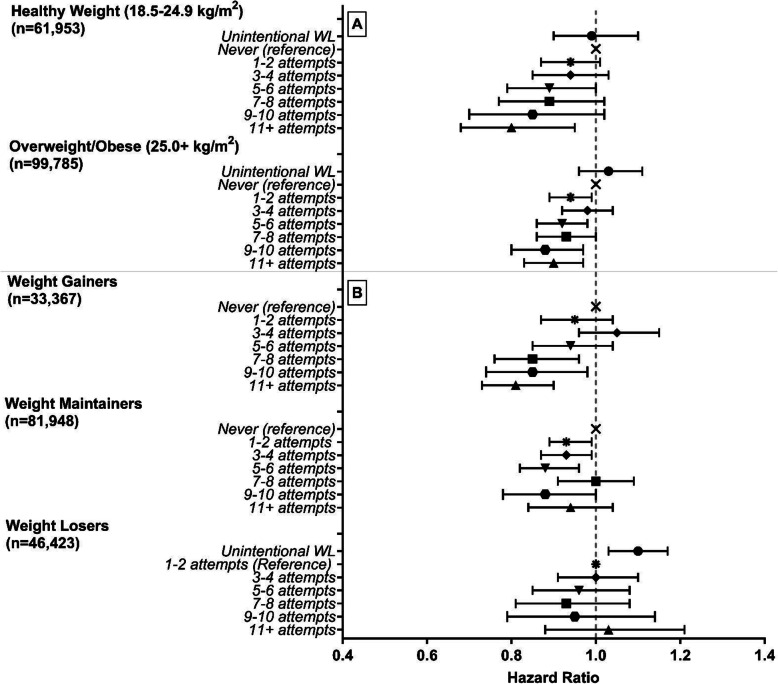
Increased frequency of weight loss attempts of at least five pounds was associated with lower mortality (p < 0.010). Multivariate hazard ratios (95% confidence intervals) for all-cause death among individuals who successfully attempted weight loss compared with those who did not make any attempts were 0.94 (0.90-0.98) for 1-2 attempts, 0.96 (0.91-1.01) for 3-4 attempts, 0.91 (0.85-0.96) for 5-6 attempts, 0.91 (0.85-0.98) for 7-8 attempts, 0.87 (0.80-0.95) for 9-10 attempts, and 0.88 (0.82-0.94) for 11+ attempts. Similar results were noted for men and women, participants with healthy weight and overweight/obesity, and even among those who gained weight over time. Protective associations were also observed for deaths due to cardiovascular disease and cancer.
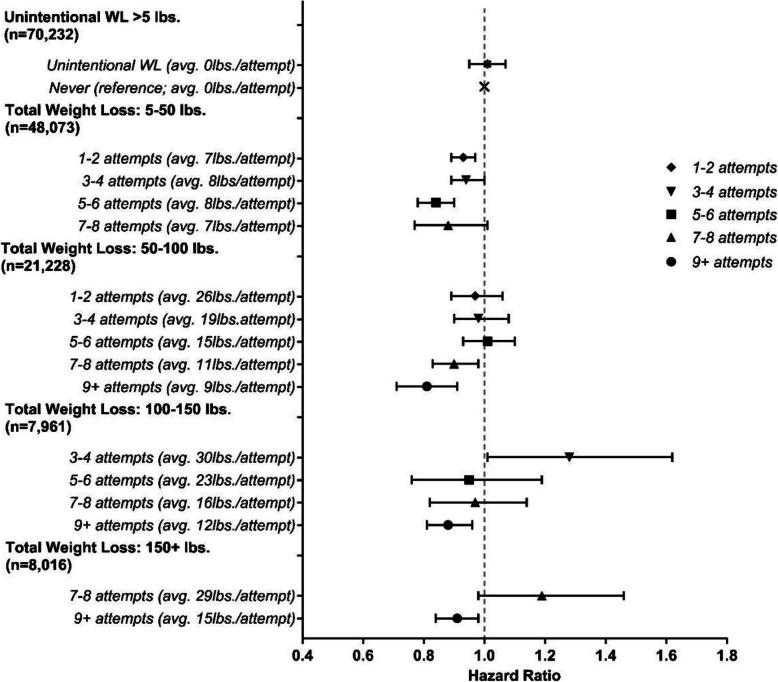
Increased frequency of intentionally losing at least five pounds in mid-life was associated with a lower risk of future death. Repeated attempts with moderate amounts of weight loss may provide benefit in terms of longevity.
ClinicalTrials.gov number, NCT00340015.
由于肥胖的高发率和体重维持的困难,体重反复减轻是很常见的。然而,关于反复体重波动与死亡率增加相关的流行病学研究结果并不一致。因此,本前瞻性队列分析旨在确定反复减肥尝试与死亡率之间的长期关联。
本前瞻性队列研究使用了 2004 年至 2006 年间居住在加利福尼亚州、佛罗里达州、路易斯安那州、新泽西州、北卡罗来纳州或宾夕法尼亚州的 6 个州或佐治亚州亚特兰大市或密歇根州底特律市的 AARP 成员和参与美国国立卫生研究院-美国退休人员协会饮食与健康研究的成年人的数据。对 161738 名中年成年人的自我报告数据进行了分析。在平均 7 年的随访期间,记录了 21194 例死亡。使用调整人口统计学、生活方式和行为风险因素的方法,估计了全因、心血管和癌症死亡率的风险比。
至少减轻 5 磅的减肥尝试频率增加与死亡率降低相关(p<0.010)。与未进行任何尝试的人相比,成功尝试减肥的个体的全因死亡的多变量风险比(95%置信区间)为 0.94(0.90-0.98),1-2 次尝试为 0.96(0.91-1.01),3-4 次尝试为 0.91(0.85-0.96),5-6 次尝试为 0.91(0.85-0.98),7-8 次尝试为 0.87(0.80-0.95),9-10 次尝试为 0.88(0.82-0.94),11 次以上尝试为 0.88(0.82-0.94)。男女、体重正常和超重/肥胖的参与者,甚至随着时间体重增加的参与者都观察到了类似的结果。心血管疾病和癌症死亡也观察到了保护关联。
中年时有意减轻至少 5 磅的减肥尝试频率增加与未来死亡风险降低相关。多次适度减轻体重可能对长寿有益。
ClinicalTrials.gov 编号,NCT00340015。