Leibniz Research Institute for Environmental Medicine, Auf'm Hennekamp 50, 40225, Düsseldorf, Germany.
Cell Biology and Epigenetics, Department of Biology, Technical University of Darmstadt, Schnittspahnstr. 10, 64287, Darmstadt, Germany.
Sci Rep. 2020 Sep 16;10(1):15196. doi: 10.1038/s41598-020-71315-0.
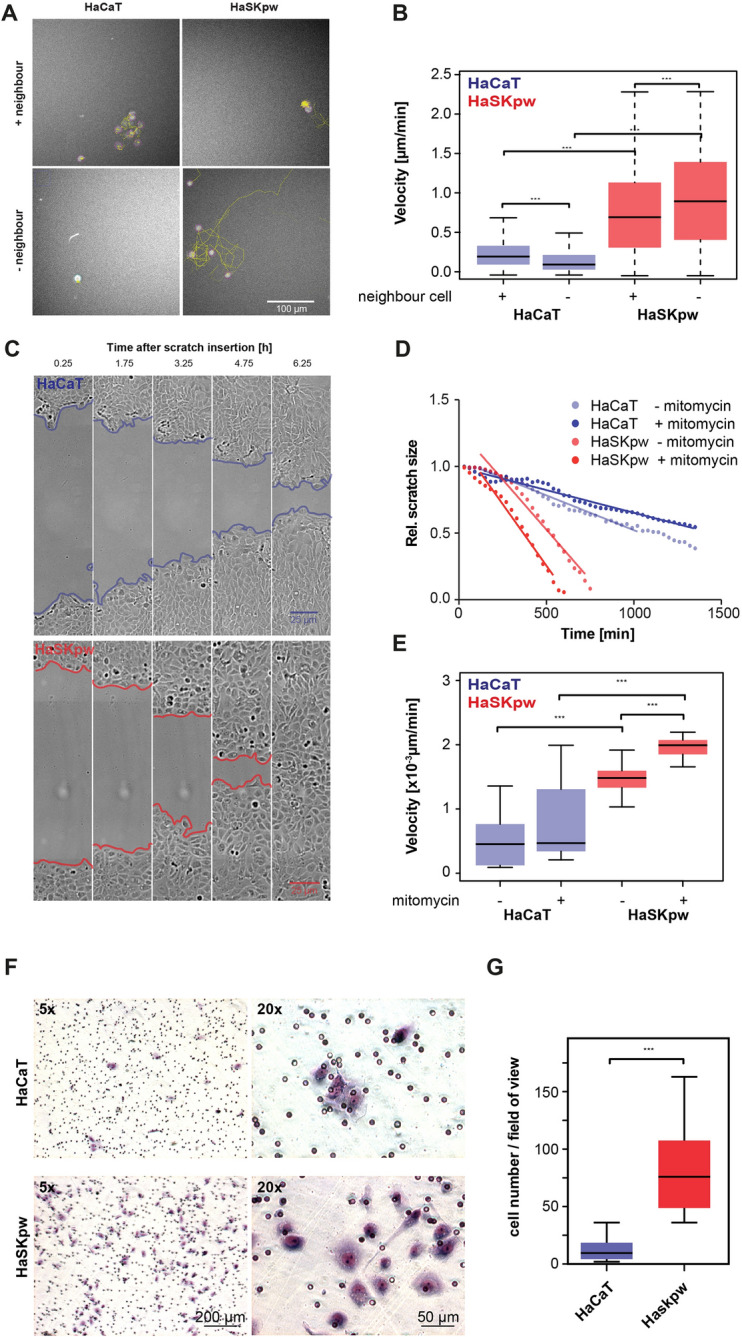
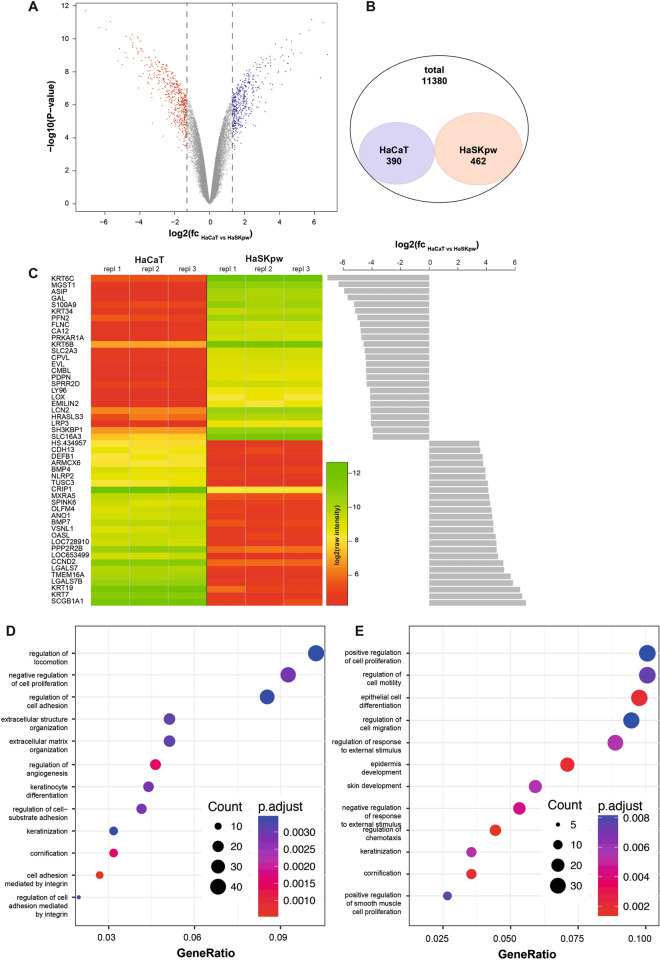
We here present the spontaneously immortalised cell line, HaSKpw, as a novel model for the multistep process of skin carcinogenesis. HaSKpw cells were established from the epidermis of normal human adult skin that, without crisis, are now growing unrestricted and feeder-independent. At passage 22, clonal populations were established and clone7 (HaSKpwC7) was further compared to the also spontaneously immortalized HaCaT cells. As important differences, the HaSKpw cells express wild-type p53, remain pseudodiploid, and show a unique chromosomal profile with numerous complex aberrations involving chromosome 20. In addition, HaSKpw cells overexpress a pattern of genes and miRNAs such as KRT34, LOX, S100A9, miR21, and miR155; all pointing to a tumorigenic status. In concordance, HaSKpw cells exhibit reduced desmosomal contacts that provide them with increased motility and a highly migratory/invasive phenotype as demonstrated in scratch- and Boyden chamber assays. In 3D organotypic cultures, both HaCaT and HaSKpw cells form disorganized epithelia but only the HaSKpw cells show tumorcell-like invasive growth. Together, HaSKpwC7 and HaCaT cells represent two spontaneous (non-genetically engineered) "premalignant" keratinocyte lines from adult human skin that display different stages of the multistep process of skin carcinogenesis and thus represent unique models for analysing skin cancer development and progression.
我们在此介绍自发永生化细胞系 HaSKpw,它是皮肤多步癌变过程的一个新模型。HaSKpw 细胞源自正常成人皮肤的表皮,在没有危机的情况下,现在正在无限制地生长且无需饲养细胞。在第 22 代时,建立了克隆群体,并进一步将克隆 7(HaSKpwC7)与同样自发永生化的 HaCaT 细胞进行比较。作为重要的区别,HaSKpw 细胞表达野生型 p53,保持假二倍体,并显示出独特的染色体图谱,存在涉及 20 号染色体的大量复杂异常。此外,HaSKpw 细胞过度表达 KRT34、LOX、S100A9、miR21 和 miR155 等基因和 miRNA 的模式;所有这些都指向肿瘤发生状态。相应地,HaSKpw 细胞表现出减少的桥粒接触,这为它们提供了更高的迁移性和高度迁移/侵袭表型,如划痕和 Boyden 室测定所证明的那样。在 3D 器官型培养中,HaCaT 和 HaSKpw 细胞均形成组织紊乱的上皮细胞,但只有 HaSKpw 细胞表现出肿瘤样的侵袭性生长。总之,HaSKpwC7 和 HaCaT 细胞代表来自成人皮肤的两种自发(非基因工程)“前恶性”角质形成细胞系,它们显示皮肤癌变多步过程的不同阶段,因此代表了分析皮肤癌发展和进展的独特模型。