Touloupou Panayiota, Finkenstädt Bärbel, Spencer Simon E F
Department of Statistics, University of Warwick, Coventry, UK.
J Comput Graph Stat. 2019 Sep 18;29(2):238-249. doi: 10.1080/10618600.2019.1654880. eCollection 2020.
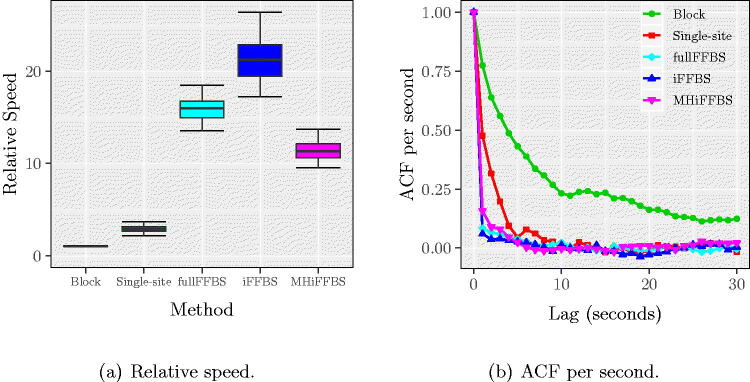
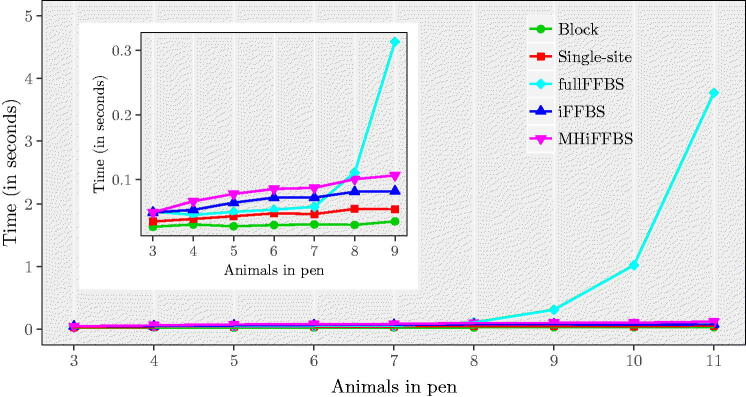
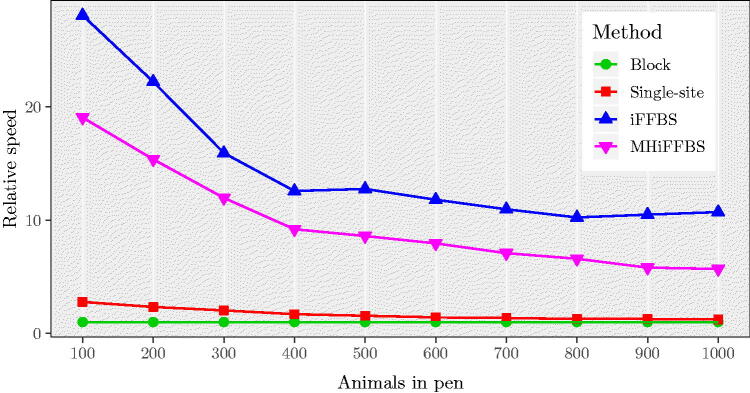
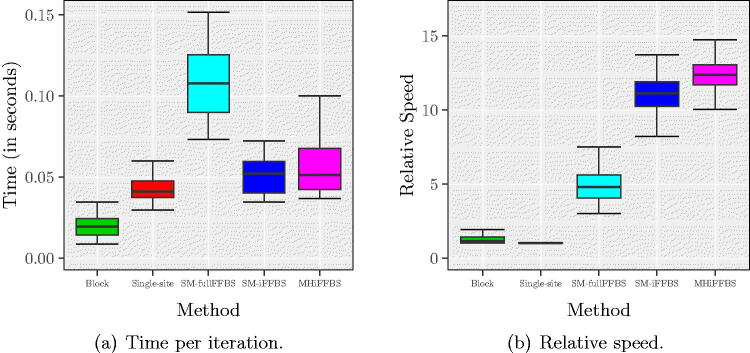
Bayesian inference for coupled hidden Markov models frequently relies on data augmentation techniques for imputation of the hidden state processes. Considerable progress has been made on developing such techniques, mainly using Markov chain Monte Carlo (MCMC) methods. However, as the dimensionality and complexity of the hidden processes increase some of these methods become inefficient, either because they produce MCMC chains with high autocorrelation or because they become computationally intractable. Motivated by this fact we developed a novel MCMC algorithm, which is a modification of the forward filtering backward sampling algorithm, that achieves a good balance between computation and mixing properties, and thus can be used to analyze models with large numbers of hidden chains. Even though our approach is developed under the assumption of a Markovian model, we show how this assumption can be relaxed leading to minor modifications in the algorithm. Our approach is particularly well suited to epidemic models, where the hidden Markov chains represent the infection status of an individual through time. The performance of our method is assessed on simulated data on epidemic models for the spread of O157:H7 in cattle. Supplementary materials for this article are available online.
耦合隐马尔可夫模型的贝叶斯推理通常依赖于数据增强技术来估算隐藏状态过程。在开发此类技术方面已经取得了相当大的进展,主要是使用马尔可夫链蒙特卡罗(MCMC)方法。然而,随着隐藏过程的维度和复杂性增加,这些方法中的一些变得效率低下,要么是因为它们产生具有高自相关性的MCMC链,要么是因为它们在计算上变得难以处理。基于这一事实,我们开发了一种新颖的MCMC算法,它是前向滤波后向采样算法的一种改进,在计算和混合特性之间实现了良好的平衡,因此可用于分析具有大量隐藏链的模型。尽管我们的方法是在马尔可夫模型的假设下开发的,但我们展示了如何放宽这一假设,从而对算法进行微小修改。我们的方法特别适用于流行病模型,其中隐马尔可夫链代表个体随时间的感染状态。我们的方法在模拟的牛O157:H7传播流行病模型数据上进行了评估。本文的补充材料可在线获取。