Department of Radiology, Kaohsiung Veterans General Hospital, Kaohsiung, Taiwan, ROC.
National Yang-Ming University, School of Medicine, Taipei, Taiwan, ROC.
PLoS One. 2020 Sep 17;15(9):e0239271. doi: 10.1371/journal.pone.0239271. eCollection 2020.
To evaluate the kinetic patterns of benign and malignant breast lesions using contrast-enhanced digital mammogram (CEDM).
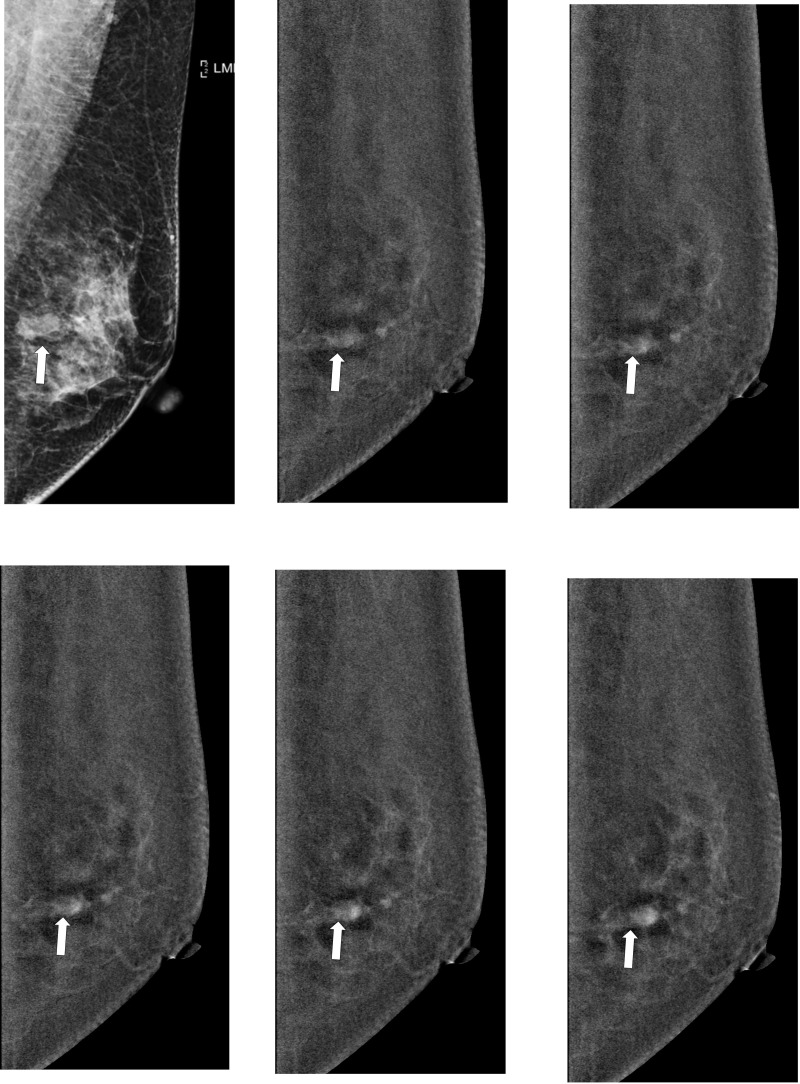
Women with suspicious breast lesions on mammography or ultrasound were enrolled. Single-view mediolateral oblique (MLO) CEDM of an affected breast was acquired at 2, 3, 4, 7, and 10 min after injection of contrast agent. Three readers visually and semi-quantitatively analyzed the enhancement of suspicious lesions. The kinetic pattern of each lesion was classified as persistent, plateau, or washout over two time intervals, 2-4 min and 2-10 min, by comparing the signal intensity at the first time interval with that at the second.
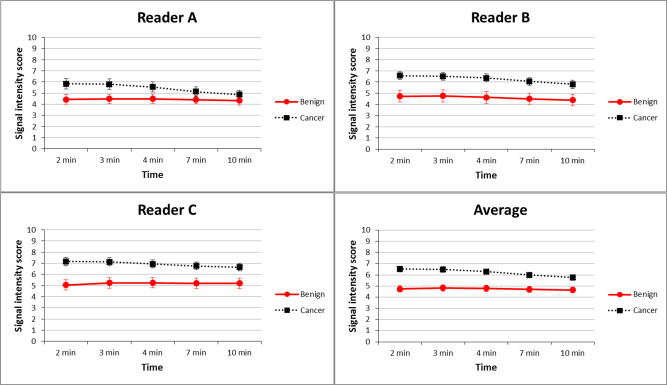
There were 73 malignant and 75 benign lesions in 148 patients (mean age: 52 years). Benign and malignant breast lesions showed the highest signal intensity at 3 min and 2 min, respectively. Average areas under receiver operating characteristic (ROC) curve for diagnostic accuracy based on lesion enhancement at different time points were 0.73 at 2 min, 0.72 at 3 min, 0.69 at 4 min, 0.67 at 7 min, and 0.64 at 10 min. Diagnostic performance was significantly better at 2, 3, and 4 min than at 7 and 10 min (all p < 0.05). A washout kinetic pattern was significantly associated with malignant lesions at 2-4 min and 2-10 min frames according to two of the three readers' interpretations (all p ≤ 0.001).
Applications of optimal time intervals and kinetic patterns show promise in differentiation of benign and malignant breast lesions on CEDM.
利用对比增强数字乳腺断层摄影术(CEDM)评估良性和恶性乳腺病变的动力学模式。
招募乳腺钼靶或超声检查发现可疑乳腺病变的女性。在注射造影剂后 2、3、4、7 和 10 分钟,对受影响的乳房进行单视图内外斜位(MLO)CEDM。三位读者分别进行视觉和半定量分析可疑病变的增强情况。通过比较第一个时间间隔和第二个时间间隔的信号强度,将每个病变的动力学模式分为持续、平台或廓清。
148 例患者中有 73 例恶性和 75 例良性病变(平均年龄:52 岁)。良性和恶性乳腺病变在 3 分钟和 2 分钟时分别显示出最高的信号强度。基于不同时间点病变增强的诊断准确性的受试者工作特征(ROC)曲线下平均面积分别为 2 分钟时 0.73、3 分钟时 0.72、4 分钟时 0.69、7 分钟时 0.67、10 分钟时 0.64。在 2、3 和 4 分钟时,诊断性能明显优于 7 和 10 分钟(均 p<0.05)。根据三位读者中的两位的解释,在 2-4 分钟和 2-10 分钟时,廓清动力学模式与恶性病变显著相关(均 p≤0.001)。
CEDM 上应用最佳时间间隔和动力学模式有望区分良性和恶性乳腺病变。