Department of Psychiatry, Nagoya University Graduate School of Medicine, 65 Tsurumai-cho, Showa-ku, Nagoya, Aichi, 4668550, Japan.
Department of Molecular Neuroscience, Graduate School of Medicine and Pharmaceutical Sciences, University of Toyama, Toyama, 9300194, Japan.
J Neurodev Disord. 2020 Sep 17;12(1):25. doi: 10.1186/s11689-020-09325-2.
Rare genetic variants contribute to the etiology of both autism spectrum disorder (ASD) and schizophrenia (SCZ). Most genetic studies limit their focus to likely gene-disrupting mutations because they are relatively easier to interpret their effects on the gene product. Interpretation of missense variants is also informative to some pathophysiological mechanisms of these neurodevelopmental disorders; however, their contribution has not been elucidated because of relatively small effects. Therefore, we characterized missense variants detected in NRXN1, a well-known neurodevelopmental disease-causing gene, from individuals with ASD and SCZ.
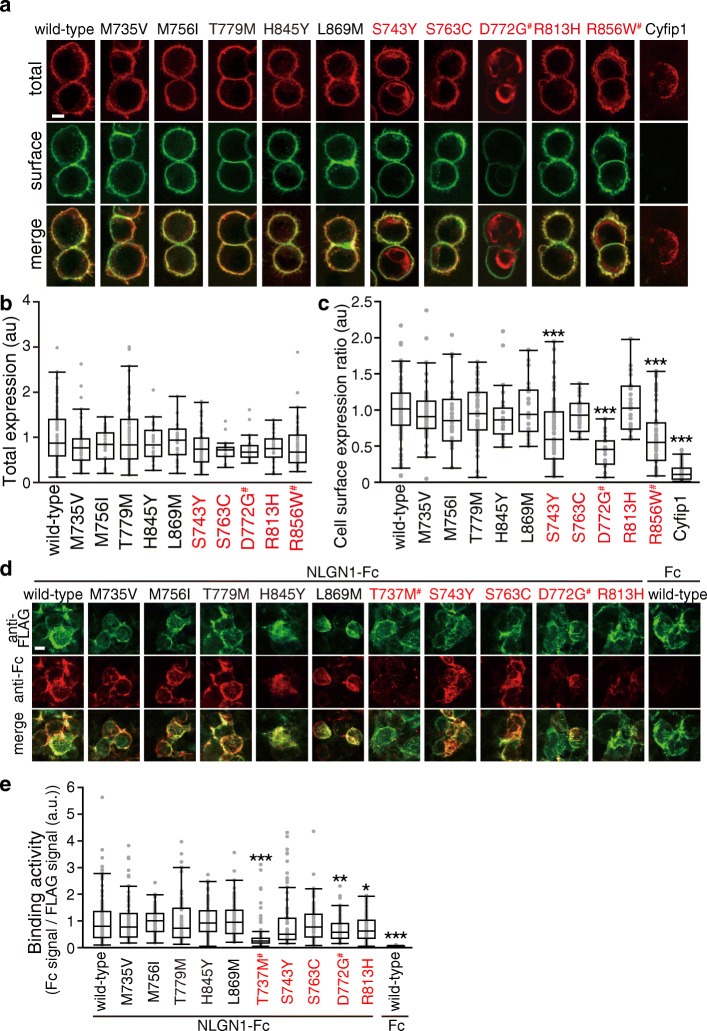
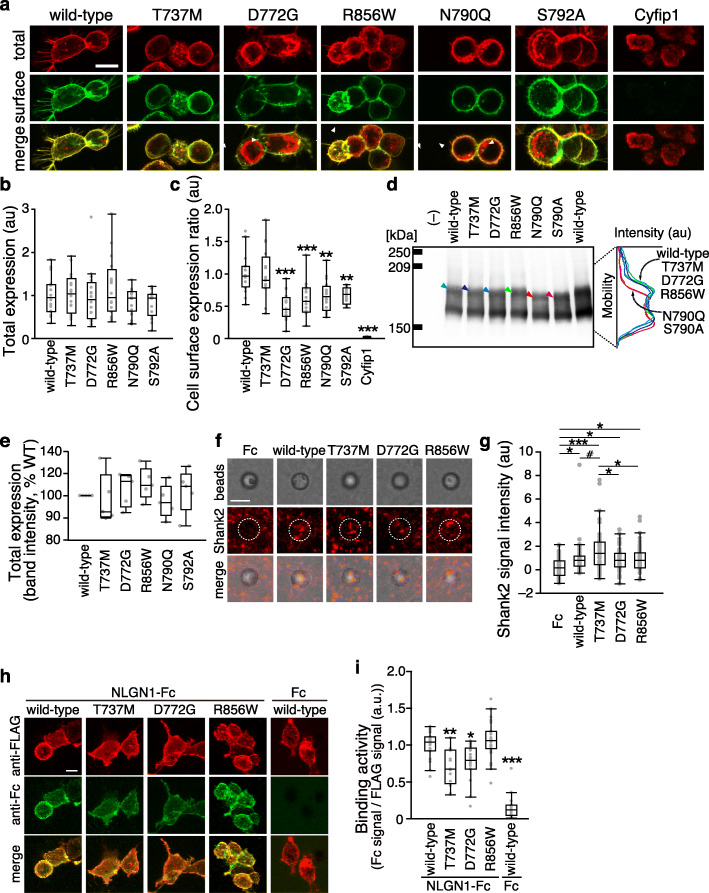
To discover rare variants with large effect size and to evaluate their role in the shared etiopathophysiology of ASD and SCZ, we sequenced NRXN1 coding exons with a sample comprising 562 Japanese ASD and SCZ patients, followed by a genetic association analysis in 4273 unrelated individuals. Impact of each missense variant detected here on cell surface expression, interaction with NLGN1, and synaptogenic activity was analyzed using an in vitro functional assay and in silico three-dimensional (3D) structural modeling.
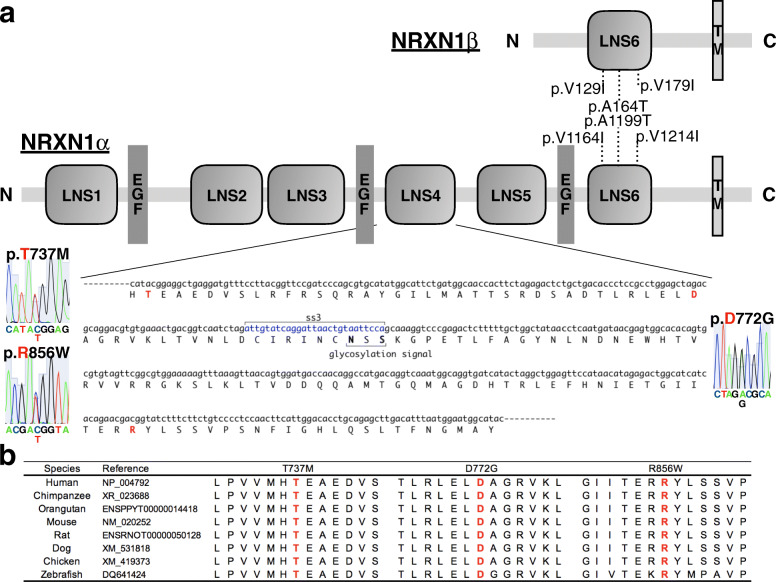
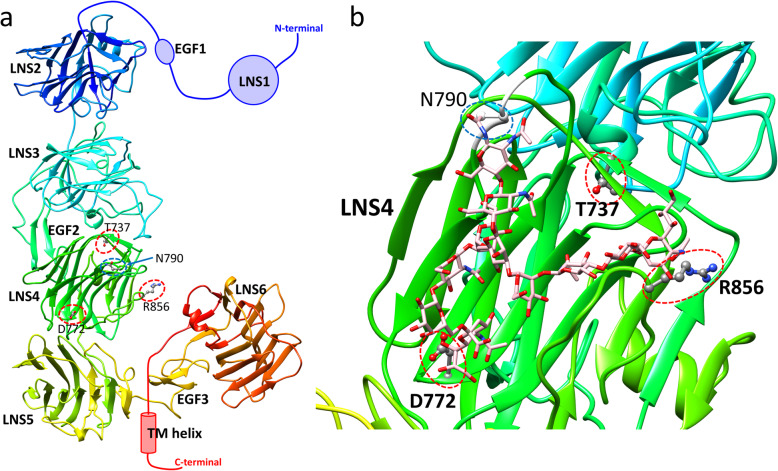
Through mutation screening, we regarded three ultra-rare missense variants (T737M, D772G, and R856W), all of which affected the LNS4 domain of NRXN1α isoform, as disease-associated variants. Diagnosis of individuals with T737M, D772G, and R856W was 1ASD and 1SCZ, 1ASD, and 1SCZ, respectively. We observed the following phenotypic and functional burden caused by each variant. (i) D772G and R856W carriers had more serious social disabilities than T737M carriers. (ii) In vitro assay showed reduced cell surface expression of NRXN1α by D772G and R856W mutations. In vitro functional analysis showed decreased NRXN1α-NLGN1 interaction of T737M and D772G mutants. (iii) In silico 3D structural modeling indicated that T737M and D772G mutations could destabilize the rod-shaped structure of LNS2-LNS5 domains, and D772G and R856W could disturb N-glycan conformations for the transport signal.
The combined data suggest that missense variants in NRXN1 could be associated with phenotypes of neurodevelopmental disorders beyond the diagnosis of ASD and/or SCZ.
罕见的遗传变异与自闭症谱系障碍(ASD)和精神分裂症(SCZ)的病因有关。大多数遗传研究都将重点放在可能导致基因失活的突变上,因为这些突变相对更容易解释它们对基因产物的影响。错义变异的解释对于这些神经发育障碍的一些病理生理机制也有启示作用;然而,由于影响相对较小,它们的作用尚未阐明。因此,我们对来自 ASD 和 SCZ 患者的 NRXN1 中检测到的错义变异进行了特征描述,NRXN1 是一个已知的神经发育疾病致病基因。
为了发现具有大效应量的罕见变异,并评估它们在 ASD 和 SCZ 共同发病机制中的作用,我们对 562 名日本 ASD 和 SCZ 患者的 NRXN1 编码外显子进行了测序,随后对 4273 名无关个体进行了遗传关联分析。使用体外功能测定和计算机三维(3D)结构建模分析了在此处检测到的每个错义变异对细胞表面表达、与 NLGN1 的相互作用和突触形成活性的影响。
通过突变筛选,我们认为三个超罕见的错义变异(T737M、D772G 和 R856W)都影响 NRXN1α 同种型的 LNS4 结构域,是疾病相关变异。T737M、D772G 和 R856W 的个体诊断为 1 个 ASD 和 1 个 SCZ、1 个 ASD 和 1 个 SCZ。我们观察到了每个变异引起的以下表型和功能负担。(i)D772G 和 R856W 携带者的社会功能障碍比 T737M 携带者更严重。(ii)体外测定显示 D772G 和 R856W 突变导致 NRXN1α 的细胞表面表达减少。体外功能分析表明 T737M 和 D772G 突变体的 NRXN1α-NLGN1 相互作用减少。(iii)计算机 3D 结构建模表明,T737M 和 D772G 突变可能使 LNS2-LNS5 结构域的杆状结构不稳定,D772G 和 R856W 可能干扰 N-糖链的构象以用于转运信号。
综合数据表明,NRXN1 中的错义变异可能与 ASD 和/或 SCZ 以外的神经发育障碍表型相关。