
实施小儿轻度头部创伤的PECARN规则是否能改善资源较少的急诊科以患者为中心的结局:一项回顾性队列研究。
Does implementation of the PECARN rules for minor head trauma improve patient-centered outcomes in a lower resource emergency department: a retrospective cohort study.
作者信息
Sawaya Rasha D, Wakil Cynthia, Wazir Adonis, Shayya Sami, Berbari Iskandar, Safa Rawan, Makki Maha, Hamade Mahdi, Tamim Hani
机构信息
Department of Emergency Medicine, American University of Beirut Medical Center, Beirut, Lebanon.
Faculty of Medicine, American University of Beirut, Beirut, Lebanon.
出版信息
BMC Pediatr. 2020 Sep 17;20(1):439. doi: 10.1186/s12887-020-02328-x.
BACKGROUND
Managing children with minor head trauma remains challenging for physicians who evaluate for the need for computed tomography (CT) imaging for clinically important traumatic brain injury (ciTBI) identification. The Pediatric Emergency Care Applied Research Network (PECARN) prediction rules were adopted in our pediatric emergency department (PED) in December 2013 to identify children at low risk for ciTBI. This study aimed to evaluate this implementation's impact on CT rates and clinical outcomes.
METHODS
Retrospective cohort study on pediatric patients with head trauma presenting to the PED of the American University of Beirut Medical Center in Lebanon. Participants were divided into pre- (December 2012 to December 2013) and post-PECARN (January 2014 to December 2016) groups. Patients were further divided into < 2 and ≥ 2 years and stratified into groups of low, intermediate and high risk for ciTBI. Bivariate analysis was conducted to determine differences between both groups.
RESULTS
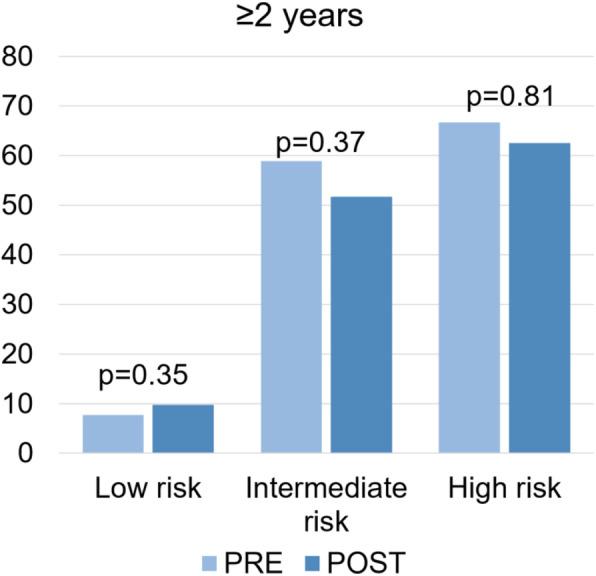
We included 1362 children of which 425 (31.2%) presented pre- and 937 (68.8%) presented post-PECARN rules implementation with 1090 (80.0%) of low, 214 (15.7%) of intermediate and 58 (4.3%) of high risk for ciTBI. CTs were ordered on 92 (21.6%) pre- versus 174 (18.6%) patients post-PECARN (p = 0.18). Among patients < 2 years, CT rates significantly decreased from 25.2% (34/135) to 16.5% (51/309) post-PECARN (p = 0.03), and dropped in all risk groups but only significantly for low risk patients from 20.7% (24/116) to 11.4% (30/264) (p = 0.02). There was no significant decrease in CT rates in patients ≥2 years (20% pre (58/290) vs 19.6% post (123/628), p = 0.88). There was no increase in bounce back numbers, nor in admission rates or positive CT findings among bounce backs.
CONCLUSIONS
PECARN rules implementation did not significantly change the overall CT scan rate but reduced the CT scan rate in patients aged < 2 years at low risk of ciTBI. The implementation did not increase the number of missed ciTBI.
背景
对于评估是否需要进行计算机断层扫描(CT)成像以识别具有临床重要意义的创伤性脑损伤(ciTBI)的医生而言,管理轻度头部创伤的儿童仍然具有挑战性。2013年12月,我们儿科急诊科(PED)采用了儿科急诊护理应用研究网络(PECARN)预测规则,以识别ciTBI低风险儿童。本研究旨在评估这一实施对CT使用率和临床结果的影响。
方法
对黎巴嫩贝鲁特美国大学医学中心儿科急诊科的头部创伤儿科患者进行回顾性队列研究。参与者分为PECARN实施前(2012年12月至2013年12月)和实施后(2014年1月至2016年12月)两组。患者进一步分为<2岁和≥2岁两组,并根据ciTBI的低、中、高风险分层。进行双变量分析以确定两组之间的差异。
结果
我们纳入了1362名儿童,其中425名(31.2%)在PECARN规则实施前就诊,937名(68.8%)在实施后就诊,ciTBI低风险者1090名(80.0%),中风险者214名(15.7%),高风险者58名(4.3%)。PECARN实施前有92名(21.6%)患者接受了CT检查,实施后为174名(18.6%)患者(p = 0.18)。在<2岁的患者中,PECARN实施后CT使用率从25.2%(34/135)显著降至16.5%(51/309)(p = 0.03),所有风险组均有所下降,但仅低风险患者显著下降,从20.7%(24/116)降至11.4%(30/264)(p = 0.02)。≥2岁患者的CT使用率没有显著下降(实施前为20%(58/290),实施后为19.6%(123/628),p = 0.88)。复诊人数、复诊患者的住院率或CT阳性结果均未增加。
结论
PECARN规则的实施并未显著改变总体CT扫描率,但降低了ciTBI低风险的<2岁患者的CT扫描率。该实施并未增加漏诊ciTBI的数量。


 Zotero 插件