Department of Joint Surgery, The Affiliated Hospital of Qingdao University, No. 59, Haier Road, Qingdao, 266000, China.
Medical Department of Qingdao University, Qingdao, 266071, Shandong, China.
J Orthop Surg Res. 2020 Sep 17;15(1):421. doi: 10.1186/s13018-020-01951-9.
The purpose of this study was to explore the mid-and long-term clinical effects of Chinese patients with medial pivot (MP) prosthesis and posterior-stabilized (PS) prosthesis after total knee arthroplasty (TKA), to provide a reference for the recommendation of clinical prostheses.
A retrospective analysis of 802 patients who received TKA was performed from June 2010 to December 2013. A total of 432 patients received a MP prosthesis (MP group) and 375 patients received a PS prosthesis (PS group). Postoperative range of motion (ROM), clinical scores including the knee scoring system (KSS), the Western Ontario and McMaster Universities osteoarthritis index (WOMAC), the forgotten joint score (FJS), and postoperative complications were compared between the two groups.
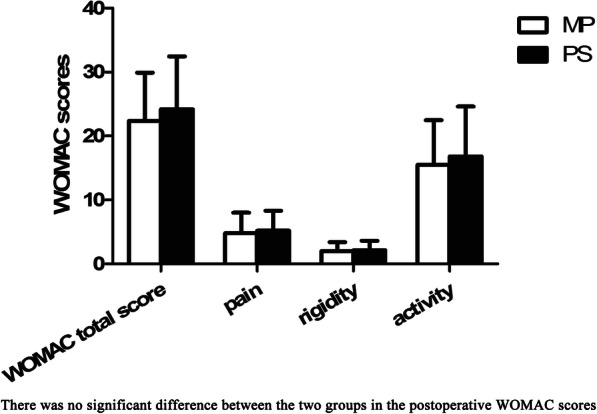
A total of 527 patients were followed up, including 290 in the MP group and 237 in the PS group. Both groups achieved satisfactory results in terms of KSS score, WOMAC score, and postoperative ROM, which were significantly improved compared with those before surgery, but the difference between the groups was not statistically significant (P > 0.05). The FJS scores of the MP group and the PS group were satisfactory and no significant difference was observed (P = 0.426). Postoperative complications occurred in 5 and 11 patients in the MP group and PS group, respectively.
The clinical results of TKA with MP or PS in Chinese patients at mid- and long-term are encouraging, and no significant differences were observed between the two types of prostheses. Studies have also shown that both prostheses are safe for Chinese patients.
本研究旨在探讨中国内侧铰链(MP)假体和后稳定(PS)假体患者全膝关节置换术后的中、长期临床疗效,为临床假体推荐提供参考。
回顾性分析 2010 年 6 月至 2013 年 12 月接受 TKA 的 802 例患者。其中 432 例患者接受 MP 假体(MP 组),375 例患者接受 PS 假体(PS 组)。比较两组术后膝关节活动度(ROM)、临床评分(包括膝关节评分系统(KSS)、西安大略和麦克马斯特大学骨关节炎指数(WOMAC)、遗忘关节评分(FJS))和术后并发症。
共随访 527 例患者,其中 MP 组 290 例,PS 组 237 例。两组 KSS 评分、WOMAC 评分和术后 ROM 均较术前明显改善,差异均有统计学意义(P<0.05),但两组间差异无统计学意义(P>0.05)。MP 组和 PS 组的 FJS 评分均满意,差异无统计学意义(P=0.426)。MP 组和 PS 组术后并发症分别为 5 例和 11 例。
中国患者 MP 或 PS 全膝关节置换术的中、长期临床效果令人鼓舞,两种假体之间无显著差异。研究还表明,两种假体对中国患者均安全。