Department of Joint Surgery, The Affiliated Hospital of Qingdao University, Qingdao, China.
Department of Science and Technology Management, Chinese Academy of Medical Sciences and Peking Union Medical College, Beijing, China.
Orthop Surg. 2020 Dec;12(6):1843-1853. doi: 10.1111/os.12822. Epub 2020 Oct 23.
To compare the postoperative inflammation and pain response between medial pivot (MP) and posterior stabilized (PS) prostheses among total knee arthroplasty (TKA) patients.
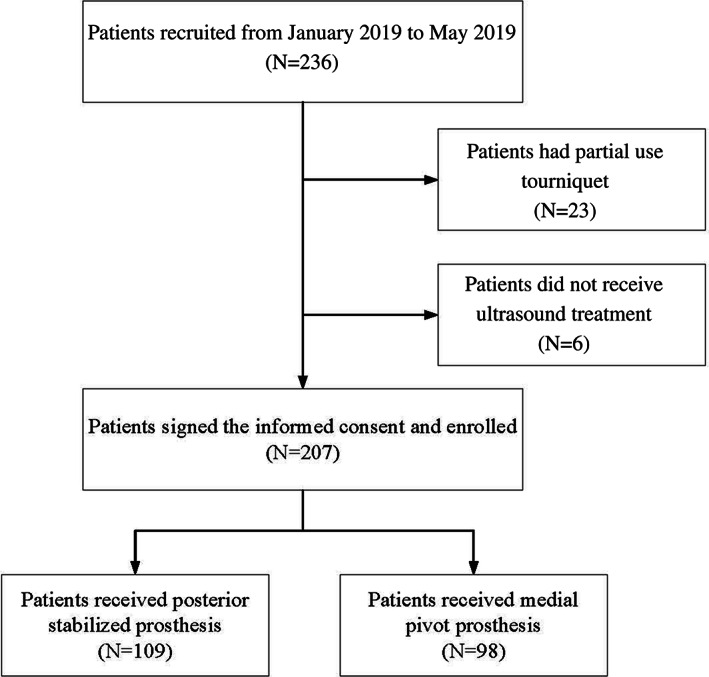
A prospective cohort study was conducted from January 2019 to May 2019 at the Affiliated Hospital of Qingdao University. The study included patients diagnosed with stage III or IV Kellgren-Lawrence knee osteoarthritis (KOA) who had failed conservative treatment, had undergone no previous knee surgeries, had varus substantial deformities (11°-20° deviation), and had received their first unilateral TKA. A total of 109 patients who underwent PS prosthesis TKA and 98 patients who underwent MP prosthesis TKA were continuously enrolled. Inflammation biomarkers, such as leukocyte (white blood cells), erythrocyte sedimentation rate (ESR), and C-reactive protein (CRP), together with hemoglobin (Hb), the visual analog pain score (VAS) and range of motion (ROM) were compared between the two groups. The Student t-test was applied to analyze continuous parameters, and the χ -test was used for categorical parameters. The linear mixed model was used for the repeated measurement data from the follow-up visits. Multivariate backward logistic and linear regression models were used to determine the factors potentially influencing prostheses and VAS scores.
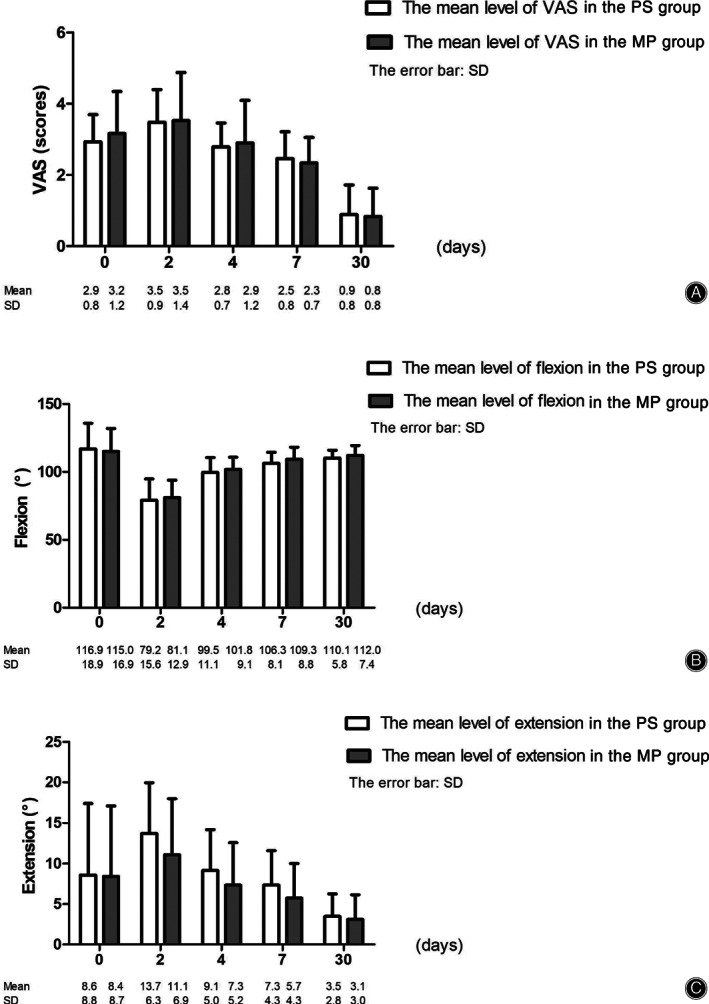
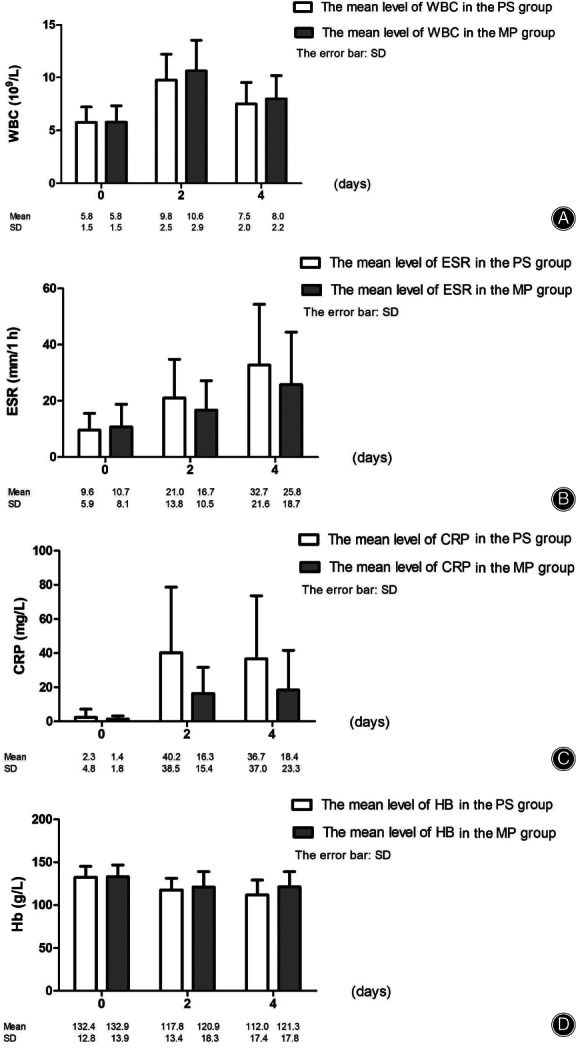
All these enrolled patients were followed up at 2, 4, 7, and 30 days after TKA. There were no significant differences between the PS group and the MP group in body mass index (BMI), gender, laterality, usage of nonsteroidal anti-inflammatory drugs (NSAIDs) and opioids, and drain tube extubation time (P > 0.05). Compared with the PS group, the MP group were older (67.5 years vs 65.4 years), and had a higher mid-vastus approach rate (67.3% vs 26.6%), a shorter tourniquet duration (68.3 ± 10.2 h vs 73.9 ± 11.2 h), a larger prosthetic pad (10.8 ± 1.2 mm vs 10.4 ± 1.2 mm), and a lower drain tube diversion volume (187.6 ± 119.3 mL vs 234.0 ± 155.7 mL). In the linear mixed model, MP prostheses had less CRP and ESR elevation and less Hb decrease than PS prostheses (P for group × time < 0.001). There were no significant differences in the changing trends between MP and PS prostheses by time for VAS scores and ROM. In the multivariate logistic regression model, MP prostheses showed significant differences compared with PS prostheses in treatment approach (odds ratio [OR] = 3.371, 95% confidence interval [CI]: 1.953-7.127; P < 0.001), ultrasound treatment start time (OR = 2.669, 95% CI: 1.385-5.141; P = 0.003), and tourniquet duration (OR = 0.954, 95% CI: 0.925-0.984; P = 0.003). Higher VAS scores on the second day postoperatively were related to high VAS scores preoperatively, use of opioids, high drain tube diversion, long tourniquet duration, and long drain tube extubation (P < 0.05), respectively.
The MP prostheses showed potential advantages compared with PS prostheses in TKA in inflammatory responses.
比较全膝关节置换术(TKA)中内侧枢轴(MP)和后稳定(PS)假体的术后炎症和疼痛反应。
这是一项前瞻性队列研究,于 2019 年 1 月至 2019 年 5 月在青岛大学附属医院进行。该研究纳入了诊断为 III 或 IV 级 Kellgren-Lawrence 膝关节骨关节炎(KOA)的患者,这些患者经保守治疗失败,且既往无膝关节手术史、存在明显的内翻畸形(11°-20°的偏差),并接受了单侧初次 TKA。连续纳入了 109 例接受 PS 假体 TKA 和 98 例接受 MP 假体 TKA 的患者。比较两组之间的炎症生物标志物(如白细胞(白细胞)、红细胞沉降率(ESR)和 C 反应蛋白(CRP)),以及血红蛋白(Hb)、视觉模拟疼痛评分(VAS)和活动范围(ROM)。采用学生 t 检验分析连续参数,采用卡方检验分析分类参数。采用线性混合模型对随访期间的重复测量数据进行分析。采用多元逐步逻辑回归和线性回归模型来确定可能影响假体和 VAS 评分的因素。
所有纳入的患者均在 TKA 后 2、4、7 和 30 天进行了随访。PS 组和 MP 组在体重指数(BMI)、性别、侧别、非甾体抗炎药(NSAIDs)和阿片类药物的使用以及引流管拔出时间方面无显著差异(P > 0.05)。与 PS 组相比,MP 组年龄较大(67.5 岁比 65.4 岁),高位股中动脉入路比例较高(67.3%比 26.6%),止血带使用时间较短(68.3 ± 10.2 h 比 73.9 ± 11.2 h),假体垫较大(10.8 ± 1.2 mm 比 10.4 ± 1.2 mm),引流管引流体积较小(187.6 ± 119.3 mL 比 234.0 ± 155.7 mL)。在线性混合模型中,MP 假体的 CRP 和 ESR 升高以及 Hb 下降均低于 PS 假体(P 组×时间<0.001)。VAS 评分和 ROM 随时间的变化趋势在 MP 和 PS 假体之间无显著差异。在多元逻辑回归模型中,与 PS 假体相比,MP 假体在治疗方法(比值比 [OR] = 3.371,95%置信区间 [CI]:1.953-7.127;P <0.001)、超声治疗开始时间(OR = 2.669,95%CI:1.385-5.141;P = 0.003)和止血带使用时间(OR = 0.954,95%CI:0.925-0.984;P = 0.003)方面具有显著差异。术后第 2 天的 VAS 评分较高与术前 VAS 评分较高、使用阿片类药物、引流管分流较多、止血带使用时间较长、引流管拔出时间较长有关(P <0.05)。
与 PS 假体相比,MP 假体在 TKA 中的炎症反应中具有潜在优势。