Chen Kaiyan, Zhang Fanrong, Fan Yun, Cheng Guoping
Cancer Hospital of the University of Chinese Academy of Sciences (Zhejiang Cancer Hospital), Hangzhou 310022, People's Republic of China.
Institute of Cancer and Basic Medicine (IBMC), Chinese Academy of Sciences, Hangzhou 310022, People's Republic of China.
Onco Targets Ther. 2020 Sep 4;13:8837-8844. doi: 10.2147/OTT.S255478. eCollection 2020.
Graded prognostic assessment for lung cancer using molecular markers (Lung-molGPA) for brain metastases is a powerful prognostic tool. However, it has not been validated for non-small-cell lung cancer (NSCLC) patients with synchronous or metachronous brain metastases.
A total of 1184 NSCLC patients with synchronous or metachronous brain metastases were reviewed in this study. Comparative clinicopathological variables and survival analysis for these two groups (synchronous vs metachronous), as well as complimentary analysis of prognostic factors for the entire patient cohort, were performed. Afterward, patients were stratified using Lung-molGPA to evaluate the accuracy of the survival estimates.
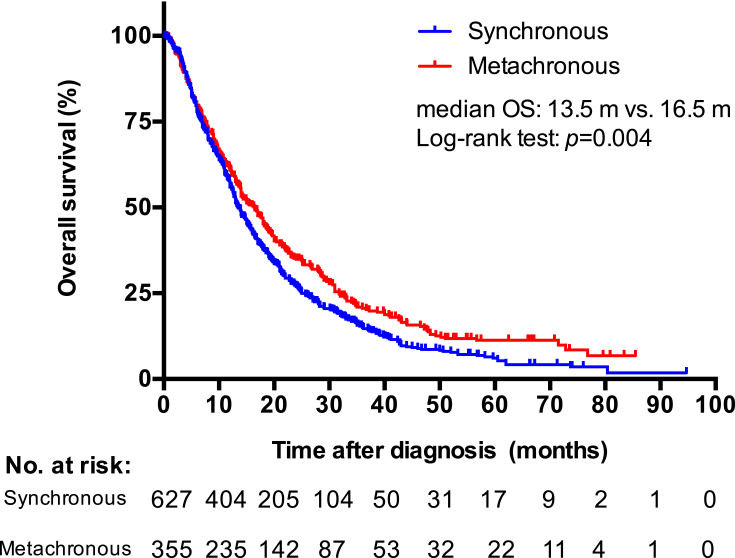
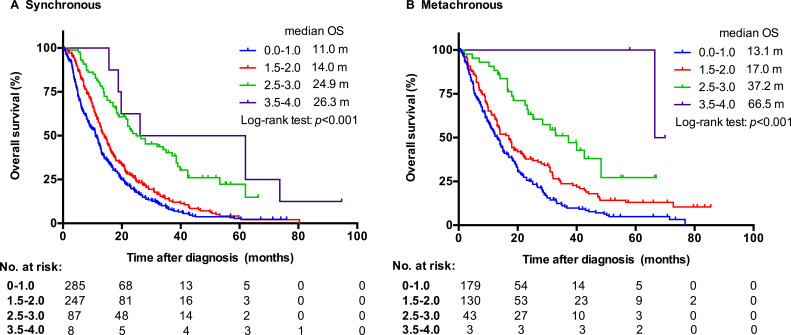
A total of 763 patients (64.4%) had synchronous metastases while 35.6% (421 patients) had metachronous metastasis. Patients with synchronous metastases were more likely to have a smoking history, limited metastatic lesions, and absence of cerebral symptoms (P<0.05). Patients with metachronous metastatic NSCLC had an overall survival (OS) period of 16.5 (95% CI 14.5-18.6) months and were longer compared to patients with synchronous metastases (16.5 vs 13.5 [12.5-14.6] months, P=0.004). In Cox regression multivariable analysis, age (HR=1.25, P=0.008), Karnofsky performance status (HR=1.30, P=0.005), extracranial metastases (HR=1.57, P<0.001), number of brain metastases (HR=1.22, P=0.043), gene mutation (HR=1.40 [wild type vs mutation], P=0.050; HR=1.42 [unknown vs mutation], P=0.007), and treatment (including TKI, chemotherapy, and local brain treatment, P<0.05) were independent prognostic predictors of OS. Additionally, metachronous metastatic patients were at lower risk for disease-related death compared to synchronous metastatic patients (HR=0.69, P<0.001). Importantly, median OS stratified by Lung-molGPA of 0-1, 1.5-2, 2.5-3 and 3.5-4 scores were 11.0, 14.0, 24.9, and 26.3 months for synchronous brain metastases, and 13.1, 17.0, 37.2, and 66.5 months for metachronous metastases, respectively (P<0.001).
Lung-molGPA could estimate the prognosis of NSCLC patients with synchronous or metachronous brain metastases. Hence, patients should be carefully stratified for consideration of aggressive therapy.
使用分子标志物进行肺癌脑转移的分级预后评估(Lung-molGPA)是一种强大的预后工具。然而,它尚未在伴有同步或异时性脑转移的非小细胞肺癌(NSCLC)患者中得到验证。
本研究回顾了1184例伴有同步或异时性脑转移的NSCLC患者。对这两组(同步性与异时性)进行了比较临床病理变量和生存分析,以及对整个患者队列的预后因素进行了补充分析。之后,使用Lung-molGPA对患者进行分层,以评估生存估计的准确性。
共有763例患者(64.4%)发生同步转移,而35.6%(421例患者)发生异时性转移。同步转移患者更有可能有吸烟史、转移病灶局限且无脑部症状(P<0.05)。异时性转移性NSCLC患者的总生存期(OS)为16.5(95%CI 14.5-18.6)个月,与同步转移患者相比更长(16.5对13.5[12.5-14.6]个月,P=0.004)。在Cox回归多变量分析中,年龄(HR=1.25,P=0.008)、卡诺夫斯基功能状态(HR=1.30,P=0.005)、颅外转移(HR=1.57,P<0.001)、脑转移数量(HR=1.22,P=0.043)、基因突变(HR=1.40[野生型与突变型],P=0.050;HR=1.42[未知与突变型],P=0.007)以及治疗(包括TKI、化疗和局部脑部治疗,P<0.05)是OS的独立预后预测因素。此外,与同步转移性患者相比,异时性转移性患者的疾病相关死亡风险更低(HR=0.69,P<0.001)。重要的是,对于同步脑转移,按Lung-molGPA分层的0-1、1.5-2、2.5-3和3.5-4分的中位OS分别为11.0、14.0、24.9和26.3个月,而异时性转移分别为13.1、17.0、37.2和66.5个月(P<0.001)。
Lung-molGPA可以估计伴有同步或异时性脑转移的NSCLC患者的预后。因此,应仔细对患者进行分层,以考虑积极治疗。