Li Qi, Zhu Jiaying, Kang Jianbang, Song Yan, Yin Donghong, Guo Qian, Song Junli, Zhang Yan, Wang Shuyun, Duan Jinju
Department of Pharmacy, School of Pharmacy, Shanxi Medical University, Taiyuan, Shanxi, People's Republic of China.
Department of Pharmacy, Second Hospital of Shanxi Medical University, Taiyuan, Shanxi, People's Republic of China.
Infect Drug Resist. 2020 Sep 4;13:3075-3089. doi: 10.2147/IDR.S261117. eCollection 2020.
To characterize the clinical, resistance, and virulence features of carbapenem-resistant (CRKP) and hypervirulent (hvKP) and also provide an effective selection of drug in CRKP and hvKP treatment.
Twelve strains were collected and investigated these isolates for their antimicrobial susceptibility and molecular features. Resistance mechanisms, virulence-associated genes, multilocus sequence typing (MLST), and serotypes were detected by PCR and sequencing. Next general sequencing (NGS) was carried out to determine the features of carbapenem resistance and virulence. The synergistic activity of tigecycline-imipenem (TGC+IPM), tigecycline-meropenem (TGC+MEM), and tigecycline-aztreonam (TGC+ATM) combinations were performed by microdilution checkerboard method.
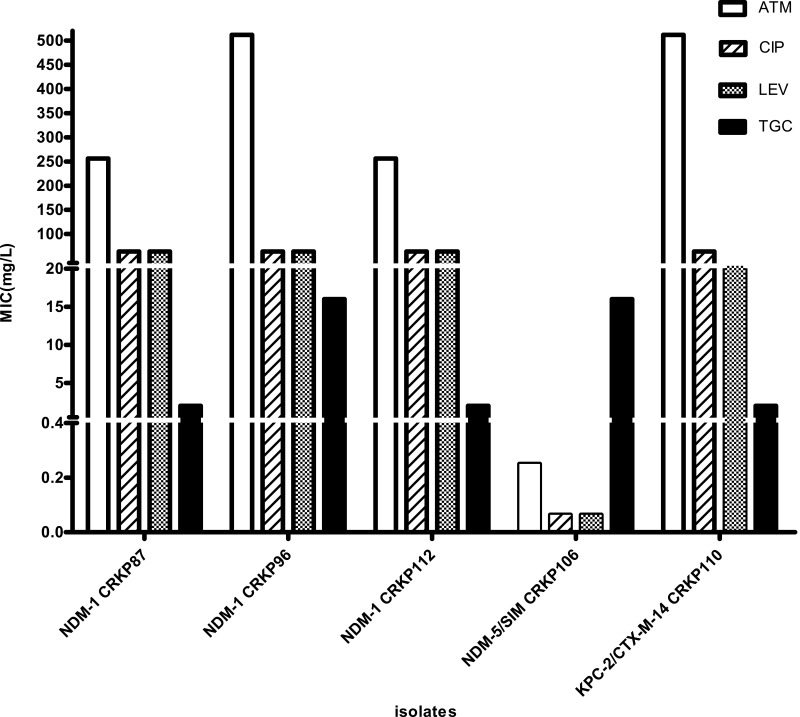
Eleven CRKP and one hvKP strains were collected. All strains showed highly sensitive rates to tigecycline (TGC) and amikacin (AMK). NDM (33.3%, 4/12) was the main resistance mechanism and MLST assigned 3 of them to ST11. CTX-M-producing (n = 1) and KPC-2-producing (n = 1) isolates belonged to ST147 and ST11, respectively. The MICs of ATM and quinolones in NDM-1 CRKP and NDM-5 CRKP strains were different. The serotype of the majority strains was KL22KL137 (58.3%, 7/12), hvKP stain belonged to K64. CRKP strains harbored plasmid-mediated quinolone resistance genes (oqxA, oqxB, qnrS, qnrB), β-lactams ( ), aminoglycosides, type I and type III fimbriae genes, siderophore genes, and transporter and pumps. SIM-producing ST1764 K64 showed typical features of hvKP, showing hypermucoviscosity phenotype. The virulence genes, including and aerobactin genes, linked to hvKP, were found in ST1764 hvKP. hvKP was sensitive to quinolone; also, gene was detected. All TGC combinations showed highly synergistic effects and TGC+IPM was more effective treatment.
We first identified the NDM-5-producing ST690 CRKP and SIM-producing ST1764 hvKP strains in Shanxi province. Tigecycline-carbapenem combinations were available treatments for CRKP.
对耐碳青霉烯类肺炎克雷伯菌(CRKP)和高毒力肺炎克雷伯菌(hvKP)的临床、耐药性及毒力特征进行表征,并为CRKP和hvKP治疗提供有效的药物选择。
收集12株菌株,对这些分离株进行抗菌药敏试验和分子特征研究。通过聚合酶链反应(PCR)和测序检测耐药机制、毒力相关基因、多位点序列分型(MLST)和血清型。随后进行全基因组测序(NGS)以确定碳青霉烯耐药性和毒力特征。采用微量稀释棋盘法检测替加环素-亚胺培南(TGC+IPM)、替加环素-美罗培南(TGC+MEM)和替加环素-氨曲南(TGC+ATM)联合用药的协同活性。
收集到11株CRKP和1株hvKP菌株。所有菌株对替加环素(TGC)和阿米卡星(AMK)均表现出高敏感率。NDM(33.3%,4/12)是主要耐药机制,其中3株MLST分型为ST11。产CTX-M(n=1)和产KPC-2(n=1)的分离株分别属于ST147和ST11。NDM-1 CRKP和NDM-5 CRKP菌株中氨曲南和喹诺酮类药物的最低抑菌浓度(MIC)不同。多数菌株的血清型为KL22KL137(58.3%,7/12),hvKP菌株属于K64。CRKP菌株携带质粒介导的喹诺酮耐药基因(oqxA、oqxB、qnrS、qnrB)、β-内酰胺酶基因、氨基糖苷类耐药基因、I型和III型菌毛基因、铁载体基因以及转运蛋白和泵。产奇异杆菌素(SIM)的ST1764 K64表现出hvKP的典型特征,呈现高黏液性表型。在ST1764 hvKP中发现了与hvKP相关的毒力基因,包括气杆菌素基因。hvKP对喹诺酮敏感,同时检测到了[具体基因名称缺失]基因。所有TGC联合用药均表现出高度协同作用,TGC+IPM是更有效的治疗方案。
我们首次在山西省鉴定出产NDM-5的ST690 CRKP和产SIM的ST1764 hvKP菌株。替加环素-碳青霉烯联合用药是CRKP的有效治疗方案。