Zhang Tao, Bi Nan, Zhou Zongmei, Chen Dongfu, Feng Qinfu, Liang Jun, Xiao Zefen, Hui Zhouguang, Lv Jima, Wang Xin, Deng Lei, Wang Wenqing, Liu Wenyang, Wang Jianyang, Zhai Yirui, Wang Luhua
Department of Radiation Oncology, National Cancer Center/National Clinical Research Center for Cancer/Cancer Hospital, Chinese Academy of Medical Science and Peking Union Medical College, Beijing, China.
Department of VIP Medical Services, National Cancer Center/National Clinical Research Center for Cancer/Cancer Hospital, Chinese Academy of Medical Science and Peking Union Medical College, Beijing, China.
J Thorac Dis. 2020 Aug;12(8):4347-4356. doi: 10.21037/jtd-20-2137.
Chemoradiotherapy is the recommended treatment for patients with unresectable locally advanced non-small cell lung cancer (NSCLC). This study aimed to determine the impact of age on the survival outcomes and risk of radiation pneumonitis (RP) in patients with unresectable locally advanced NSCLC.
The data of patients with unresectable locally advanced NSCLC who were treated with radiotherapy (RT), sequential chemoradiotherapy, or concurrent chemoradiotherapy between January, 2013, and December, 2017, in our institution were retrospectively reviewed and analyzed. Student's -test and χ test were used to evaluate the differences between groups divided by optimal cutoff. Survival rates were calculated using the Kaplan-Meier method, and multivariate cox regression was performed to determine the prognostic factors for survival outcomes.
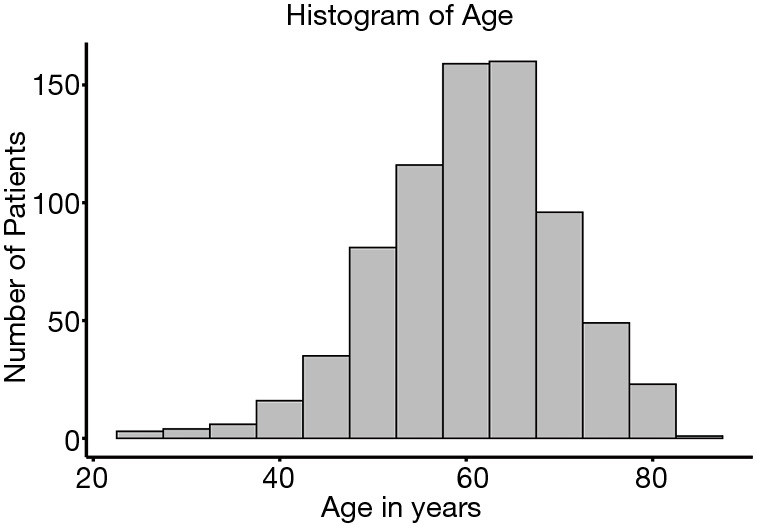
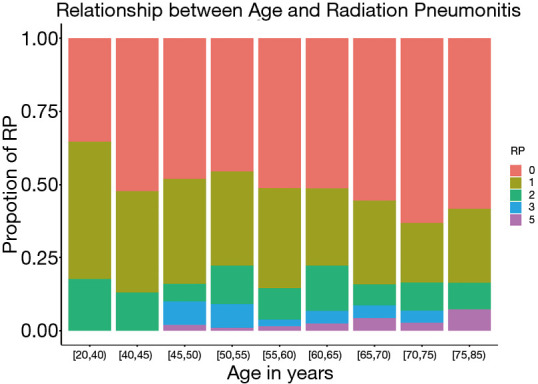
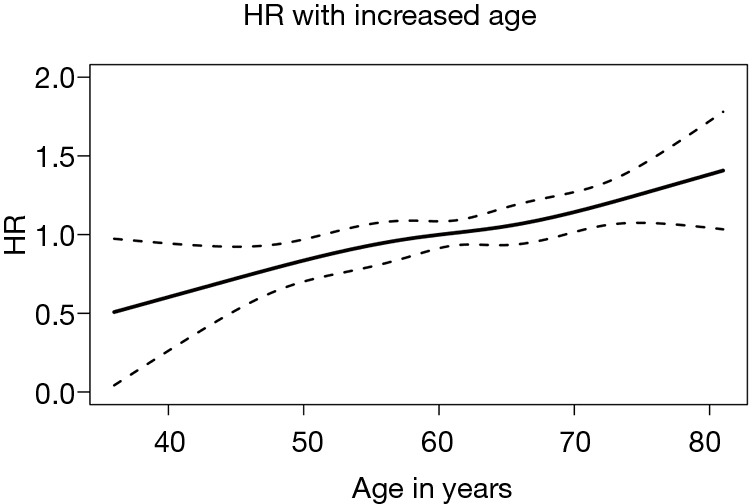
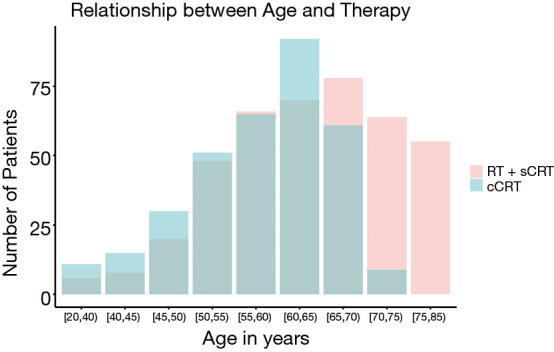
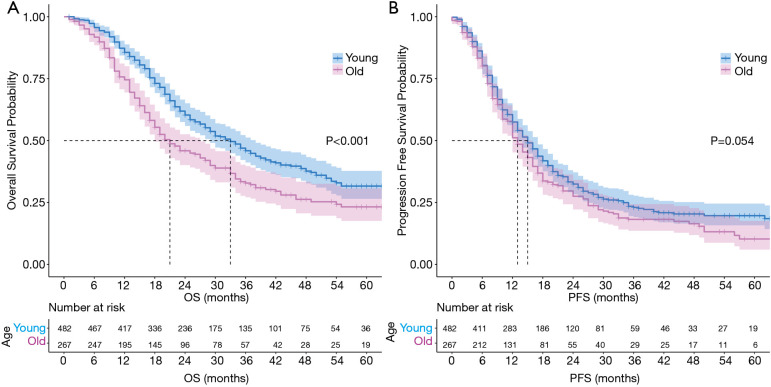
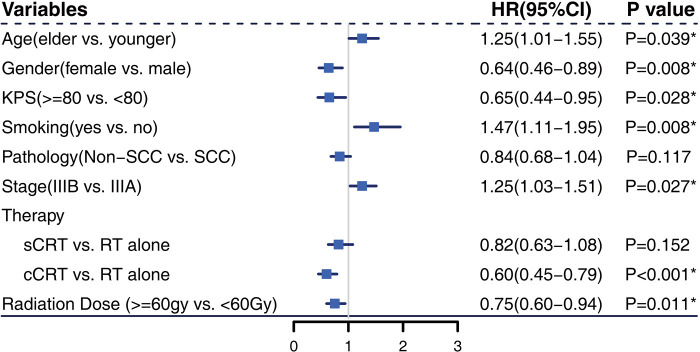
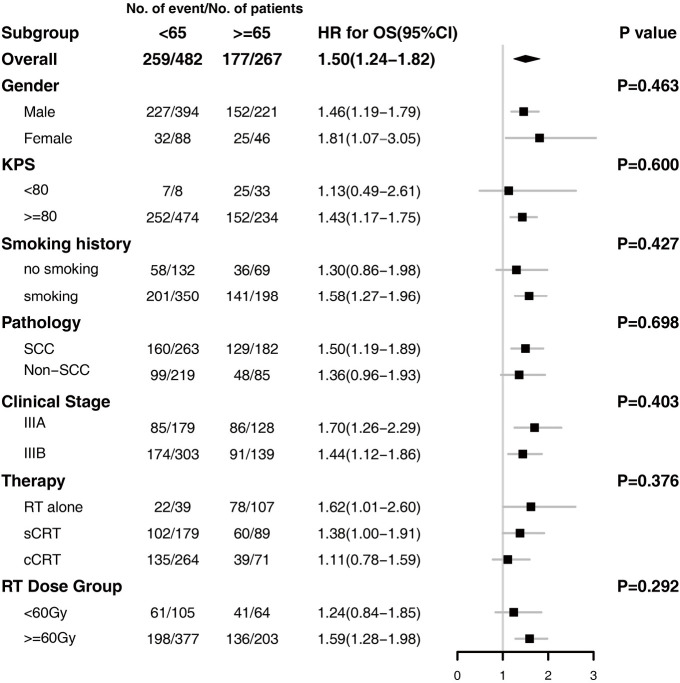
A total of 749 patients were included in this analysis. Based on the optimal cutoff, the patients were stratified into two age groups: <65 years old (the younger group, n=482) and ≥65 years old (the older group, n=267). The older group had more patients with poor Karnofsky Performance Score (KPS), squamous cell sarcoma (SCC), and IIIA stage than the younger group. The older patients were more likely to have received RT alone (40.1%) and less likely to have received concurrent chemoradiotherapy (cCRT) (26.6%) than the younger patients (8.1% and 54.8%, respectively, P<0.001). The median overall survival (OS) was 33 months (95% CI: 29-37 months) and 21 months (95% CI: 18-27 months) for the younger group and the older group, respectively (P<0.001). Multivariate Cox regression analysis showed that age had a significant independent association with OS (HR, 1.25; 95% CI: 1.01-1.55) after adjustment for covariates. The incidences of RP, symptomatic RP, and severe RP were similar between the two groups, but the incidence of fatal RP was higher in the older group (4.5% 1.7%, P=0.039).
The clinical characteristics of the older patients in our study differed from those of the younger patients, and the older patients were more likely to choose conservative treatment. OS was longer in the older patients and more cases of fatal RP occurred in the older group.
对于不可切除的局部晚期非小细胞肺癌(NSCLC)患者,放化疗是推荐的治疗方法。本研究旨在确定年龄对不可切除的局部晚期NSCLC患者生存结局及放射性肺炎(RP)风险的影响。
回顾性分析2013年1月至2017年12月在我院接受放疗(RT)、序贯放化疗或同步放化疗的不可切除局部晚期NSCLC患者的数据。采用Student's -检验和χ检验评估按最佳临界值划分的组间差异。采用Kaplan-Meier法计算生存率,并进行多因素Cox回归分析以确定生存结局的预后因素。
本分析共纳入749例患者。根据最佳临界值,患者被分为两个年龄组:<65岁(较年轻组,n = 482)和≥65岁(较年长组,n = 267)。较年长组中卡氏功能状态评分(KPS)差、鳞状细胞癌(SCC)和IIIA期的患者比年轻组更多。与年轻患者(分别为8.1%和54.8%)相比,年长患者更有可能仅接受放疗(40.1%),而接受同步放化疗(cCRT)的可能性较小(26.6%)(P < 0.001)。较年轻组和较年长组的中位总生存期(OS)分别为33个月(95%CI:29 - 37个月)和21个月(95%CI:18 - 27个月)(P < 0.001)。多因素Cox回归分析显示,在对协变量进行调整后,年龄与OS有显著的独立关联(HR,1.25;95%CI:1.01 - 1.55)。两组间RP、有症状RP和重度RP的发生率相似,但较年长组的致命性RP发生率更高(4.5%对1.7%,P = 0.039)。
本研究中较年长患者的临床特征与较年轻患者不同,且较年长患者更倾向于选择保守治疗。较年长患者的OS更长,且较年长组发生致命性RP的病例更多。