Tan Guobin, Xuan Zijun, Li Zhiqin, Huang Shuitong, Chen Guangming, Wu Yonglu, Chen Xianxi, Liang Zhijin, Wu Aiming
Department of Urology, Maoming People's Hospital, Maoming, China.
Department of urology, Dongguan Kanghua hospital, Dongguan, China.
Transl Androl Urol. 2020 Aug;9(4):1725-1734. doi: 10.21037/tau-20-1079.
The BAP1 mutation is commonly found kidney renal clear cell carcinoma (KIRC) and a potential biomarker of individualized therapy. We evaluated the clinical significance of BAP1 mutation in the prognosis and treatment therapies for KIRC. Potential key pathways and related genes associated with these mechanisms were also identified in this investigation.
We identified the relevant data of patients BAP1 mutated on the cBioPortal and the compounds with significant selectivity to BAP1 mutations on the Genomics of Drug Sensitivity in Cancer (GDSC). And then, we identified the differences in mRNA expression levels of biological function annotation and pathways between mutated and wild type BAP1 patients by GSEA analysis. Furthermore, we screened the differentially expressed genes (DEGs) between BAP1 mutated and wild typed in KIRC patients and performed the GO and KEGG analysis. Finally, we conducted a protein-protein interaction (PPI) network to investigate the interaction between proteins encoded by candidate DEGs.
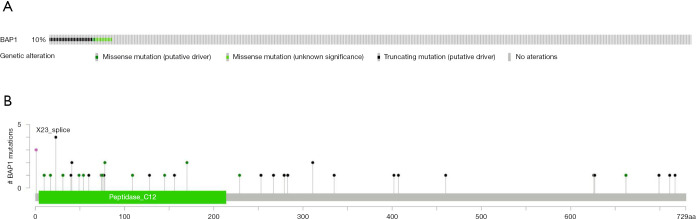
Review of the TCGA data revealed 41 patients (10%) with KIRC displayed the BAP1 mutation. Further analysis led to the identification of 730 DEGs, while 617 genes were shown to be down-regulated, with 113 genes displaying upregulation. GO and KEGG pathway analysis indicated DEGs as enriched in metabolism, drug metabolism-cytochrome P450, and Drug-metabolizing enzymes. Subsequently, the top 10 hub genes, ranked by the degree in the PPI network were identified. Furthermore, our findings verify that the BAP1 mutation was associated with the deterioration of prognosis in patients with KIRC. Additionally, analysis of the GDSC database revealed that KIRC patients with BPP1 mutation are more prone to responding to Linsitinib.
Our investigation identified the main pathways and relevant genes related to the BAP1 mutation in KIRC, which can contribute to the development of targeted treatment strategies for enhanced prognostic predictions of KIRC.
BAP1突变常见于肾透明细胞癌(KIRC),是个体化治疗的潜在生物标志物。我们评估了BAP1突变在KIRC预后和治疗中的临床意义。本研究还确定了与这些机制相关的潜在关键途径和相关基因。
我们在cBioPortal上确定了BAP1突变患者的相关数据,以及癌症药物敏感性基因组学(GDSC)中对BAP1突变具有显著选择性的化合物。然后,通过GSEA分析确定BAP1突变型和野生型患者之间生物学功能注释和途径的mRNA表达水平差异。此外,我们筛选了KIRC患者中BAP1突变型和野生型之间的差异表达基因(DEG),并进行了GO和KEGG分析。最后,我们构建了蛋白质-蛋白质相互作用(PPI)网络,以研究候选DEG编码的蛋白质之间的相互作用。
对TCGA数据的回顾显示,41例(10%)KIRC患者存在BAP1突变。进一步分析确定了730个DEG,其中617个基因下调,113个基因上调。GO和KEGG通路分析表明,DEG富集于代谢、药物代谢-细胞色素P450和药物代谢酶。随后,确定了PPI网络中按度数排名的前10个枢纽基因。此外,我们的研究结果证实,BAP1突变与KIRC患者的预后恶化相关。此外,对GDSC数据库的分析表明,BPP1突变的KIRC患者更容易对林西替尼产生反应。
我们的研究确定了KIRC中与BAP1突变相关的主要途径和相关基因,这有助于制定靶向治疗策略,以增强KIRC的预后预测。