Key Laboratory of Crop Genomics and Molecular Breeding of Jiangsu Province/Key Laboratory of Plant Functional Genomics of the Ministry of Education, College of Agriculture, Yangzhou University, Yangzhou, China.
State Key Laboratory of Agrobiotechnology, School of Life Sciences, The Chinese University of Hong Kong, Hong Kong, China.
Plant Biotechnol J. 2021 Mar;19(3):490-501. doi: 10.1111/pbi.13478. Epub 2020 Sep 29.
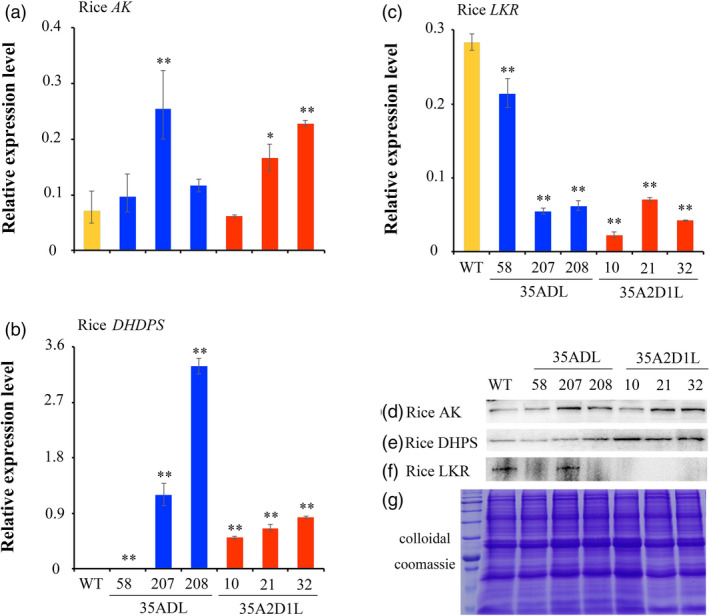
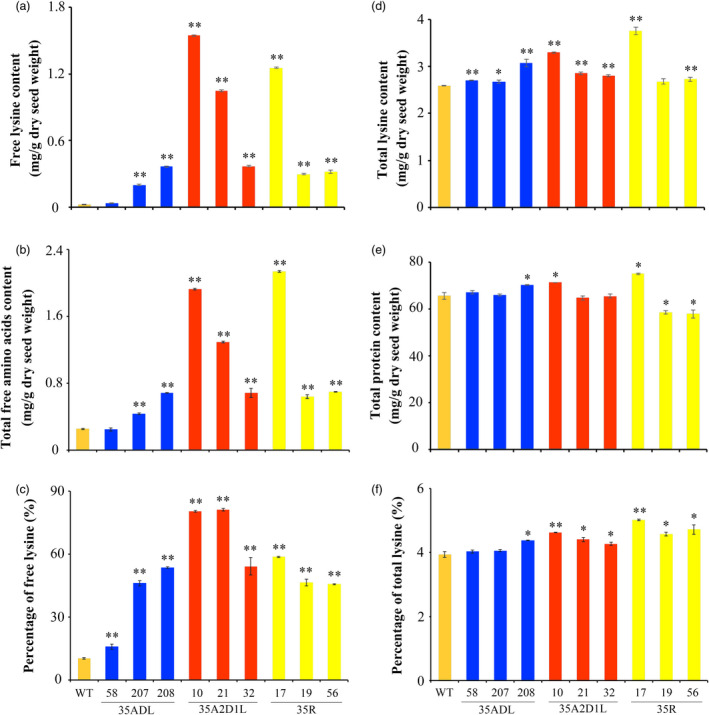
Lysine is the main limiting essential amino acid (EAA) in the rice seeds, which is a major energy and nutrition source for humans and livestock. In higher plants, the rate-limiting steps in lysine biosynthesis pathway are catalysed by two key enzymes, aspartate kinase (AK) and dihydrodipicolinate synthase (DHDPS), and both are extremely sensitive to feedback inhibition by lysine. In this study, two rice AK mutants (AK1 and AK2) and five DHDPS mutants (DHDPS1-DHDPS5), all single amino acid substitution, were constructed. Their protein sequences passed an allergic sequence-based homology alignment. Mutant proteins were recombinantly expressed in Escherichia coli, and all were insensitive to the lysine analog S-(2-aminoethyl)-l-cysteine (AEC) at concentrations up to 12 mm. The AK and DHDPS mutants were transformed into rice, and free lysine was elevated in mature seeds of transgenic plants, especially those expressing AK2 or DHDPS1, 6.6-fold and 21.7-fold higher than the wild-type (WT) rice, respectively. We then engineered 35A2D1L plants by simultaneously expressing modified AK2 and DHDPS1, and inhibiting rice LKR/SDH (lysine ketoglutaric acid reductase/saccharopine dehydropine dehydrogenase). Free lysine levels in two 35A2D1L transgenic lines were 58.5-fold and 39.2-fold higher than in WT and transgenic rice containing native AK and DHDPS, respectively. Total free amino acid and total protein content were also elevated in 35A2D1L transgenic rice. Additionally, agronomic performance analysis indicated that transgenic lines exhibited normal plant growth, development and seed appearance comparable to WT plants. Thus, AK and DHDPS mutants may be used to improve the nutritional quality of rice and other cereal grains.
赖氨酸是稻米种子中的主要必需氨基酸(EAA),是人类和家畜的主要能量和营养来源。在高等植物中,赖氨酸生物合成途径的限速步骤由两种关键酶催化,天冬氨酸激酶(AK)和二氢二吡啶羧酸合酶(DHDPS),两者都对赖氨酸的反馈抑制极其敏感。在这项研究中,构建了两个水稻 AK 突变体(AK1 和 AK2)和五个 DHDPS 突变体(DHDPS1-DHDPS5),均为单个氨基酸取代。它们的蛋白质序列通过基于过敏序列的同源性比对。突变蛋白在大肠杆菌中重组表达,所有突变蛋白对赖氨酸类似物 S-(2-氨基乙基)-L-半胱氨酸(AEC)的浓度高达 12 mm 时均不敏感。AK 和 DHDPS 突变体被转化到水稻中,成熟种子中的游离赖氨酸水平升高,尤其是表达 AK2 或 DHDPS1 的转基因植物,分别比野生型(WT)水稻高 6.6 倍和 21.7 倍。然后,我们通过同时表达修饰后的 AK2 和 DHDPS1,并抑制水稻 LKR/SDH(赖氨酸酮戊二酸还原酶/蔗糖酸脱水酶),构建了 35A2D1L 植物。两个 35A2D1L 转基因系中的游离赖氨酸水平分别比 WT 和含有天然 AK 和 DHDPS 的转基因水稻高 58.5 倍和 39.2 倍。35A2D1L 转基因水稻中的总游离氨基酸和总蛋白含量也有所提高。此外,农艺性能分析表明,转基因系表现出与 WT 植物相当的正常植物生长、发育和种子外观。因此,AK 和 DHDPS 突变体可用于提高稻米和其他谷物的营养价值。