Zhang Feng, Liu Zhiyu, He Xijing, Li Zhanqi, Shi Bin, Cai Fengmei
Department of Orthopedics, The Second Affiliated Hospital of Xi'an Jiaotong University, Xi'an, China.
Department of Orthopedics, Xi'an Fourth Hospital, Xi'an, China.
Drug Deliv. 2020 Dec;27(1):1329-1341. doi: 10.1080/10717544.2020.1818883.
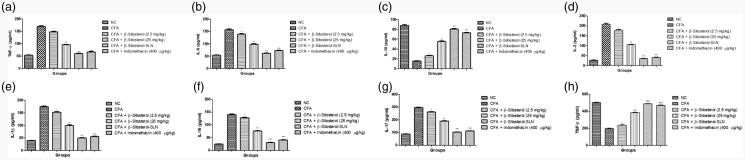
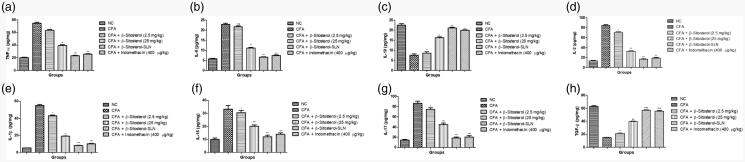
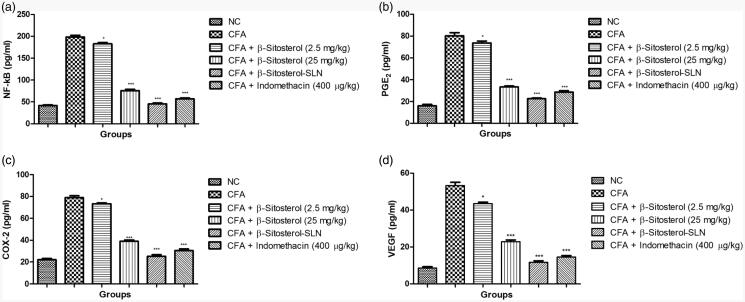
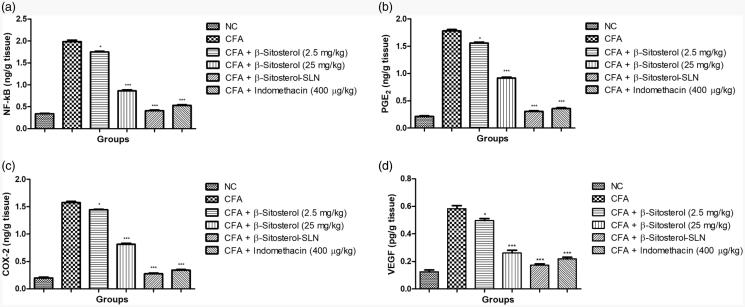
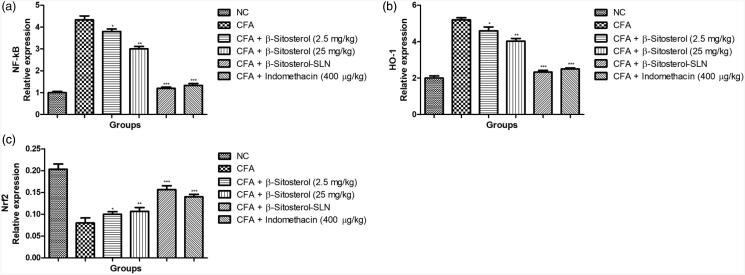
Rheumatoid arthritis (RA), autoimmune disease that is categorized via chronic inflammation manifestation, obesity, cardiovascular risk and even enhanced the mortality and affect the 0.3 and 1% of population worldwide. The current experimental study was scrutinize the anti-arthritic effect of β-sitosterol loaded solid lipid nanoparticles (SLN) against complete Fruend adjuvant (CFA)-induced arthritis via dual pathway. Double emulsion solvent displacement method was used for the preparation of β-sitosterol solid lipid nanoparticles (SLN). CFA was used to induce arthritis and rats were divided into different groups for 28 days. Biochemical, anti-inflammatory, pro-inflammatory cytokines and inflammatory mediator were estimated, respectively. Receptor activator of nuclear factor kappa-B ligand (RANKL), signal transducer and activator of transcription-3 (STAT3) nuclear factor erythroid 2-related factor 2 (Nrf), Heme Oxygenase-1(HO-1) and Nuclear factor-κB (NF-κB) expression were estimated. β-sitosterol-SLN significantly ( < .001) reduced the paw edema, arthritic index and increased the body weight. β-sitosterol-SLN increased the redox status of synovium {reduce the malonaldehyde (MDA) and increase superoxide dismutase (SOD), glutathione (GSH) and catalase (CAT)} level and reduced the cytokines such as tumor necrosis factor-α (TNF-α), interleukin-1β (IL-1β), interleukin-2, interleukin-6, interleukin-16, interleukin-17 and increased level of interleukin-10, Transforming growth factor beta (TGF-β). β-sitosterol-SLN significantly ( < .001) reduced the level of cyclooxygenase-2 (COX-2), prostaglandin E (PGE), vascular Endothelial Growth Factor (VEGF) and NF-κB. β-sitosterol-SLN significantly increased the expression of HO-1,Nrf and decreased the expression of NF-κB, RANKL, STAT3. In conclusion, β-sitosterol SLN showed the antiarthritic effect via suppression of NF-kB and activation of HO-1/Nrf-2 pathway.
类风湿性关节炎(RA)是一种自身免疫性疾病,通过慢性炎症表现、肥胖、心血管风险进行分类,甚至会增加死亡率,影响全球0.3%至1%的人口。当前的实验研究通过双途径仔细研究了负载β-谷甾醇的固体脂质纳米粒(SLN)对完全弗氏佐剂(CFA)诱导的关节炎的抗关节炎作用。采用双乳液溶剂置换法制备β-谷甾醇固体脂质纳米粒(SLN)。使用CFA诱导关节炎,并将大鼠分为不同组,持续28天。分别评估生化指标、抗炎、促炎细胞因子和炎症介质。评估核因子κB配体受体激活剂(RANKL)、信号转导和转录激活因子3(STAT3)、核因子红细胞2相关因子2(Nrf)、血红素加氧酶-1(HO-1)和核因子-κB(NF-κB)的表达。β-谷甾醇-SLN显著(<0.001)减轻了爪部水肿、关节炎指数,并增加了体重。β-谷甾醇-SLN提高了滑膜的氧化还原状态{降低丙二醛(MDA)并增加超氧化物歧化酶(SOD)、谷胱甘肽(GSH)和过氧化氢酶(CAT)}水平,并降低了细胞因子,如肿瘤坏死因子-α(TNF-α)、白细胞介素-1β(IL-1β)白细胞介素-2、白细胞介素-6、白细胞介素-16、白细胞介素-17,并提高了白细胞介素-10、转化生长因子β(TGF-β)的水平。β-谷甾醇-SLN显著(<0.001)降低了环氧合酶-2(COX-2)、前列腺素E(PGE)、血管内皮生长因子(VEGF)和NF-κB的水平。β-谷甾醇-SLN显著增加了HO-1、Nrf的表达,并降低了NF-κB、RANKL、STAT3的表达。总之,β-谷甾醇SLN通过抑制NF-κB和激活HO-1/Nrf-2途径显示出抗关节炎作用。