Department of Medical Entomology, Centre for Research in Infectious Diseases (CRID), Yaoundé, Cameroon.
Department of Animal Biology and Physiology, Faculty of Science, University of Yaoundé 1, Yaoundé, Cameroon.
PLoS One. 2020 Sep 18;15(9):e0230984. doi: 10.1371/journal.pone.0230984. eCollection 2020.
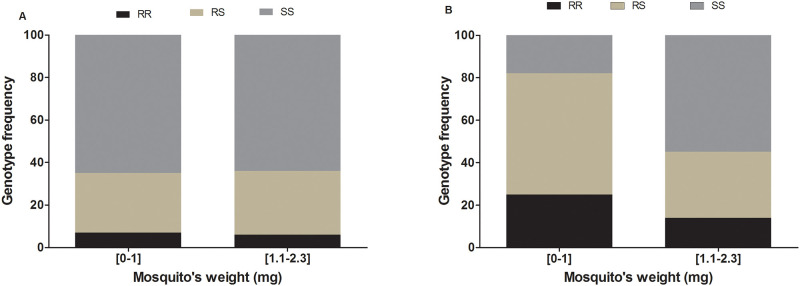
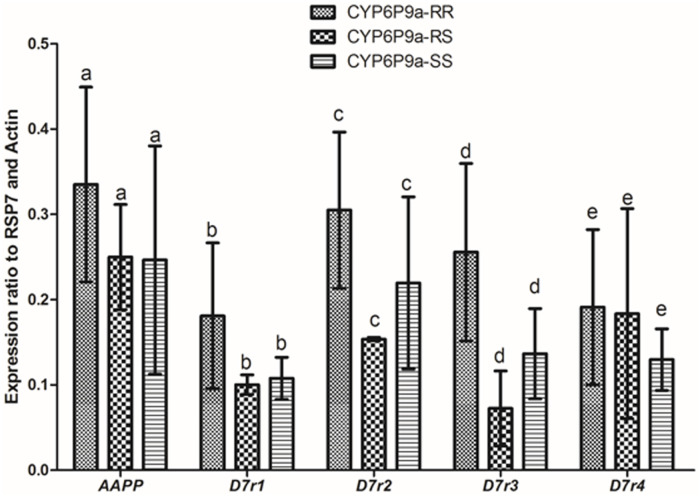
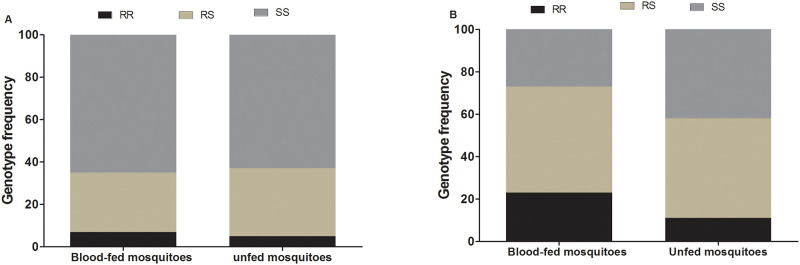
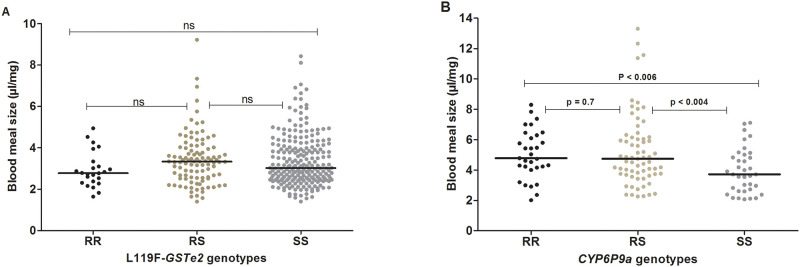
Insecticide resistance genes are often associated with pleiotropic effects on various mosquito life-history traits. However, very little information is available on the impact of insecticide resistance on blood feeding process in mosquitoes. Here, using two recently detected DNA-based metabolic markers in the major malaria vector, An. funestus, we investigated how metabolic resistance genes could affect the blood meal intake. After allowing both the field F1 and lab F8 Anopheles funestus strains to feed on the human arm for 30 minutes, we assessed the association between key parameters of blood meal process including, probing time, feeding duration, blood feeding success, blood meal size, and markers of glutathione S-transferase (L119F-GSTe2) and cytochrome P450 (CYP6P9a_R)-mediated metabolic resistance. None of the parameters of blood meal process was associated with L119F-GSTe2 genotypes. By contrast, for CYP6P9a_R, homozygous resistant mosquitoes were significantly more able to blood-feed than homozygous susceptible (OR = 3.3; CI 95%: 1.4-7.7; P = 0.01) mosquitoes. Moreover, the volume of blood meal ingested by CYP6P9a-SS mosquitoes was lower than that of CYP6P9a-RS (P<0.004) and of CYP6P9a-RR (P<0.006). This suggests that CYP6P9a gene is inked with the feeding success and blood meal size of An. funestus. However, no correlation was found in the expression of CYP6P9a and that of genes encoding for salivary proteins involved in blood meal process. This study suggests that P450-based metabolic resistance may influence the blood feeding process of Anopheles funestus mosquito and consequently its ability to transmit malaria parasites.
昆虫抗药性基因通常与各种蚊子生活史特征的多效性有关。然而,关于抗药性对蚊子吸血过程的影响,信息非常有限。在这里,我们使用最近在主要疟疾传播媒介按蚊属中检测到的两种基于 DNA 的代谢标志物,研究了代谢抗性基因如何影响吸血量。在允许野外 F1 和实验室 F8 按蚊属菌株在人的手臂上吸血 30 分钟后,我们评估了包括探测时间、吸血持续时间、吸血成功率、血餐大小以及谷胱甘肽 S-转移酶 (L119F-GSTe2) 和细胞色素 P450 (CYP6P9a_R) 介导的代谢抗性标志物在内的关键血餐过程参数之间的关联。没有一个血餐过程参数与 L119F-GSTe2 基因型有关。相比之下,对于 CYP6P9a_R,纯合抗性蚊子比纯合敏感蚊子(OR = 3.3;95%CI:1.4-7.7;P = 0.01)更能吸血。此外,CYP6P9a-SS 蚊子摄入的血餐量低于 CYP6P9a-RS(P<0.004)和 CYP6P9a-RR(P<0.006)。这表明 CYP6P9a 基因与按蚊属的吸血成功率和血餐大小有关。然而,在参与血餐过程的唾液蛋白编码基因的 CYP6P9a 表达与 CYP6P9a 基因之间未发现相关性。这项研究表明,基于 P450 的代谢抗性可能影响按蚊属蚊子的吸血过程及其传播疟疾寄生虫的能力。